
Trichophytosis
Trichophyton verrucosum
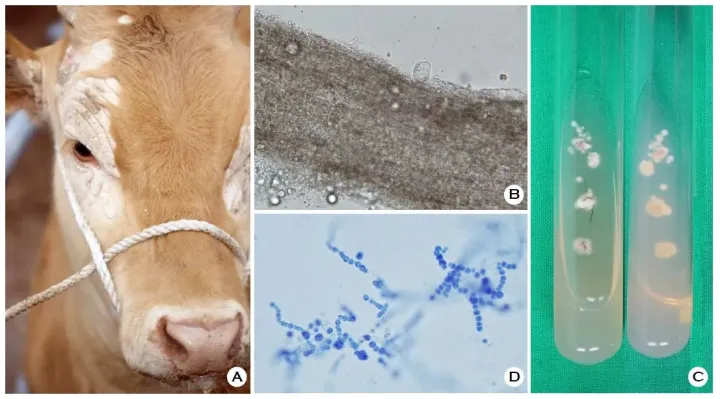
Description
Pathogen
The causative agent of this disease is the microscopic fungus Trichophyton verrucosum. While primarily recognized as a dermatophyte infecting animals and humans, in an agricultural context, it acts as a persistent contaminant in soils and feed storage facilities.
This fungus is a highly resilient organism capable of surviving adverse conditions in the soil, on farm implements, and within dry plant matter for several years.
The fungal mycelium can colonize organic-rich substrates, making improperly processed manure a primary vector for spreading the pathogen to agricultural fields.
The biology of the pathogen is characterized by the production of robust spores that are easily dispersed by wind, water runoff, and physical contact with contaminated materials.
Understanding the life cycle of Trichophyton verrucosum is critical for agronomists aiming to break the cycle of infection that links livestock health with crop production quality.
Conditions for development
The development of Trichophyton verrucosum is significantly favored by temperatures ranging from 25 to 28 degrees Celsius combined with moderate humidity levels.
Soils that have been heavily amended with raw or incompletely composted organic matter provide the ideal nutritional base for the growth of this fungal species.
Poor soil aeration and water stagnation in low-lying areas create microclimates that protect the fungus from UV radiation and environmental extremes.
The pathogen prefers neutral to slightly alkaline pH levels, frequently found in fields where animal waste products are applied consistently without adequate monitoring.
Long-term use of the same fields for forage production without crop rotation allows the fungus to accumulate and build up a high level of infective pressure in the soil.
Why it matters
The primary concern regarding this pathogen is the contamination of forage crops, which subsequently serves as a source of ringworm infection for livestock.
Infected feed leads to widespread disease among cattle, causing significant economic losses due to reduced growth rates, veterinary expenses, and potential quarantine of farm produce.
The presence of the fungus in stored hay or silage poses a long-term risk, as the spores can remain viable throughout the winter season, affecting entire herds.
Crop quality degradation caused by fungal contamination complicates market access and limits the export potential of agricultural outputs from affected farms.
The cumulative impact on agricultural productivity includes increased labor costs for sanitation and the necessity of discarding contaminated feed resources.
Protection
Strict sanitation protocols during the composting of manure are the most effective way to eliminate the pathogen before it is introduced into the soil environment.
Farm management strategies must prioritize the disinfection of machinery and equipment that rotate between livestock areas and crop fields to prevent cross-contamination.
- Implementation of systematic crop rotation to disrupt fungal cycles.
- Proper storage of forage to prevent mold and spore accumulation.
- Regular inspection and hygiene measures for all agricultural structures.
- Heat treatment of animal waste to ensure total pathogen inactivation.
Integrated pest management focusing on soil health can support beneficial microbial populations that naturally compete with Trichophyton verrucosum.
Proactive monitoring of both herd health and feed quality is essential to identify and isolate potential infection sources before they cause widespread agricultural damage.
Discussion
No discussions yet — be the first.