
Poplar tricholoma
Tricholoma populinum
Description
Symptoms
The fruit bodies of the poplar tricholoma are easily identifiable due to their distinct morphological traits and growth habits in poplar stands.
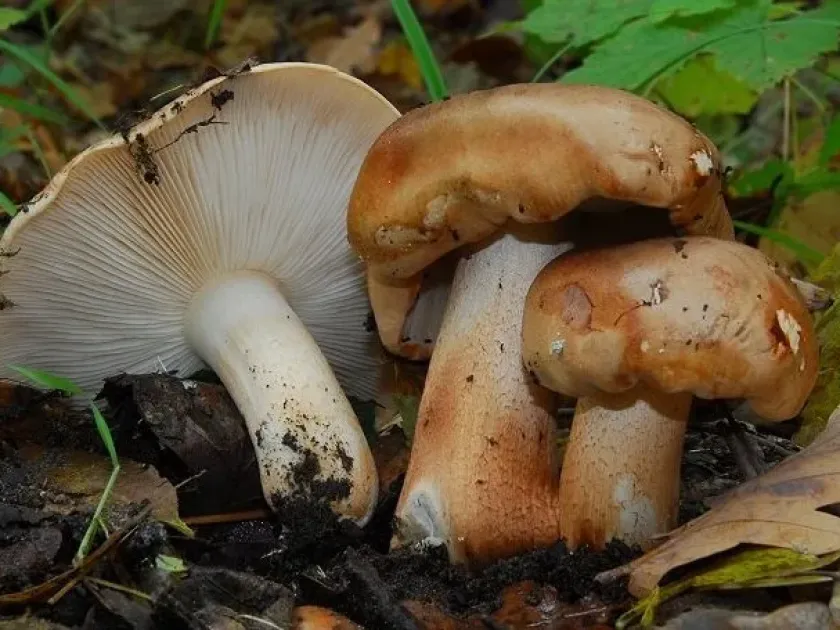
The cap typically measures 6–15 cm in diameter, exhibiting a reddish-brown or yellowish-brown hue. The surface is often tacky or moist, which helps in moisture retention.
The gills are crowded and initially white, but they frequently develop reddish-brown spotting as the fruit body ages or when pressure is applied.
The stem is robust, short, and often buried deep in sandy soils, indicating its close association with the root zone of the host tree.
The most reliable field identifier is the strong, distinctive mealy smell of the flesh, which distinguishes it from other similar-looking species.
Pathogen
Poplar tricholoma (Latin Tricholoma populinum) is an edible gill mushroom belonging to the Tricholomataceae family. It is strictly a mycorrhizal species and is not a plant pathogen.
The fungus establishes a symbiotic relationship with the root system of poplar trees. Through this connection, it exchanges soil nutrients and moisture for sugars produced by the tree.
This biological interaction is purely mutualistic. The fungus does not invade living plant tissues, nor does it cause any decay, necrosis, or systemic plant diseases.
Scientific literature does not categorize Tricholoma populinum as a pest or disease agent; it is an essential component of the forest soil ecosystem.
Misclassification of this mushroom as a disease often stems from the dense concentration of mycelium in the soil, which can mimic the appearance of pathogenic root fungi.
Conditions for development
The primary prerequisite for the presence of Tricholoma populinum is the presence of poplar trees, as it cannot survive without this specific symbiotic partner.
It favors well-drained, sandy, or loamy soil types that are rich in organic leaf litter, providing the necessary environment for mycelial development.
The growth of fruit bodies usually occurs from late summer through late autumn, depending heavily on rainfall and stable soil moisture levels.
The fungus is adapted to temperate climates and can tolerate minor frost, which often serves as a trigger for the peak of the fruiting season.
Healthy, mature poplar stands provide the most suitable ecological niche for the widespread colonization of this mycorrhizal fungus.
Why it matters
This mushroom causes no harm to agricultural crops, garden plants, or forestry trees. It is essentially a neutral or beneficial element of the forest ecosystem.
No agricultural protection or control measures are required, as the fungus does not impact the health or structural integrity of the host trees.
The presence of this fungus is often an indicator of good soil health and the ecological balance within a poplar-dominated landscape.
Potential risks are limited to accidental misidentification by foragers who might confuse it with toxic species present in similar habitats.
Given its lack of pathogenicity, there are no documented cases of economic loss attributed to the activity of Tricholoma populinum.
Discussion
No discussions yet — be the first.