
Tricholoma atrosquamosum
Tricholoma atrosquamosum
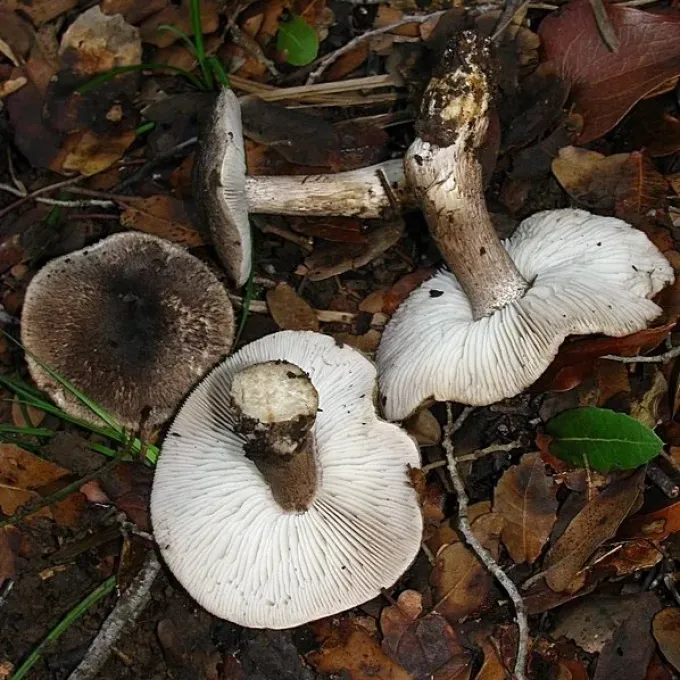
Description
Symptoms
The appearance of Tricholoma atrosquamosum is characterized by the formation of fruit bodies (mushrooms) in forest soils. The cap typically ranges from 4 to 8 cm in diameter and is covered with small, blackish scales, which is the primary identifying feature.
The gills are white and crowded, and the stem is firm, fibrous, and lacks a ring. These morphological traits are strictly limited to the reproductive organs of the fungus and do not represent symptoms of an infection on agricultural vegetation.
The flesh is white and firm, often emitting a distinct spicy or floury odor. Unlike plant pathogens that cause visible lesions, necrosis, or wilting, this fungus simply grows out of the soil surface without impacting any plant life nearby.
The white spore print is released into the environment, but these spores do not result in any phytopathological effects. No spots, galls, or abnormal growth occur on nearby plants, confirming that the fungus is not a disease agent.
The presence of these mushrooms is simply an indicator of healthy, nutrient-rich soil in forested areas and does not signify an outbreak of a plant disease.
Pathogen
Tricholoma atrosquamosum, commonly known as the dark-scaled knight, is a fungus in the Tricholomataceae family. From an agronomic perspective, it is important to clarify that this fungus is not a plant pathogen and does not cause any crop diseases.
The fungus functions as a saprotroph or a mycorrhizal symbiont associated with forest trees. It does not infect the tissues of agricultural crops such as vegetables, grains, or fruits, nor does it possess the biological machinery to attack cultivated plants.
In agricultural science, Tricholoma atrosquamosum is not categorized as a disease agent. Therefore, there are no established phytosanitary protocols or management strategies aimed at controlling this fungus in farming environments.
The organism lives exclusively in woodland areas where it can establish symbiotic relationships with roots or decompose organic matter in the leaf litter. It lacks the ability to survive in the intensive, managed environments of modern farmlands.
Consequently, the status of this fungus in agriculture is that of a neutral, natural organism. It is not associated with any epidemic or damage to crops, and it poses no risk to agricultural productivity.
Conditions for development
The fungus develops primarily in coniferous or mixed forests where it can find suitable partners for mycorrhizal colonization. It requires a humid microclimate with abundant leaf litter or pine needles to thrive.
The optimal temperature for the development of fruiting bodies occurs in the autumn months, generally between 10°C and 15°C. High levels of moisture are essential for the survival and growth of the mycelium.
Tricholoma atrosquamosum requires a specific soil pH and organic content found in woodland ecosystems. It cannot adapt to the soil conditions and cultivation practices typical of high-input agricultural fields.
Direct sunlight and the lack of forest cover prevent the growth of this species. Thus, it remains localized in forest habitats and does not encroach upon surrounding agricultural or garden lands.
Reproduction is achieved through the dispersal of spores, yet colonization is restricted to stable forest environments. The fungus does not possess the mechanisms to colonize or persist in industrial farming sites.
Why it matters
There is zero harm associated with Tricholoma atrosquamosum in the context of agriculture. It does not cause economic losses, nor does it impact the quality or yield of agricultural produce.
Because the fungus is not a parasite, it does not feed on host plants or secrete toxins that inhibit crop growth. Its ecological role is focused on the carbon cycle within forest settings.
Agricultural managers do not need to worry about this species, as it is not a threat to crops. It does not lead to root rot, stem diseases, or leaf blight, which are common issues caused by true fungal pathogens.
Competition for nutrients or resources with agricultural crops is non-existent because the habitats of Tricholoma atrosquamosum do not overlap with cultivated farmland.
The fungus is essentially harmless to all aspects of human-managed agriculture and is not an issue that requires monitoring or management by agronomists.
Protection
Control measures are unnecessary and not recommended for Tricholoma atrosquamosum. Since it is not a pest or a disease, the application of fungicides would be ecologically unsound and financially wasteful.
No preventive measures are required, as the fungus does not spread through agricultural pathways. If fruit bodies appear near the perimeter of a farm, manual removal is sufficient for aesthetic reasons only.
Fungicides used to control crop-threatening diseases, such as rusts or mildews, are entirely ineffective against this type of fungus and should not be deployed against it.
Good agricultural practices, such as proper drainage and soil management, are intended to promote crop health and are not influenced by the occasional presence of this forest species.
The recommended approach for agricultural professionals is to recognize that this fungus is a natural inhabitant of forests and poses no risk to agricultural activities, requiring no action or intervention.
Discussion
No discussions yet — be the first.