
Wine cap
Stropharia rugosoannulata
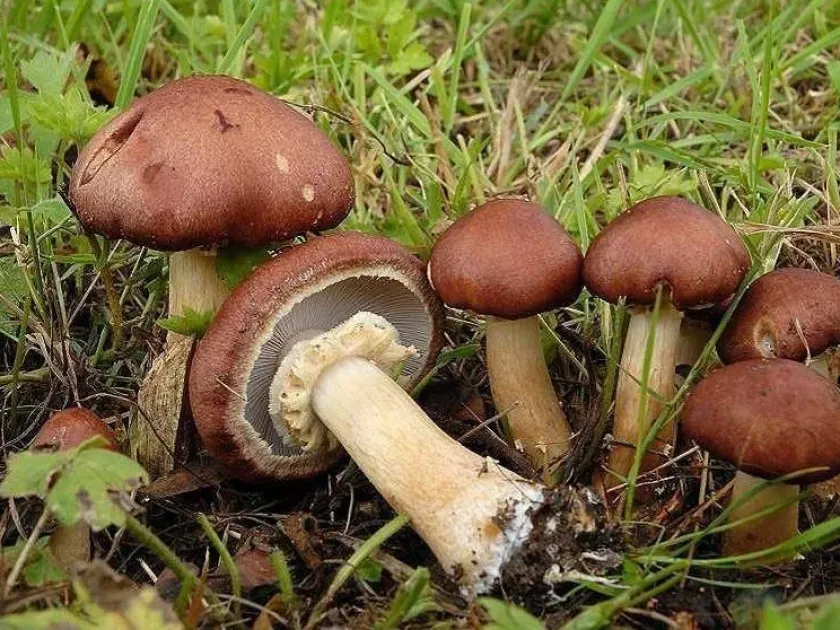
Description
Pathogen
Stropharia rugosoannulata, commonly referred to as the Wine cap or Garden giant, is a saprotrophic fungus, not a plant disease pathogen.
It belongs to the family Strophariaceae and feeds on dead and decaying organic matter, such as wood chips, straw, and leaf litter.
Because it lacks the biological mechanisms to penetrate living plant tissues, it does not induce systemic or localized plant diseases.
Agronomically, this organism is considered a beneficial decomposer that helps turn raw organic materials into nutrient-rich soil humus.
Labeling this fungus as a plant disease is a common misconception, as it lives entirely on non-living substrates and poses no threat to crop vitality.
Conditions for development
The development of Stropharia rugosoannulata is highly dependent on high moisture levels, usually requiring humidity above 70% in the substrate.
The fungus thrives in temperate climates, with mycelial growth occurring most rapidly in temperature ranges between 20°C and 28°C.
It prefers shaded or semi-shaded areas where the organic matter is kept moist and protected from direct ultraviolet radiation which can inhibit spore germination.
An abundant supply of cellulose and lignin-rich materials is the primary requirement for successful colonization and fruit body formation.
Proper aeration is also essential; while the fungus loves moisture, it cannot thrive in permanently waterlogged, anaerobic conditions.
Why it matters
The Wine cap causes no harm to crops, as it does not compete with living plants for water or nutrients in a detrimental way.
It actually improves soil aeration and water retention, which are essential factors for the successful growth of many horticultural crops.
There are no reports of the fungus attacking or damaging roots, stems, or leaves, regardless of the plant species grown nearby.
Its presence is a positive indicator of healthy, organic-rich soil rather than a sign of poor plant health or pathological infestation.
Therefore, no damage to yield or plant quality should be expected from the presence of this mushroom in an agricultural field or greenhouse.
Protection
As Stropharia rugosoannulata is not a pathogen, there is no need for chemical fungicides or protective measures against it.
If its expansion is unwanted in a specific area, simply increasing the frequency of soil cultivation or reducing the mulch thickness will effectively limit its growth.
Lowering the water content in the substrate will cause the mycelium to go dormant or die back, preventing further colonization of the area.
Physical removal of the colonized organic debris is a highly effective way to manage the population if the grower decides it is necessary.
Integrating the mushroom into a crop management system can actually be beneficial, as the fungal network helps to break down crop residues naturally.
Discussion
No discussions yet — be the first.