
Common Scab of Potato
Streptomyces griseus
Description
Symptoms
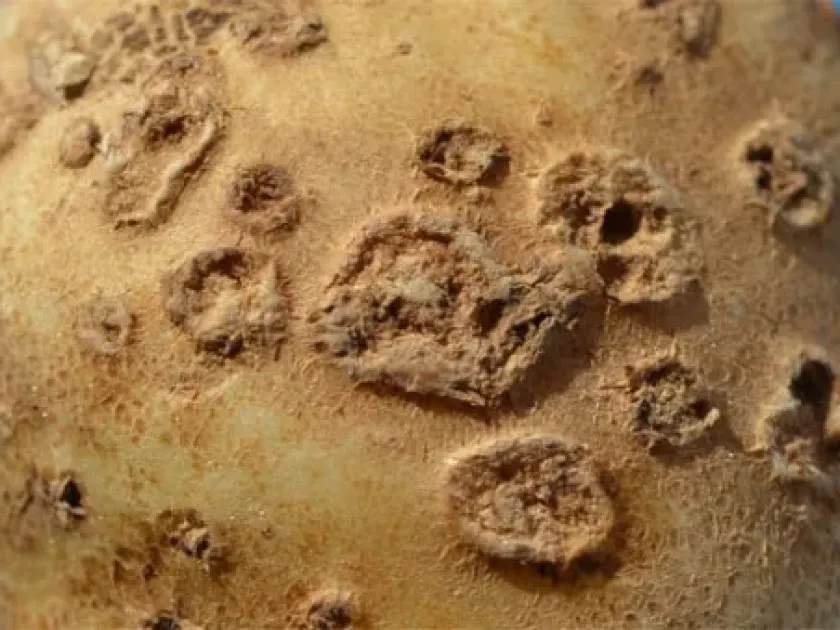
The symptoms of common scab primarily appear on the tuber surface. Early signs include small, raised, brown spots that gradually expand into characteristic lesions or crusty scabs.
There are several distinct forms of the disease, including superficial (russet) scab, raised scab, and deep (pitted) scab. Each form varies in its depth of penetration into the tuber tissue.
In cases of severe infection, the skin of the potato becomes completely covered with corky, necrotic tissues, which causes significant deformation and cracking of the tubers.
While the internal flesh of the potato usually remains healthy, the lesions can serve as entry points for secondary decay-causing organisms, particularly in storage conditions with high humidity.
Under magnification or in high-moisture conditions, a greyish, dusty layer consisting of mycelium and spores of the pathogen may be visible on the surface of the affected tuber areas.
Pathogen
The causal agent of common scab of potato is a group of soil-dwelling actinomycetes, primarily Streptomyces scabies. These microorganisms share characteristics of both bacteria and fungi and are native inhabitants of many soils worldwide.
As saprophytes, these organisms can survive indefinitely in the soil by feeding on decomposing organic matter. They do not require a living host to reproduce, which makes the disease extremely difficult to eradicate from infected fields.
The infection begins when the pathogen enters the developing tubers through lenticels, stomata, or small wounds caused by mechanical abrasion or insect activity during the expansion phase.
These bacteria thrive in specific ecological niches within the soil profile. Their growth and virulence are heavily influenced by the microbial community composition of the soil, as well as physical parameters like moisture and aeration.
The organism has a high level of genetic plasticity, allowing different strains to develop resistance to environmental stress and to adapt to various cropping systems commonly used in agriculture.
Conditions for development
The development of common scab is strongly favored by dry and hot soil conditions during the critical tuber initiation stage. Soil moisture levels directly impact the vulnerability of the tuber skin to pathogen penetration.
Soil pH plays a critical role in disease severity. The pathogen prefers neutral to alkaline soils, with the disease being most prevalent in soils where the pH is above 5.5 to 6.0.
The addition of fresh organic matter, such as uncomposted manure, to the soil immediately before planting often exacerbates the disease, as it provides an abundance of nutrients for the actinomycetes.
Soil temperature is another factor; warm temperatures ranging between 20°C and 25°C are generally considered optimal for the rapid growth and colonization of the pathogen within the tuber tissues.
Well-aerated soils with poor water retention capacity often harbor higher populations of the pathogen. Management strategies must account for these environmental variables to minimize the impact of the disease.
Why it matters
The primary harm caused by common scab is the drastic reduction in the marketability of the potato crop. Tubers with unsightly lesions are downgraded or rejected by packers and retailers.
Although common scab does not usually result in complete yield loss, it significantly decreases the profitability of the operation due to the lower value of the produced crop.
In storage, the disease becomes a bigger issue as the lesions provide entry points for secondary pathogens like soft rot bacteria and fungi, leading to increased decay and storage losses.
Culinary use of the potatoes is impacted as the corky skin requires deep peeling, leading to increased waste and reduced efficiency in processing plants, such as those producing fries or chips.
For seed potato production, the presence of scab is a major issue as it can introduce the pathogen to previously clean fields, compromising the quality of the seed stock for multiple seasons.
Protection
Effective management begins with the use of resistant potato varieties. Many breeding programs focus on developing cultivars with thicker skin or inherent resistance to Streptomyces strains.
Long crop rotations that include crops that do not host the pathogen, such as cereals or specific forage crops, are essential for reducing the inoculum density in the soil over time.
Adjusting soil pH is a standard practice; incorporating acid-forming fertilizers, such as ammonium sulfate, can help create a slightly acidic micro-environment around the tubers that inhibits pathogen growth.
Maintaining adequate and consistent soil moisture during the tuberization period is one of the most effective ways to prevent the infection from establishing itself on young tubers.
Biological control agents, such as specific strains of Bacillus or other antagonistic bacteria, can be applied at planting to colonize the tuber surface and outcompete the pathogen for space and nutrients.
Discussion
No discussions yet — be the first.