
Common Scab of potato
Streptomyces bottropensis
Description
Symptoms
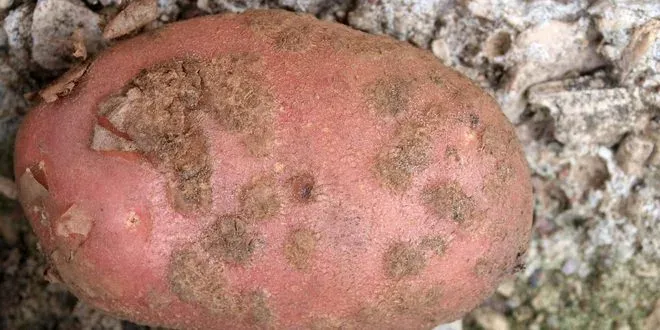
The primary symptom is the appearance of lesions on the surface of tubers. These can take various forms, including shallow, raised, or deeply pitted scabs, often surrounded by corky tissue.
Initial lesions are small, dark spots that gradually expand. As the lesion matures, the skin ruptures, and the area becomes rough and unsightly, resembling a callus or crust.
The severity of the disease can range from minimal spotting to total coverage of the tuber surface with large, coalesced scabs, rendering the product unmarketable.
In some cases, the root system or stolons may show dark lesions, although these are often overlooked compared to the obvious symptoms on the potato tuber itself.
Internal tuber tissues usually remain sound unless secondary infections, such as soft rot, enter through the lesions caused by the scab, which can then destroy the entire tuber.
Pathogen
The causative agent of this disease is the actinomycete Streptomyces bottropensis, a soil-borne bacterium. It is a filamentous microorganism that survives in the soil environment for years.
These bacteria act as saprotrophs, consuming organic matter. Their resilience allows them to persist in a dormant state during adverse conditions, making eradication from the soil extremely difficult.
The infection spreads primarily through contaminated potato tubers used for planting and through soil movement on machinery. Once introduced to a new field, it becomes a permanent inhabitant.
The bacterium enters the tuber through the lenticels or small wounds on the skin. It secretes enzymes that cause local damage to the potato skin, leading to the formation of the characteristic scabs.
Understanding the biology of Streptomyces is crucial because their pathogenicity is highly dependent on the soil environment, particularly the presence of potato roots and tubers to host their growth.
Conditions for development
Common scab thrives in neutral to alkaline soils, with a pH of 6.5 or higher. Soil acidity is a major limiting factor for the growth of Streptomyces bacteria.
Dry soil conditions during the tuber-bulking phase are the primary trigger for the disease. If soil moisture is low, the bacteria infect the expanding tubers much more aggressively.
Warm temperatures, particularly between 20°C and 25°C, create the optimal environment for the proliferation of the pathogen in the soil and its colonization of the plant tissue.
High levels of organic matter, especially fresh manure application immediately before planting, create a favorable nutritional environment for these bacteria, increasing the risk of severe outbreaks.
Frequent potato monocropping without rotation allows the pathogen population in the soil to build up, leading to increasingly severe infestations over time.
Why it matters
The main impact of common scab is the significant reduction in the commercial value of the potato harvest. The unattractive appearance makes the tubers unsuitable for fresh markets.
Scabbed potatoes are more prone to dehydration. The compromised skin structure allows moisture to escape, leading to premature wilting and weight loss during storage.
The disease acts as an entry point for secondary bacterial and fungal pathogens, which can cause significant decay and rot in storage facilities, leading to further crop loss.
Growers often face high economic losses due to the necessity of grading out heavily affected potatoes, reducing the overall sellable volume of the production.
For industrial processors, potatoes with deep scab lesions require more peeling and processing effort, which can lower the final yield of chips or frozen products.
Protection
Selecting resistant potato varieties is the most effective long-term management strategy. Some modern cultivars have been bred to withstand infection even in conducive soil conditions.
Maintaining proper soil moisture during the tuberization period is critical. Consistent irrigation can keep the bacteria from successfully colonizing the young, sensitive tubers.
Managing soil pH is highly effective; keeping it slightly acidic (below 5.5) can significantly inhibit the growth and virulence of Streptomyces bottropensis.
Crop rotation with crops that are not hosts to the pathogen, such as legumes or certain grasses, can help reduce the infection pressure in the field over several years.
- Use certified disease-free seed potatoes to prevent introduction.
- Avoid over-liming the soil if the pH is already near neutral.
- Incorporate green manures to improve soil health and microbial diversity.
Discussion
No discussions yet — be the first.