
Gummy stem blight
Stagonosporopsis citrulli
Description
Symptoms
Symptoms typically appear as tan or brown necrotic lesions on leaves, stems, and fruit, often accompanied by the exudation of reddish-brown gum.
Leaf lesions often start as small, water-soaked spots that enlarge, turning necrotic and potentially causing the entire leaf to wither and die.
Stem lesions often occur at the nodes, where the tissue becomes cracked and oozes a sticky sap, which gives the disease its common name: gummy stem blight.
Small black dots, known as pycnidia, appear on the surface of the lesions; these contain masses of spores that are visible under magnification.
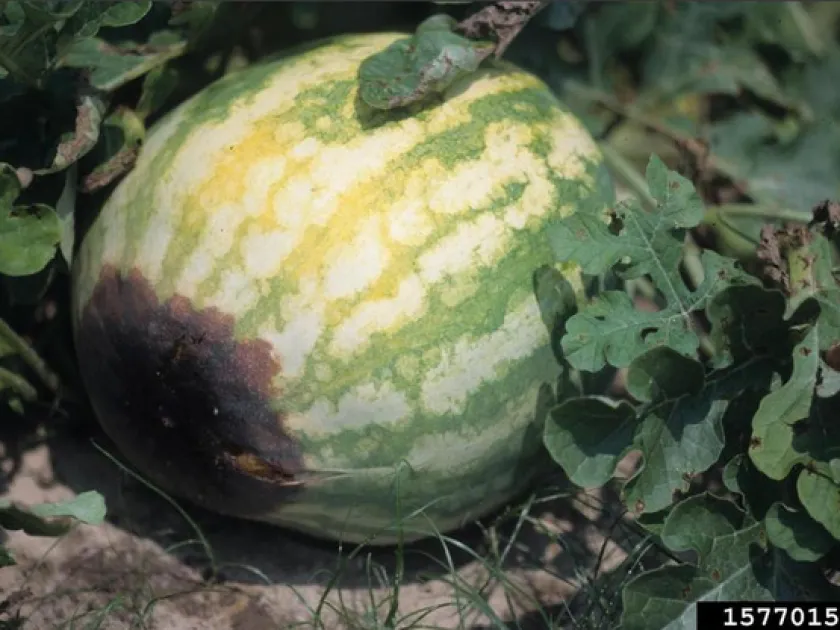
Fruit decay usually manifests as dark, sunken spots that may eventually spread to the entire fruit, often becoming covered in a grey fungal mold.
Pathogen
Gummy stem blight is caused by the fungus Stagonosporopsis citrulli (formerly classified as Didymella bryoniae or Ascochyta citrullina).
This pathogen is an ascomycete fungus known to attack almost all members of the Cucurbitaceae family, including melons, watermelons, cucumbers, and squashes.
The fungus survives between seasons in crop residues, soil, and can be transmitted through contaminated seeds, which makes sanitation a critical control factor.
The life cycle involves the production of pycnidia and pseudothecia, which release spores that are easily spread by wind, splashing rain, and irrigation water.
It is a highly persistent pathogen that adapts quickly to changing environmental conditions, often surviving for several years in the field debris.
Conditions for development
Gummy stem blight thrives in warm, humid environments, with the optimal temperature range for infection being between +20°C and +25°C.
Poor greenhouse ventilation, high plant density, and constant canopy wetness create the perfect conditions for the rapid spread of the disease.
Prolonged rainfall or heavy dew creates long periods of leaf wetness, which is essential for the fungal spores to germinate and infect the plant tissue.
Wounds caused by pruning, training, or insect damage act as primary entry points for the fungal spores to colonize the host plant.
High nitrogen levels and low light intensities can exacerbate symptoms by encouraging overly succulent and fragile plant growth.
Why it matters
The disease causes significant damage by reducing the foliage area available for photosynthesis, leading to stunted plant growth and poor yield.
In severe cases, stem girdling occurs, which restricts water and nutrient transport, ultimately causing the collapse and death of the entire plant.
Fruit quality is severely impacted, making infected crops unmarketable due to both aesthetic damage and the risk of post-harvest rot.
The economic impact is particularly high in protected cropping systems where the high humidity promotes rapid infection cycles and mass crop loss.
Infected seeds can lead to damping-off in seedlings, causing total stand failure in early-season cucurbit plantings if not properly managed.
Protection
The most effective management strategy is an integrated approach combining strict sanitation, proper crop rotation, and timely fungicide application.
Removing and destroying all crop debris after harvest is essential to reduce the primary inoculum load for the following season.
Use of certified, disease-free seeds and selecting resistant or tolerant cucurbit varieties are critical preventive measures for long-term control.
- Implement a 3-year crop rotation schedule excluding all cucurbit species.
- Maintain adequate ventilation in greenhouses to reduce canopy humidity.
- Apply protective or systemic fungicides at the first sign of leaf spotting.
Avoid overhead irrigation when possible, and sanitize pruning tools between plants to prevent the mechanical transmission of the pathogen.
Discussion
No discussions yet — be the first.