
Sugarcane smut
Sporisorium sacchari
Description
Symptoms
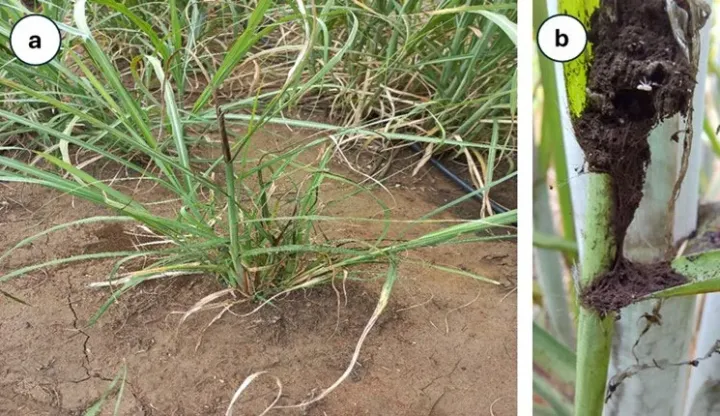
The most diagnostic feature is the emergence of a long, whip-like black structure from the center of the sugarcane stalk's growing point.
This "whip" consists of millions of teliospores held together by a thin, silvery membrane that ruptures as the spores mature and release.
Infected plants typically show excessive tillering, producing an abnormally high number of thin, spindly, and stunted shoots instead of healthy stalks.
Leaves on infected plants may appear narrower, shorter, and chlorotic due to the redirection of nutrients toward the fungal growth.
Fields with high infection rates exhibit a distinct "grassy" appearance, making it easy to identify severely affected clusters among healthy canes.
Pathogen
Sugarcane smut is caused by the fungus Sporisorium scitamineum, a basidiomycete that specifically targets species of the Saccharum genus.
This pathogen acts as an obligate parasite, invading the apical meristems and lateral buds of the sugarcane plant to complete its life cycle.
The fungus colonizes the internal tissues systemically, eventually transforming the growing tip of the stalk into a fungal reproductive structure.
Teliospores are the primary means of survival and dissemination, capable of remaining viable in the soil for several months under favorable conditions.
Understanding the biology of S. scitamineum is essential, as the infection remains latent until the pathogen begins to produce its characteristic spore whips.
Conditions for development
The disease thrives in environments with moderate temperatures and periods of high humidity, which facilitate spore germination and infection.
Winds are the primary vector for long-distance transmission, carrying teliospores from infested fields to healthy plantations nearby.
The presence of moisture on the buds, such as dew or light rain, is critical for the germination of basidiospores and their entry into the host.
Poor agronomic practices, including the use of infected stalks for propagation, significantly escalate the incidence of the disease.
Stress factors such as drought or poor soil management can weaken the plant's natural defenses, increasing its susceptibility to fungal colonization.
Why it matters
The primary economic damage results from a significant reduction in stalk weight and lower sucrose content, rendering the harvest less profitable.
Smut infection causes yield losses that can range from moderate to complete crop failure depending on the cultivar susceptibility and environmental factors.
Infected stalks have poor ratoon regrowth potential, often necessitating the early replanting of the fields, which increases production costs.
The continuous production of spores serves as a constant source of inoculum, threatening the health of all sugarcane fields within the region.
Besides biomass loss, the overall quality of the juice is compromised, leading to difficulties during the sugar extraction and processing stages.
Protection
The use of smut-resistant cultivars remains the cornerstone of integrated management strategies for controlling this disease.
Strict phytosanitary practices, such as sourcing disease-free seed canes, are vital to prevent the introduction of the pathogen into clean areas.
Heat treatment of seed canes by immersion in hot water is a highly effective method for eliminating latent mycelium before planting.
Rogueing, or the deliberate removal and destruction of infected stools, is essential to decrease the level of inoculum in the field.
Adopting balanced fertilization and optimal planting densities helps maintain plant vigor, making them more resilient to pathogen invasion.
Discussion
No discussions yet — be the first.