
Head smut of millet
Sporisorium panici-leucophaei
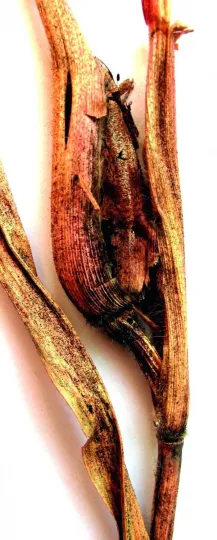
Description
Symptoms
The most visible symptom occurs at the heading stage. Instead of a normal, grain-bearing panicle, the plant produces a distorted, black, smutted mass covered by a thin, fragile membrane.
Once the membrane ruptures, the dark, dusty spore mass is exposed to the wind. These spores are easily disseminated throughout the field, settling on healthy plants or falling into the soil to await the next season.
Affected plants may exhibit stunted growth, reduced height, or abnormal tillering. While the infection is systemic, it often leads to a general decline in the plant's vigor compared to healthy counterparts.
There is a complete absence of viable grains in the affected panicles. Every spikelet is transformed into a gall containing the pathogen's spores, ensuring no yield is obtained from an infected plant.
In some cases, the entire tiller is affected, showing a darkened, unhealthy appearance well before the full emergence of the panicle. This systemic nature ensures that the entire reproductive effort of the affected plant is lost.
Pathogen
The disease is caused by the basidiomycete fungus Sporisorium panici-leucophaei (formerly Sphacelotheca panici-miliacei). It is an obligate parasite that specifically infects proso millet and related species.
The infection begins at the seedling stage. Teliospores located on the seed coat or in the soil germinate, infecting the young sprout before it emerges from the soil. The fungus then establishes a systemic infection.
As the plant grows, the fungal mycelium spreads systemically throughout the host tissues. It remains largely dormant until the plant begins its reproductive phase, when the pathogen directs its energy toward the millet panicle.
The panicle becomes the primary site of spore production. The fungus consumes the floral parts and converts them into a dense mass of black spores, effectively sterilizing the reproductive organs of the plant.
These teliospores can persist in the soil for several years, acting as a reservoir for future infections. Their longevity makes them a persistent threat in fields where millet is grown frequently.
Conditions for development
The primary factor for disease development is the presence of spores in the soil or on the surface of the seeds. Soil temperature at planting is critical; cooler temperatures favor the pathogen over the millet seedling.
If millet is planted into cool, wet soil, germination and seedling emergence are slowed. This extended period in the soil provides a larger time window for the fungus to penetrate the susceptible seedling tissues.
High soil moisture during the emergence phase promotes spore germination and successful infection. Conversely, warm, well-drained soil helps the plant grow rapidly, often allowing it to escape infection.
Crop rotation history significantly impacts the risk of head smut. Continuous cropping of millet on the same land allows the spore count in the soil to rise, leading to more frequent and severe outbreaks.
The dispersal of spores during the blooming period is aided by wind, which carries the black smut dust across the field, contaminating neighboring crops and the surface soil for subsequent years.
Why it matters
The economic impact of head smut is primarily the direct loss of grain yield. Infected plants are essentially barren, contributing nothing to the final harvest.
Seed quality is severely compromised when spores contaminate the healthy grain during harvest. Such grain is often rejected for commercial use and cannot be used as seed without rigorous cleaning and treatment.
Field contamination increases the long-term risk for subsequent millet crops. The accumulation of soil-borne spores makes it difficult to maintain profitable millet production in the same area.
In cases of severe infestation, the disease can cause major losses, significantly reducing the profitability of the entire farm operation for that season.
The disease also complicates harvesting procedures, as the release of spore clouds during mechanical harvesting can be hazardous and contributes to the spread of the disease to previously clean areas of the field.
Protection
- Use only high-quality, certified seeds that are free from fungal contamination.
- Treat seeds with effective systemic fungicides before planting to kill surface-borne spores.
- Practice crop rotation by waiting 3–4 years before planting millet in the same field again.
- Plant seeds in warm, optimal soil conditions to ensure rapid seedling growth and minimize infection time.
- Select resistant millet varieties or hybrids that have demonstrated tolerance to smut diseases.
Discussion
No discussions yet — be the first.