
Description
Symptoms
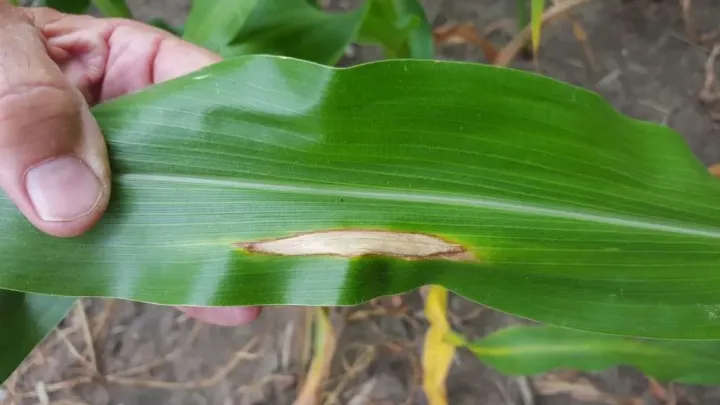
The primary symptoms appear as small, light-tan or brown spots that develop on the lower leaves and gradually move upward.
As the lesions mature, they become elongated, rectangular, and tan, typically confined by the leaf veins, reaching lengths of 2 to 3 centimeters.
Under humid conditions, the lesions produce a characteristic grayish-brown or black fuzzy fungal growth consisting of spores.
If the disease becomes severe, the lesions can merge, causing the entire leaf to wither, dry out, and appear burned or blighted.
- Elongated, rectangular lesions restricted by veins.
- Tan to brown discoloration of leaf tissue.
- Grayish-black spore masses on lesion surfaces.
- Premature leaf death starting from the base upwards.
Pathogen
Southern Corn Leaf Blight (SCLB) is a fungal disease caused by Bipolaris maydis (formerly known as Helminthosporium maydis).
The fungus survives the winter primarily on infected corn debris left on the soil surface from the previous season.
It reproduces by producing spores (conidia), which are disseminated by wind and splashing rain to the lower leaves of the developing corn plants.
Different races of the pathogen exist, with Race T historically being the most destructive due to its ability to attack corn with specific cytoplasm.
Once the spores land on a susceptible host, they germinate and penetrate the leaf tissue, initiating the infectious cycle.
Conditions for development
SCLB development is strongly favored by warm temperatures, typically ranging between 20°C and 30°C.
High relative humidity, frequent rainfall, and extended periods of dew or fog are critical for the fungus to sporulate and infect the corn plants.
Field environments with poor air circulation, often due to high planting density, maintain the moisture levels required for the disease to flare up.
Plants already under physiological stress from drought or nutrient deficiencies are more prone to successful infection by Bipolaris maydis.
The disease usually progresses more rapidly during the mid-to-late vegetative stages if the weather conditions remain consistently warm and wet.
Why it matters
The main impact of SCLB is the destruction of leaf tissue, which directly reduces the plant's photosynthetic capacity.
Reduced photosynthesis leads to poor grain filling, resulting in lighter, shriveled kernels and significant yield losses.
In addition to leaf blighting, the pathogen can infect husks and ear structures, leading to ear rots and decreased grain quality.
Severe outbreaks can cause the plants to lodge prematurely, making harvesting more difficult and increasing field losses.
Economic losses can be substantial, especially when the disease reaches the upper leaves of the canopy during the critical grain-filling period.
Protection
The most reliable control measure is the planting of resistant or tolerant corn hybrids developed through modern breeding programs.
Crop rotation to non-host species is highly effective at reducing the primary inoculum source present in the field's crop residues.
Tillage practices that incorporate crop residue into the soil help accelerate the decomposition of the pathogen's substrate.
Fungicide applications are recommended when disease pressure is high and environmental conditions continue to favor the spread of the fungus.
Maintaining adequate soil fertility and managing plant population density are essential cultural practices to support robust, healthy growth.
Pathogens and affected parts
Affects crops · 1
Discussion
No discussions yet — be the first.