
Downy mildew of millet
Sclerospora graminicola
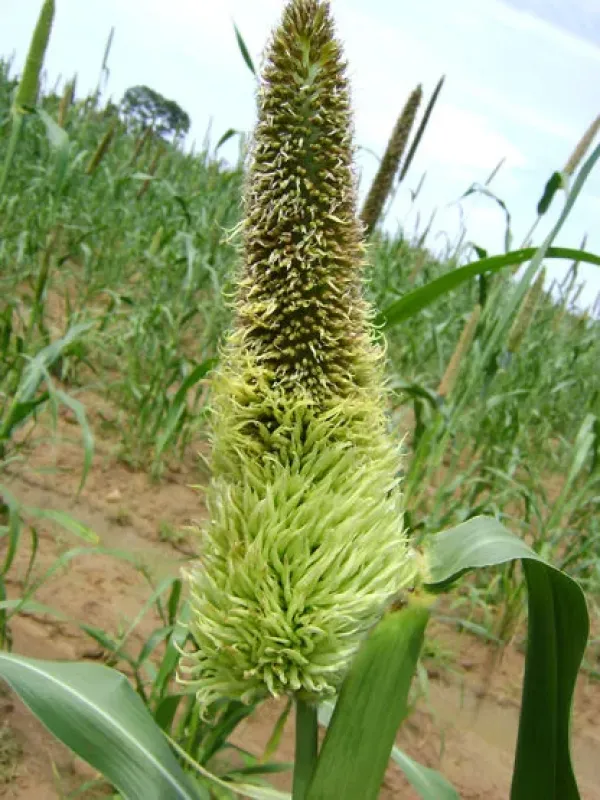
Description
Symptoms
Initial symptoms are characterized by chlorotic streaks or spots on the leaves, which appear very early in the seedling stage.
Under high humidity, a dense white or greyish fuzzy growth of the fungus can be observed on the underside of the infected leaves.
As the disease progresses, infected plants often exhibit stunted growth, excessive tillering, and twisted or deformed foliage.
The inflorescence, or panicle, is often severely malformed, frequently replaced by leafy structures, a symptom known as the "green ear" phase.
Infected plants typically fail to produce viable grain, leading to severe visual and physiological abnormalities throughout the growing season.
Pathogen
The disease is caused by an obligate parasite, an oomycete pathogen known scientifically as Sclerospora graminicola.
This pathogen exhibits a complex life cycle involving motile zoospores for seasonal spread and robust oospores that survive in the soil.
Infection primarily originates from oospores that can remain dormant in the soil and crop debris for several years under various conditions.
Primary infection occurs when the oospores germinate and infect the root system or the shoots of young millet seedlings.
Once inside the host, the pathogen colonizes the plant systemically, spreading through the vascular tissues to all parts of the plant.
Conditions for development
The disease thrives in cool, wet soil conditions, particularly when temperatures range between 15°C and 20°C during the germination phase.
High relative humidity and frequent rainfall promote the rapid development and dispersal of sporangia, facilitating the spread of secondary infection.
Dense planting configurations and poor drainage contribute to an ideal microclimate for the pathogen to flourish within the field canopy.
Low-lying areas of fields, where water may collect, often show higher incidences of infection due to the aquatic nature of the zoospores.
A history of continuous millet cultivation on the same land leads to a significant build-up of oospore inoculum in the soil profile.
Why it matters
Downy mildew is considered one of the most destructive diseases of millet, capable of causing yield losses ranging from 30% to over 50%.
Systemic infection often results in the complete loss of grain yield in affected plants, as the reproductive organs fail to develop properly.
Early-stage seedling death can lead to significant gaps in the stand, necessitating replanting and increasing production costs for farmers.
The quality of any grain produced from infected or near-infected plants is significantly diminished, impacting both marketability and germination potential.
Economic damage is compounded by the long-term contamination of fields with oospores, which limits the future cultivation of susceptible varieties.
Protection
Crop rotation remains the most effective management strategy, with a recommended break of at least 3 to 4 years between millet crops.
Deep plowing and proper soil management help to bury infected crop debris, reducing the initial inoculum pressure for the next season.
Planting healthy, fungicide-treated seeds in well-drained, warm soil promotes vigorous growth and helps seedlings escape early infection.
Selecting and cultivating resistant millet hybrids or varieties is a critical component of a sustainable integrated pest management program.
- Removal of volunteer millet plants
- Improvement of soil drainage in low-lying areas
- Timely monitoring of seedling health
- Balanced nutrient application to enhance plant vigor
Discussion
No discussions yet — be the first.