
Blackened brittlegill
Russula albonigra
Description
Symptoms
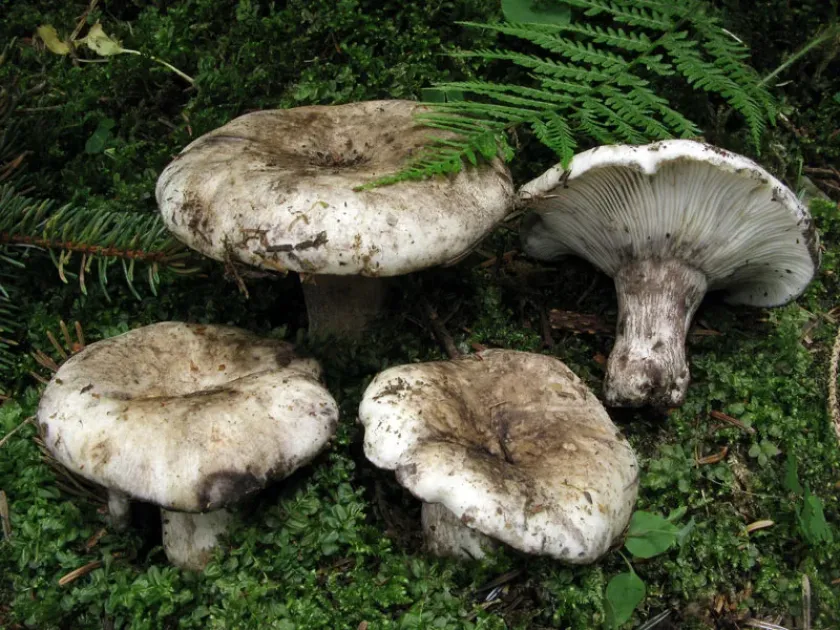
The blackened brittlegill, scientifically known as Russula albonigra, is a gilled mushroom notable for its rapid color change when physically damaged.
The cap typically reaches 4 to 12 centimeters in diameter, transitioning from a convex shape in younger specimens to a depressed or funnel shape as it matures.
Its skin color ranges from grayish-brown to almost charcoal black, which serves as a primary diagnostic feature for identifying this specific species.
The gills are crowded and initially appear white or cream-colored, but they blacken almost instantly upon contact or as the mushroom reaches maturity.
The stipe is firm, cylindrical, and often matches the color of the cap, frequently darkening significantly due to oxidation of the flesh when handled.
Pathogen
It is important to clarify that Russula albonigra is not a plant pathogen and does not cause diseases in agricultural crops or horticultural plants.
This mushroom functions as a mycorrhizal partner, establishing symbiotic relationships with the roots of trees, which is beneficial to forest health.
Unlike parasitic fungi that cause wilting, root rot, or leaf spot, this species relies on tree roots for nutrient exchange rather than attacking plant tissues.
Its biological activity is confined to the forest soil environment, where it decomposes organic matter and supports mineral cycling in symbiotic tree systems.
Agronomists do not classify this species as a risk factor; it has no negative impact on the viability or productivity of cultivated plant species.
Conditions for development
Russula albonigra typically develops in conifer, mixed, and deciduous forests, with fruiting bodies appearing primarily between July and October.
The fungus thrives in moist, organic-rich forest soils, where the mycelium remains active within the leaf litter and root zones of host trees.
Optimal growth conditions involve stable humidity and moderate temperatures, typically ranging from 15 to 22 degrees Celsius throughout the season.
Spore dispersal occurs naturally through air currents, allowing the fungus to maintain its population within established forest ecosystems.
The presence of healthy, mature tree stands is the most significant factor for the long-term survival and propagation of this mycorrhizal species.
Why it matters
There is no economic damage associated with this fungus in the agricultural sector, as it is completely neutral to crop production and farming activities.
Since it is not a competitor for nutrients or a vector for plant infections, it poses no threat to field crops, greenhouse plants, or stored agricultural goods.
The fungus does not secrete toxins that could inhibit plant growth, making it a harmless component of the environment surrounding agricultural fields.
Any concerns regarding its presence are typically unfounded, as it is a natural part of forest biodiversity rather than a harmful agricultural invader.
Consequently, Russula albonigra is categorized as ecologically neutral in terms of crop health management and agricultural biosecurity protocols.
Protection
No protective or control measures are required for Russula albonigra, as it does not constitute a disease, pest, or threat to agricultural operations.
The application of fungicides against this fungus is unnecessary and contradicts principles of integrated pest management and environmental sustainability.
Agricultural professionals should prioritize monitoring and control strategies for actual pathogens that impact crop yields, ignoring ecologically benign forest fungi.
If physical removal is necessary for site maintenance around farm structures, simple manual clearance is sufficient, though it is rarely needed in practice.
Maintaining a balanced forest edge habitat helps preserve ecological stability, which indirectly benefits field crops by preventing erosion and wind damage.
Discussion
No discussions yet — be the first.