
Pythium root rot
Pythium pulchrum
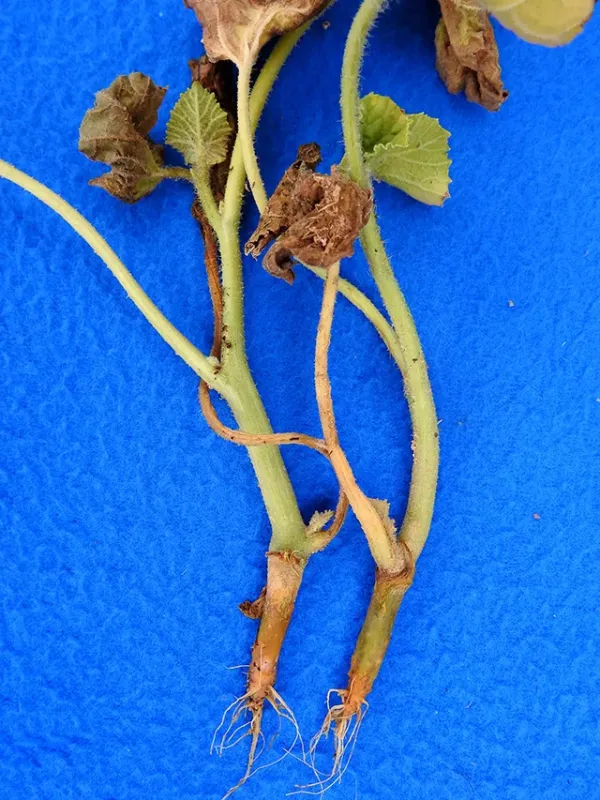
Description
Symptoms
The primary symptom is sudden wilting of the foliage, which may occur at night or immediately after irrigation. Leaves gradually lose turgor, turn yellow, and wither, while the root system undergoes rapid decay.
Upon examination, the root system shows characteristic browning and tissue softening. Roots become slimy and lose their structural integrity; often, when pulling the plant from the soil, the root part detaches from the stem, remaining in the substrate.
The stem at the soil line may become thin and water-soaked, a phenomenon often referred to as "damping-off," which is a hallmark of Pythium infection during the early stages of seedling development.
Under high humidity, a faint, white, cottony mycelium may appear around the infected area. This indicates the active phase of the pathogen's spread within the soil and onto the plant base.
Plants infected at an early age almost always die because their damaged roots cannot support growth. Adult plants, if heavily infected, show significant stunting and reduced yields due to systemic nutrient deficiency.
Pathogen
The causal agent of this disease is the microscopic oomycete Pythium pulchrum, which belongs to the class Oomycetes. Although visually similar to fungi, it is a water mold whose biology is closely linked to aquatic environments and high moisture content in the soil substrate.
This pathogen is characterized by highly motile zoospores capable of actively swimming through soil moisture toward the roots of susceptible plants. The organism survives in the soil as oospores, which can remain dormant and viable for long periods under adverse conditions.
The life cycle of Pythium pulchrum includes both asexual reproduction for rapid spread and sexual reproduction to form resilient spores. This makes the pathogen extremely persistent and difficult to eradicate in both greenhouse and field environments.
Infection initiates when mycelium penetrates root tissues or enters through small lesions in the root zone. The pathogen secretes specific enzymes that degrade plant cell walls, leading to tissue necrosis and the disruption of nutrient and water uptake.
Pythium pulchrum affects a wide range of hosts, including ornamental plants, vegetables, and seedlings of various agricultural crops. Young plants in the seedling stage are particularly vulnerable to attack.
Conditions for development
Development of Pythium pulchrum is promoted by high soil moisture levels exceeding 80% of full water-holding capacity. Standing water, poor drainage, or excessive irrigation create ideal environments for zoospore motility.
The optimal temperature range for the pathogen's activity is between 15°C and 25°C. However, the organism remains active at lower temperatures, often causing seedling loss during cooler periods of the growing season.
Overcrowded planting densities where air circulation is restricted create microclimates with elevated humidity near the soil surface, facilitating the rapid spread of the disease from plant to plant.
The presence of large amounts of undecomposed plant debris in the soil provides a nutrient source for the pathogen, allowing it to survive and multiply saprophytically. This debris acts as a primary inoculum reservoir.
Compacted, poorly aerated soils also contribute to infection. Roots suffering from oxygen deprivation are physically weakened and become highly susceptible to penetration by Pythium pulchrum zoospores.
Why it matters
The primary damage is the mass death of seedlings, leading to sparse plant stands and significant economic losses. Replanting or replacing dead plants increases labor and seed costs substantially.
In adult plants, the disease causes stunted growth and severe yield reduction. Damaged roots are unable to absorb essential nutrients and water efficiently, resulting in chlorosis and stunted development even with adequate fertilization.
Infected plants are extremely prone to secondary infections, such as bacterial rots, which quickly overwhelm the weakened host, complicating diagnosis and successful treatment strategies.
Pythium rot threatens the aesthetic and market value of produce, especially for root crops. The disease can also continue to develop during storage if moisture levels are not properly managed.
Long-term persistence of the pathogen in the soil renders fields unsuitable for susceptible crops for several years. This often forces growers to invest in expensive soil sterilization or chemical treatment programs.
Protection
The most critical preventive measure is strict adherence to irrigation schedules to avoid waterlogging. Effective soil drainage and good air circulation are essential to ensure the topsoil dries out sufficiently.
Using only certified, disease-free seed and high-quality, disinfected substrate is vital to prevent pathogen introduction. Steaming or solarizing the soil before planting is an effective way to destroy oospores.
The application of biological fungicides containing Trichoderma species helps suppress Pythium pulchrum through competition and direct hyperparasitism. These biologicals are environmentally friendly alternatives.
Chemical control involves the use of fungicides, such as phenylamides, specifically labeled for seed treatments or soil drenches. It is crucial to follow application rates strictly to prevent phytotoxicity to the crop.
Implementing crop rotation and removing all crop residues from the site after harvest significantly reduces the disease pressure. Maintaining balanced soil pH is also recommended, as the pathogen favors neutral to slightly acidic conditions.
Discussion
No discussions yet — be the first.