
Pythium root rot
Pythium polymastum
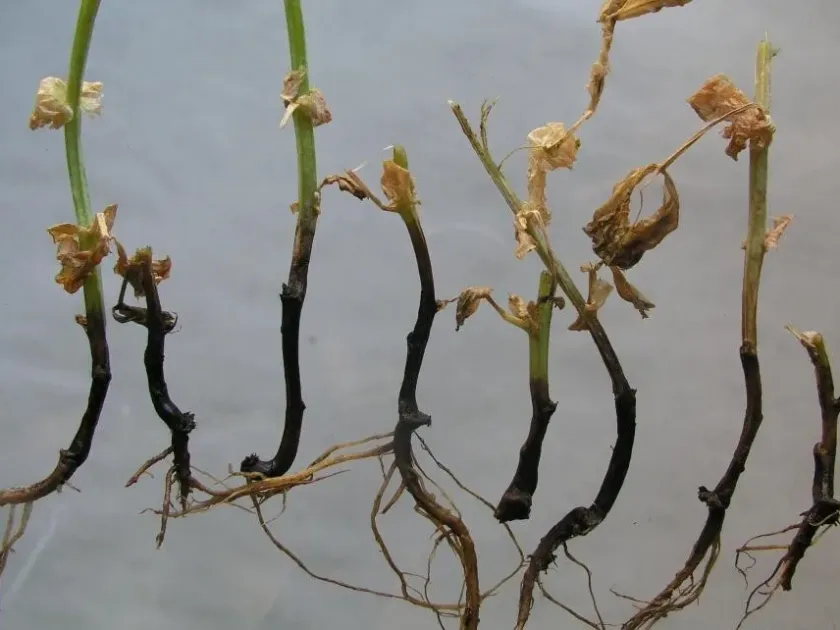
Description
Symptoms
Initial symptoms are often subtle, appearing as stunted growth and slight yellowing of the foliage, which can easily be mistaken for water or nutrient stress.
The roots of infected plants show characteristic browning and decay. The outer cortical layer of the root becomes soft and mushy, easily sloughing off when handled.
Plants often exhibit wilting during the hottest parts of the day because the damaged root system cannot supply enough water to the transpiring foliage.
In highly infested areas, damping-off occurs, where seedlings collapse suddenly and die within a few days of emergence, often resulting in patchy stands.
Advanced stages of the disease lead to the complete destruction of the root cortex, leaving only the central vascular core, which eventually leads to total plant collapse.
Pathogen
The causative agent of this disease is the oomycete Pythium polymastum. This soil-borne pathogen is highly adapted to wet environments and is classified as a water mold.
The biology of this organism depends heavily on moisture; it produces motile zoospores that swim through the soil water film to reach the host plant's roots.
The pathogen can survive in soil as mycelium or as dormant oospores, which allow it to withstand adverse environmental conditions for extended periods of time.
Once it reaches the root surface, the pathogen secretes lytic enzymes that degrade cell walls, allowing the infection to penetrate and consume the root tissues rapidly.
Dissemination often occurs through contaminated soil, irrigation water, or movement of infested tools, making strict sanitation practices crucial for disease management.
Conditions for development
Excessive moisture is the primary driver of Pythium development. Poorly drained soils or over-irrigation create the perfect conditions for zoospore movement.
The pathogen thrives in cool to moderate temperature ranges, though certain strains remain active under a variety of environmental conditions found in greenhouse settings.
High planting density restricts airflow and light penetration, increasing local humidity levels around the plant base, which promotes the spread of the disease.
Soil compaction reduces oxygen availability, which stresses the plants and makes them more susceptible to root pathogens while simultaneously favoring the anaerobic nature of Pythium.
High nitrogen levels and improper pH levels can exacerbate the problem by stimulating rapid, soft tissue growth that is easier for the pathogen to colonize.
Why it matters
The most immediate damage caused by Pythium root rot is the significant loss of seedling populations, which can lead to complete failure of a crop cycle.
In older plants, chronic root damage reduces the efficiency of water and nutrient uptake, leading to diminished fruit or vegetable yield and lower market quality.
Pythium infections frequently serve as a precursor to secondary infections by other fungi and bacteria, which further complicate the recovery of the affected crops.
Commercial growers face severe economic impacts due to the loss of product, the cost of fungicides, and the labor required for sanitation and crop replanting.
The pathogen is difficult to eradicate once established in a greenhouse or field, leading to long-term management challenges and reduced profitability for affected sites.
Protection
Effective management begins with improving soil drainage and strictly controlling irrigation practices to avoid saturated soil conditions.
Biological control agents, particularly specific strains of Trichoderma, can be used to colonize the root zone and protect against Pythium colonization.
Chemical fungicides specifically labeled for oomycete control should be applied preventatively in high-risk environments or at the first sign of symptoms.
Sanitation is paramount; equipment should be disinfected regularly, and growing media must be sterilized to ensure no initial inoculum is present.
- Implement crop rotation;
- Ensure proper seedbed preparation;
- Use sterile or pathogen-free potting mixes;
- Monitor plants for early stress symptoms;
- Maintain proper ventilation in greenhouses.
Discussion
No discussions yet — be the first.