
Pyricularia leaf spot
Pyricularia setariae
Description
Symptoms
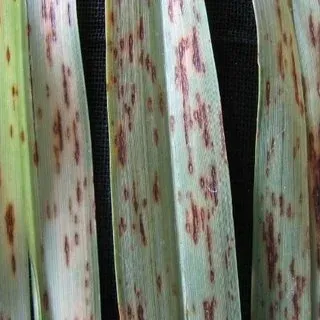
The initial symptoms appear as small, chlorotic or white lesions that expand into elongated, spindle-shaped spots with dark brown or reddish borders.
Under humid conditions, the centers of the lesions produce a characteristic grey to olive-green fuzzy growth, representing the mass production of conidia.
Severe infections lead to the coalescence of lesions, which eventually causes extensive leaf blight, browning, and premature senescence of the foliage.
The pathogen also attacks stalks and panicles, leading to "neck rot" symptoms where the grain-bearing part of the plant becomes discolored and shriveled.
Affected plants often show stunted growth and poor panicle development, drastically altering the overall visual appearance and health status of the crop.
Pathogen
The disease is caused by the fungus Pyricularia setariae, an ascomycete pathogen that primarily affects plants within the Poaceae family, including setaria species.
The fungus reproduces via conidia, which are produced on conidiophores and dispersed by wind, rain splashes, or mechanical contact, leading to secondary infections in the field.
It can overwinter as mycelium or chlamydospores in crop debris left on the soil surface, acting as the primary inoculum source for the following growing season.
The pathogen utilizes complex biochemical mechanisms, including the secretion of lytic enzymes, to penetrate the host cuticle and colonize the internal leaf tissues.
Its ability to adapt to different environmental stressors allows the fungus to persist in agricultural environments, making it a persistent challenge for crop management.
Conditions for development
The disease thrives under high relative humidity (above 85%) and moderate temperatures ranging from 20°C to 28°C, which favor spore germination and penetration.
Prolonged leaf wetness caused by heavy dew, frequent rainfall, or overhead irrigation is critical for the rapid spread of the disease within the canopy.
Planting in dense stands restricts airflow and maintains a constant high-humidity microclimate, significantly accelerating the infection cycle of the fungus.
Nutrient stress, particularly excess nitrogen fertilization, promotes succulent growth that is more susceptible to fungal entry and colonization.
The presence of wild grass weeds within or adjacent to the field provides a continuous reservoir of inoculum, facilitating early season infections.
Why it matters
The primary damage results from a reduction in the functional leaf area, which limits the photosynthetic capacity of the plant and reduces total biomass accumulation.
Grain quality and yield are negatively impacted, with infected seeds often appearing thin, lightweight, and exhibiting poor germination and seedling vigor.
In cases of severe infestation, yield losses can be substantial, jeopardizing the economic viability of the crop for farmers and commercial producers.
The structural integrity of the plant can be compromised, leading to lodging, which further complicates harvesting and contributes to additional yield losses.
Furthermore, the increased disease pressure necessitates additional chemical control inputs, thereby raising the overall cost of production.
Protection
Cultural management is the first line of defense, involving strict crop rotation and the prompt removal or deep incorporation of crop residues into the soil.
Selecting and planting resistant or tolerant cultivars is the most effective and environmentally sustainable way to manage the disease across large areas.
Seed treatment with professional fungicides is essential to ensure that seedlings are protected from soil-borne and seed-borne inoculum during emergence.
Foliar application of fungicides may be necessary during the vegetative stages if environmental conditions strongly favor the progression of the fungus.
- Implementation of balanced fertilization programs.
- Control of grass weeds to eliminate inoculum reservoirs.
- Optimizing plant spacing to improve canopy aeration.
Discussion
No discussions yet — be the first.