
Pyrenulaceae
Pyrenulaceae
Description
Symptoms
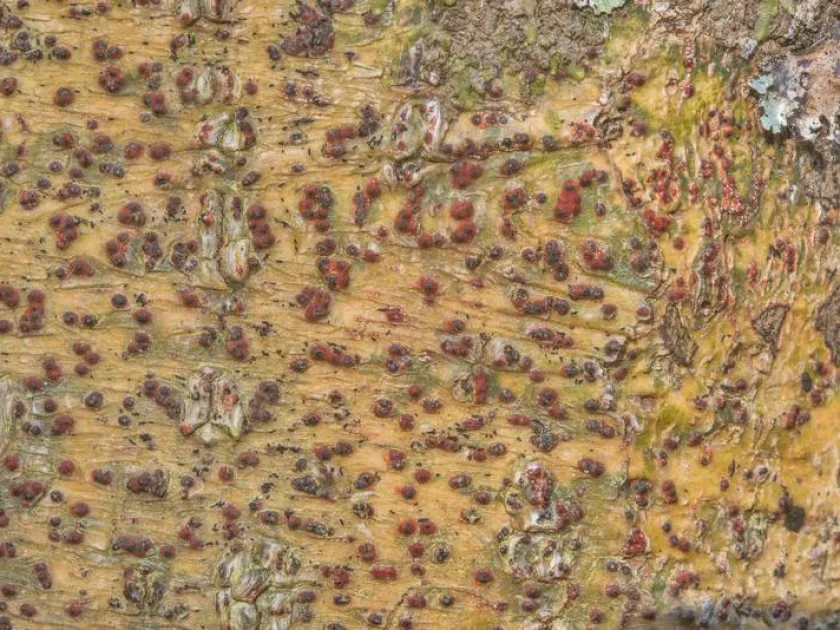
Symptoms of Pyrenulaceae presence manifest as crusty patches, spots, or textured growths on tree trunks and larger branches.
The appearance can vary from greyish-white to dark brown or black, depending on the specific species and the light conditions of the orchard.
A distinctive feature is the presence of tiny, pin-prick-sized black dots on the surface, which are the perithecia (fruiting bodies) where spores are produced.
The bark where these lichens grow often looks rougher or more weathered, sometimes appearing prematurely aged or having an uneven texture.
Unlike true bark diseases, the growth is typically restricted to the outermost layer of dead cork, leaving the living cambium intact underneath.
Pathogen
The Pyrenulaceae family consists of fungi that exist primarily as lichens, living in symbiosis with algae. While they are often viewed as a nuisance, they are not strictly pathogens that feed on the tree's sap.
These organisms use the bark of woody plants simply as a substrate for attachment. They obtain their nutrients from the air, rainwater, and organic dust settling on the bark surface.
They are classified as epiphytes, meaning they thrive on the surface of other plants without causing direct harm to the underlying vascular system.
Systematically, these fungi belong to the class Eurotiomycetes. Their life cycle depends heavily on moisture levels, which allows them to colonize surfaces that remain humid for extended periods.
In managed orchards, their presence is often an indicator of stagnant air circulation or aging bark that has not been properly maintained or cleaned.
Conditions for development
High humidity and poor air circulation are the primary drivers for the spread of Pyrenulaceae in gardens and orchards.
Shaded areas within the canopy provide a protected, damp environment where these lichens can proliferate, as they lack the tolerance for intense, direct sunlight.
Trees with rough, deeply fissured bark are more prone to colonization as these crevices trap moisture and organic matter, creating a perfect seedbed.
Neglected trees, which have not been pruned or cleared of dead bark, provide stable substrates for these organisms to settle and expand over several seasons.
Environmental cleanliness is a factor; while lichens are often seen as signs of clean air, their excessive growth on fruit trees is a symptom of poor orchard hygiene.
Why it matters
The main harm caused by Pyrenulaceae is their role as a harbor for secondary pests, such as scale insects or mites, which find protection under the lichen layer.
Dense coverage may slightly interfere with the bark's ability to "breathe" (gas exchange), although the direct physiological impact on a healthy tree is minimal.
The presence of these growths hinders the effectiveness of preventative fungicide or insecticide sprays, as the lichen layer absorbs the chemicals before they reach the bark.
It can create a micro-environment that holds moisture, potentially facilitating the growth of other, more harmful fungal pathogens that do infect the tree tissue.
- Provides shelter for insect pests.
- Reduces the efficiency of chemical bark treatments.
- Indicates a lack of proper orchard maintenance.
Protection
Mechanical cleaning of trunks and branches using stiff-bristled brushes during the dormant season is the most effective way to remove accumulated growth.
Applying a lime wash to trunks during the spring serves to create an alkaline environment that discourages lichen attachment and growth.
Pruning is essential to open up the canopy, allowing sunlight and air to reach all parts of the tree, which naturally dries out the bark.
Copper-based fungicide applications in early spring effectively sanitize the bark and inhibit the development of lichen spores and fungal mats.
Good orchard management, including proper fertilization and irrigation, keeps trees vigorous and less likely to become overgrown with epiphytic organisms.
Discussion
No discussions yet — be the first.