
Pyrenula
Pyrenula
Description
Symptoms
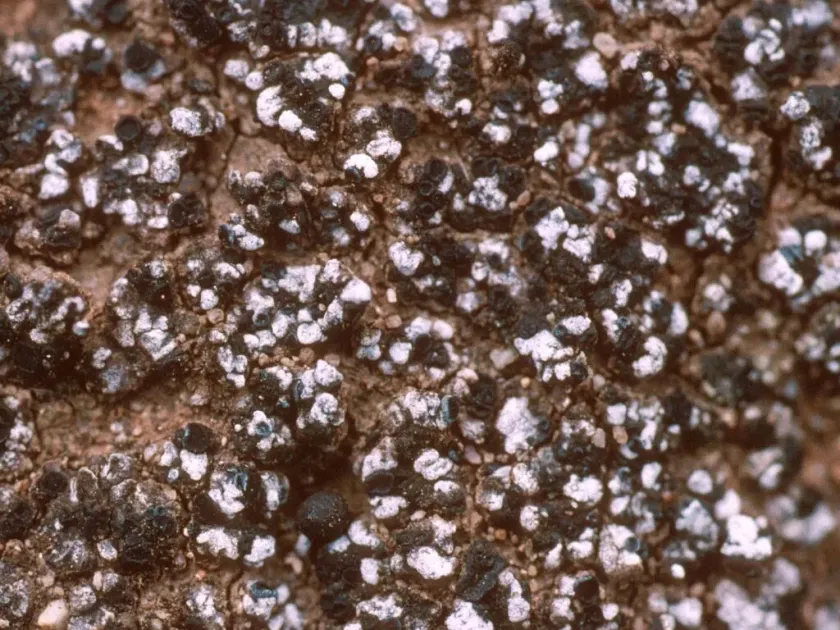
External signs of Pyrenula colonization include characteristic spots or growths on the bark. They often appear as dark, almost black or brown patches with tiny bumps, resembling a rash.
When examined closely with a magnifying glass, small, round structures called perithecia can be observed. These are the fruiting bodies of the lichen, where spores mature for further distribution.
Affected bark in areas inhabited by the lichen may acquire a specific shade and become rougher. The texture of the surface changes, creating a favorable environment for moisture retention.
The lichen usually spreads gradually, covering the lower part of the trunk and moving to the forks of skeletal branches. In the early stages, it may look like a small, rough patch.
An important distinguishing feature is that the lichen does not penetrate deep into the wood but localizes in the upper layers of dead bark. It can be easily removed from the trunk surface by mechanical scraping.
Pathogen
Pyrenula is a genus of lichens that is often mistaken for a fungal infection or a serious bark disease. Biologically, it is a symbiotic organism composed of an ascomycete fungus and an alga.
In an agronomic context, Pyrenula is classified as an epiphytic lichen that colonizes the trunks and skeletal branches of woody plants. It is not a parasite in the strict sense, as it does not directly feed on the plant's sap.
The organism uses the tree bark exclusively as a substrate for attachment. The body of the lichen (thallus) remains firmly fixed to the surface, gradually expanding and occupying significant areas over time.
Although Pyrenula does not parasitize the plant itself, its presence indicates poor tree health. It is most commonly found on mature trees with cracked bark and accumulated dead tissue.
Scientific studies confirm that species of the genus Pyrenula are frequently found in old orchards and forest ecosystems with high humidity. Their accumulation on trees is part of the natural aging process of the bark.
Conditions for development
The development of Pyrenula is favored by high humidity and poor light conditions in the orchard. Dense, poorly ventilated tree canopies create the ideal microclimate for lichen growth.
Lack of proper orchard maintenance, particularly neglecting sanitary pruning, leads to crown congestion. In such conditions, moisture evaporation is hampered, stimulating the growth of lichens.
A crucial factor in its spread is the age of the tree. Old bark, which grows slowly and has deep cracks, becomes an ideal substrate for the attachment of Pyrenula spores.
Neglected orchards where trunk whitewashing and bark cleaning are not practiced are the most susceptible to colonization. The presence of significant amounts of dead bark tissue provides a nutrient "background" for microorganisms.
Another risk factor is the weakened state of the tree due to other diseases or pests. Trees with slow bark growth are more susceptible to colonization by epiphytes.
Why it matters
The main danger of Pyrenula lies in its ability to create a favorable habitat for harmful insects. Under the dense thallus of the lichen, scale insects, mites, and other bark pests often hide.
Lichen growths trap moisture on the trunk surface for long periods. This creates a risk of rot developing in the bark and can trigger the onset of fungal diseases.
The spread of Pyrenula can hinder the normal gas exchange of the tree bark. Although not immediately fatal, the constant coverage of the trunk by this "armor" negatively impacts the overall health of the plant.
The presence of large amounts of lichen indicates a decline in the orchard's immune system. It is not so much a disease, but an indicator that the tree has stopped active growth and is failing to resist external factors.
In the long term, ignoring the "overgrowth" of the tree leads to premature bark death and a reduction in the productive lifespan of fruit trees.
Protection
The basis of protection is regular mechanical cleaning of the trunks. Damp bark is carefully cleaned with scrapers or wire brushes, taking care not to damage the living cambium layer.
To prevent the recurrence of lichens, trunk whitewashing with lime and copper sulfate is applied. This creates an unfavorable alkaline environment for lichen growth.
Mandatory agronomic practice includes thinning pruning. Ensuring good ventilation and light penetration makes the conditions unsuitable for the survival of epiphytes.
In cases of high infestation, treating the trees with fungicide solutions or specialized products for epiphyte control is recommended. This helps kill the spores and inhibits the growth of the thallus.
- Regular sanitary cleaning of trunks.
- Whitewashing with lime in the autumn period.
- Timely removal of old, affected branches.
- Maintaining high-quality cultivation to promote vigorous bark growth.
Discussion
No discussions yet — be the first.