
Spruce cone rust
Pucciniastrum areolatum
Description
Symptoms
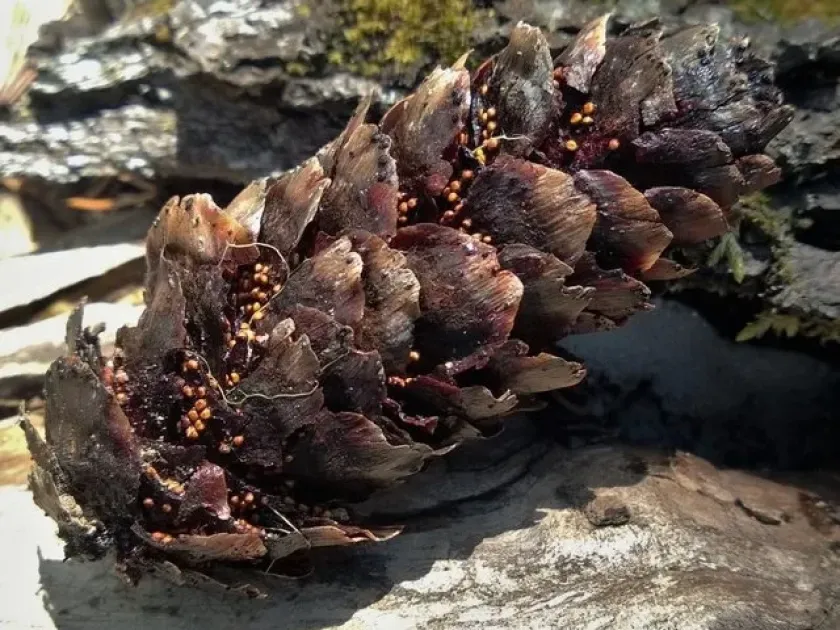
The most visible symptoms appear on the cones in the form of small, swollen, yellowish-orange pustules protruding from between the cone scales.
As the spores mature, the cone scales spread apart abnormally, exposing bright orange, powdery masses that cover the inner surfaces of the cone.
Infected cones become deformed, often curling or shriveling, and they frequently fall from the tree prematurely before they are fully mature.
Seeds within the infected cones are typically destroyed or fail to develop properly, making the cones useless for forest nursery purposes.
On the alternate host, bird cherry, the infection manifests as small yellow spots on the undersides of leaves, eventually turning into brown fungal structures.
Pathogen
The spruce cone rust is caused by the fungus Pucciniastrum areolatum. It is a heteroecious rust fungus, meaning it requires two different host species to complete its life cycle.
The primary host is Norway spruce (Picea abies), where the fungus infects the female cones, while the alternate host is bird cherry (Padus avium).
The pathogen colonizes the scales of the spruce cones, where it produces aecia, which are structures containing the orange spores characteristic of the disease.
The life cycle involves the production of aeciospores on the cones, which are dispersed by wind to the leaves of the bird cherry to continue the infection process.
This specific relationship between the pathogen and the host plants makes the timing of infection highly dependent on the simultaneous development of spruce cones and cherry foliage.
Conditions for development
Disease outbreaks are heavily influenced by the weather conditions during the period when spruce cones are opening and receiving pollen.
A wet and warm spring is highly conducive to spore germination and the successful transfer of the fungus from bird cherry hosts to spruce cones.
The presence of bird cherry shrubs in close proximity to spruce stands is the most significant factor in maintaining the infection cycle in the environment.
High humidity and poor air circulation within dense forest stands or poorly managed plantations provide ideal microclimates for the fungus to thrive.
The severity of the disease often fluctuates in cycles, mirroring years of abundant cone production, which provides the fungus with a vast supply of hosts.
Why it matters
The primary economic and ecological impact of spruce cone rust is the massive loss of viable spruce seeds, which hampers forest regeneration.
Commercial seed orchards can suffer devastating losses, as the rust can infect the majority of the cone crop in a single season under favorable conditions.
In landscape gardening, the disease negatively impacts the aesthetic value of spruce trees by causing deformed and prematurely dropping cones.
While the rust does not usually kill the mature spruce tree, the persistent loss of reproductive potential weakens the long-term sustainability of the stand.
The inability to collect healthy seeds from infected areas complicates reforestation efforts and reduces the availability of high-quality planting stock.
Protection
The most effective management strategy is to eradicate or physically separate the alternate host, bird cherry, from spruce stands within a radius of at least 500 meters.
In nurseries and seed orchards, systematic removal and destruction of infected cones before they shed their spores can significantly reduce the inoculum load.
Chemical control using authorized fungicides is generally restricted to high-value nursery or ornamental plantings and must be applied during the susceptible flowering stage.
Maintaining appropriate spacing in plantations improves air movement and reduces the humidity levels that favor the spread of the fungus.
- Spatial separation from bird cherry hosts.
- Sanitary removal of infected cones.
- Monitoring of spruce cone development.
- Use of resistant spruce genotypes where possible.
Discussion
No discussions yet — be the first.