
American raspberry rust
Pucciniastrum americanum
Description
Symptoms
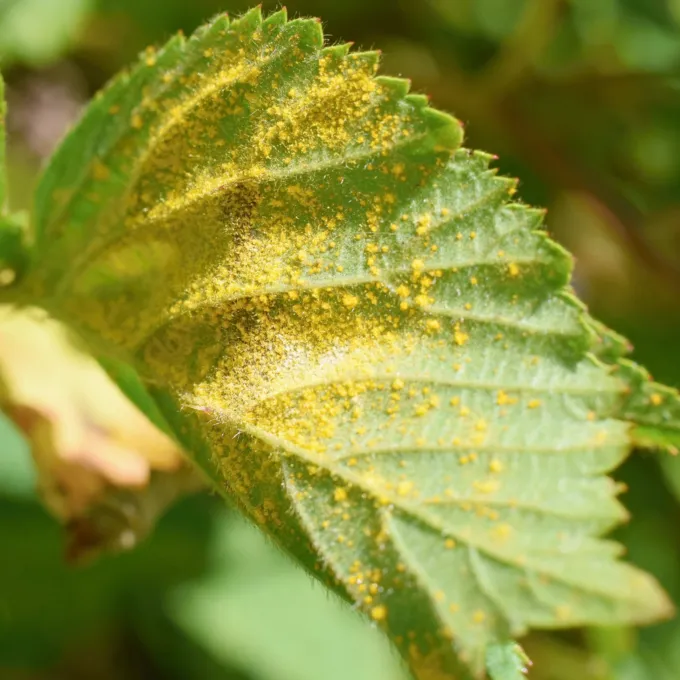
The first visual symptoms appear on the upper surface of raspberry leaves as small, yellow-orange spots of irregular shape. As the infection progresses, these spots increase in diameter and become more prominent.
On the underside of the infected leaves, numerous small pustules — aecia — form, containing the fungal spores. These pustules appear as small, raised structures of a distinct bright color.
Severe infection leads to premature yellowing and subsequent leaf drop. In advanced cases, the disease affects not only the leaves but also the pedicels and young raspberry canes.
When the flower stalks are affected, berry deformation occurs; the fruit becomes small, dry, and unsuitable for consumption. Berries lose their marketability and flavor, which is critical for commercial production.
- Yellowing of leaves early in the season.
- Appearance of bright orange spots on the upper leaf surface.
- Presence of pustules on the underside of the leaf blade.
- Premature defoliation.
- Deformation and shriveling of berries.
Pathogen
The causal agent of this disease is the heteroecious rust fungus Pucciniastrum americanum. Its life cycle is intricately linked to two distinct host plants: raspberries and spruce, on which the fungus completes various stages of its development.
In spring, the infection is often transmitted from spruce, where the fungus overwinters on needles, to the young shoots and leaves of raspberry plants. Following the primary infection, the pathogen produces urediniospores capable of repeatedly reinfecting raspberry plantings throughout the growing season.
The fungus is characterized by high aggressiveness under favorable weather conditions. Its mycelium develops within the plant tissues, gradually depleting its resources and disrupting the critical processes of photosynthesis.
The fungal spores are microscopic and easily dispersed by air currents over long distances. This makes the disease difficult to control in regions with a high density of both raspberry plantations and spruce forests.
The biology of the pathogen requires strict adherence to phytosanitary standards. Understanding the development cycle of Pucciniastrum americanum allows agronomists to precisely time preventive treatments.
Conditions for development
The development of American raspberry rust depends directly on air humidity. High humidity, prolonged rainfall, or heavy dew create an ideal environment for the germination of fungal spores.
The optimal temperature range for the spread of the infection is between +15°C and +22°C. Under such conditions, the incubation period of the fungus is significantly shortened, which triggers disease outbreaks.
Poor aeration of the site also contributes to disease development. Dense planting, lack of pruning, and weed growth create a microclimate with high humidity, which favors the accumulation of spores.
The proximity of spruce stands to the berry patch significantly increases the risk of epiphytotic outbreaks. Since spruce is an essential intermediate host, spores from it regularly reach raspberry plants when the wind is favorable.
Poor agricultural practices, such as excessive nitrogen fertilization, reduce the natural resistance of plants to fungal attacks, making them more susceptible to the pathogen.
Why it matters
The harmfulness of American raspberry rust lies in the significant reduction of the plant's photosynthetic activity. The loss of leaves in the second half of summer negatively impacts the formation of fruit buds for the following year.
The disease leads to a sharp decrease in yield. Berries affected by rust often fail to ripen, have an unpleasant taste, and poor shelf life, rendering them unsuitable for storage and transportation.
Plants weakened by the fungus are less capable of surviving winter cold. Due to the depletion of nutrient reserves in the root system, raspberries are more likely to suffer winterkill, leading to the destruction of entire plots.
Without systematic control, the disease can destroy up to 50% or more of the harvest. This causes serious economic losses for farms specializing in raspberry cultivation.
The pathogen also contributes to the general weakening of the bushes, making them vulnerable to other diseases and pests. The plant loses its natural immunity, which ultimately shortens the productive lifespan of the plantation.
Protection
The primary measure of protection is the selection of resistant raspberry cultivars. Using high-quality, virus-free planting material significantly reduces the risk of infection sites appearing on the plot.
It is important to perform regular sanitary pruning. Removing and immediately burning infected shoots and fallen leaves denies the fungus a source of nutrition and overwintering sites for its spores.
Maintaining optimal planting density and thinning the bushes improves air circulation. This helps leaves dry faster after rain, which prevents the fungal spores from germinating.
If necessary, chemical protection methods are applied. The use of copper-based fungicides or systemic products is effective during the growing season to prevent primary and secondary infection.
It is recommended to avoid establishing new plantations in close proximity to forest areas where spruce trees are prevalent. Spatial isolation is one of the most reliable ways to prevent this rust.
Discussion
No discussions yet — be the first.