
Porpidia tuberculosa
Porpidia tuberculosa
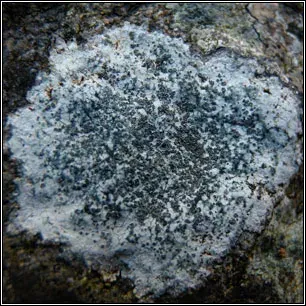
Description
Symptoms
Visually, Porpidia tuberculosa appears as a thin, granular, or tuberculate crust of a grayish, whitish, or slightly brownish color.
One of the key characteristics is the apothecia—the fungal fruiting bodies—which appear as tiny black discs, often embedded within the thallus body.
The lichen forms a characteristic pattern on the surface of stones, often highlighting their texture and cracks.
When wet, the color of the thallus may change slightly, helping to distinguish it from other lichen species growing in similar conditions.
Unlike plant diseases, this growth cannot be washed away or removed without mechanical impact on the substrate, as the lichen's hyphae penetrate deep into the stone's micro-cracks.
Pathogen
Porpidia tuberculosa is not a plant disease in the standard agronomic sense. It is an epilithic lichen belonging to a group of organisms that colonize rocky substrates.
In biological classification, this object is a symbiotic organism consisting of a fungus and an alga. It is not a parasite of agricultural crops.
Morphologically, the object presents as a crustose thallus that adheres tightly to the substrate. Its biology is fully adapted to life on exposed, often extreme rock surfaces.
This lichen does not secrete toxins capable of suppressing the growth of higher plants or causing pathological changes in their tissues.
Therefore, its presence in an agroecosystem should be viewed as an element of natural biodiversity rather than a phytopathological risk to the harvest.
Conditions for development
For normal development, this organism requires stable rocky surfaces devoid of dense vegetation cover.
The lichen prefers open areas with good access to sunlight, as its photobiont requires intensive photosynthesis.
Humidity levels are of critical importance: the lichen develops actively under conditions of moderate air humidity and rainfall, enduring long dry periods.
Substrate acidity also influences species distribution, as it is sensitive to the chemical composition of the stone and surrounding atmospheric precipitation.
In agricultural landscapes, it can be found on field borders, stone fences, building foundations, or on boulders in fallow lands.
Why it matters
Porpidia tuberculosa does not cause direct damage to agricultural crops, as it is unable to develop on living plant tissues.
Its impact on the environment is limited to the slow weathering processes of the stones it inhabits, which does not pose a threat to farming.
The absence of negative impact on the phytosanitary state of crops is confirmed by the lack of pathogenicity of this lichen in agronomic literature.
The lichen does not compete with crops for nutrients or water, as its metabolism is entirely autonomous and linked solely to the atmosphere.
The economic significance of this object is limited to ecological monitoring, as many lichens serve as indicators of air purity.
Protection
As Porpidia tuberculosa is not a pest or a disease pathogen, special control or protection measures are not required.
The use of fungicides or other pesticides against this lichen is impractical and economically unjustified.
If the presence of lichen on buildings is undesirable, mechanical cleaning of surfaces with brushes without the use of chemicals is recommended.
To prevent colonization of stones by lichens for architectural purposes, it is necessary to maintain dry surfaces and exclude constant water stagnation.
Prevention in agronomy should be directed toward managing actual pathogens rather than representatives of the natural flora that pose no threat.
Discussion
No discussions yet — be the first.