
American gooseberry mildew
Podosphaera mors-uvae
Description
Symptoms
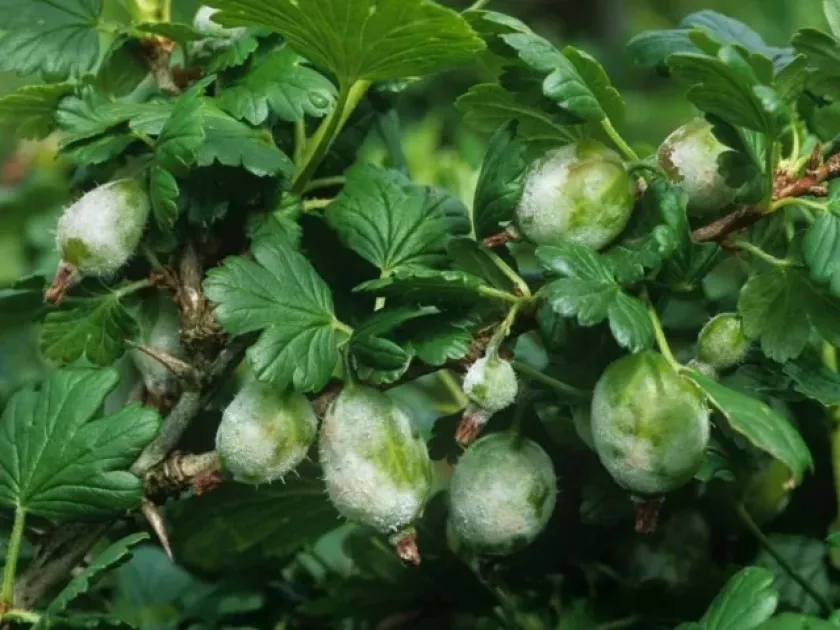
The initial signs are white, powdery patches on young leaves, soft shoots, and developing berries, which can be easily wiped away in the early stages.
As the infection progresses, the powdery mycelium darkens, becoming felt-like, brown, and hard to remove. Infected tissues become stunted, deformed, and brittle.
Visible black dots, representing the fruiting bodies (cleistothecia) of the fungus, appear on the older, felt-like patches toward the end of the season.
Shoots affected by the disease often stop growing, their tips curl, turn black, and eventually die back, leading to a significant loss of plant vigor.
Fruit quality is severely impacted; berries develop a brown, cracked skin covered in fungus, making them unmarketable and unattractive for consumption.
Pathogen
The causative agent of American gooseberry mildew is the fungus Podosphaera mors-uvae. It is an obligate parasite that specifically targets plants within the Grossulariaceae family.
The fungus overwinters as cleistothecia on infected twigs and fallen leaves. In the spring, these release ascospores that initiate primary infections on emerging leaves and shoots.
During the growing season, the pathogen produces vast quantities of conidia, which act as secondary inoculum, spreading the disease rapidly through wind and water splashes.
The mycelium resides primarily on the surface of plant tissues, penetrating the host cells with specialized structures called haustoria to extract nutrients.
This fungal life cycle is highly adapted to the host, allowing it to persist throughout the year and reactivate quickly under favorable conditions.
Conditions for development
The disease thrives in warm, humid environments, particularly when temperatures range between 17°C and 25°C with high atmospheric humidity.
Frequent rain showers, heavy morning dew, and poor air circulation within the shrub canopy provide perfect conditions for fungal spore germination and development.
Plants grown in crowded, dense plantings without adequate pruning are significantly more susceptible to outbreaks due to reduced airflow and increased humidity.
High levels of soil nitrogen can trigger excessive, tender new growth that is highly vulnerable to infection by Podosphaera mors-uvae spores.
Stress factors such as drought or mineral deficiencies can weaken the host plant, further decreasing its natural resistance to fungal invasion.
Why it matters
The primary economic impact is a dramatic reduction in fruit yield, as berries become unfit for fresh market consumption or commercial processing.
The disease causes premature defoliation, which hampers photosynthesis and leaves the plant unable to store enough energy for winter, leading to cold injury.
Stunted growth of new shoots limits the production capacity for the following year, causing a cumulative decline in overall plant health.
If left unmanaged, the fungus can build up a significant inoculum load in the garden, making it extremely difficult to maintain healthy gooseberry bushes.
Severe infections can lead to the death of the entire plant over several seasons, necessitating complete removal and replacement of the infected bushes.
Protection
Successful management relies on planting resistant cultivars and ensuring proper spacing between plants to maximize light penetration and air movement.
Regular pruning is essential to remove infected shoot tips, which significantly reduces the amount of overwintering inoculum present in the garden.
Fungicidal treatments, including sulfur-based products or synthetic systemic fungicides, should be applied preventively during the susceptible growth periods.
Sanitation practices, such as removing and burning fallen leaves and debris, are crucial to breaking the disease cycle and preventing secondary infections.
- Choose resistant gooseberry varieties.
- Apply balanced fertilizers (avoiding excess nitrogen).
- Maintain strict garden sanitation.
- Use biological fungicides for early-season protection.
- Ensure bushes are regularly thinned.
Discussion
No discussions yet — be the first.