
Podaxis pistillaris
Podaxis pistillaris
Description
Symptoms
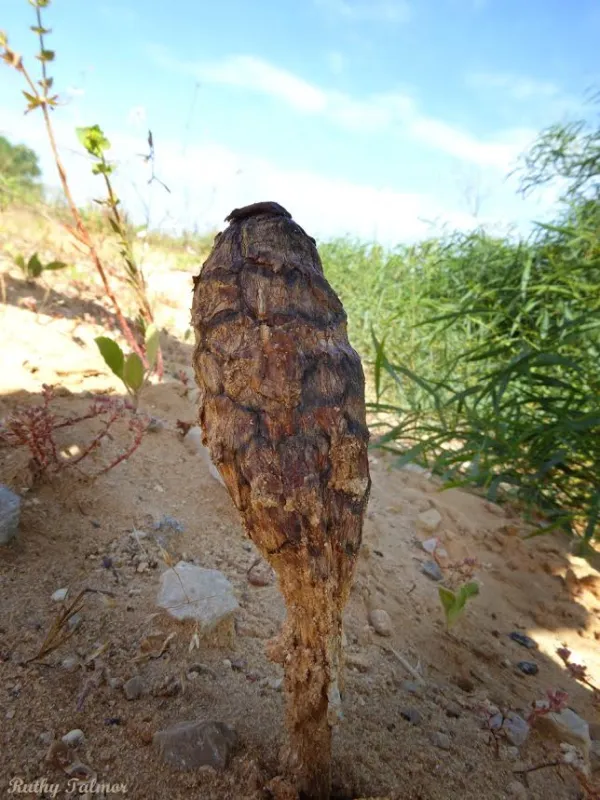
The most visible sign of Podaxis pistillaris is the emergence of stalked, club-shaped or cylindrical fruiting bodies above the ground surface.
The fruiting bodies often feature a scaly, fibrous exterior that transitions from white to brown as the fungus matures and produces spores.
When the internal structure breaks down, it releases a dark brown, powdery mass of spores that are easily dispersed by wind currents.
Crops in the vicinity show no signs of distress, wilting, lesions, or chlorosis, confirming the organism's non-parasitic relationship with the surrounding vegetation.
Development is most noticeable after rainfall, as moisture triggers the rapid emergence of the fruiting bodies from the soil.
Pathogen
Podaxis pistillaris is a basidiomycete fungus known as a saprotroph, which feeds on decaying organic matter. It is often misidentified as a plant pathogen due to its appearance in fields.
In reality, this fungus does not infect or cause diseases in living plants. It is a vital component of the soil ecosystem, particularly in arid and semi-arid environments.
The fungus functions as a decomposer, breaking down plant residues and contributing to the natural mineral cycle within the soil structure.
Its biology is uniquely adapted to high-heat and low-moisture environments, allowing it to flourish where typical agricultural pathogens would fail.
Because it lacks the mechanisms to colonize living tissue, it poses absolutely no risk to the physiological health of crops or their potential yields.
Conditions for development
Development is favored by warm temperatures and the presence of abundant organic mulch or buried organic matter within the soil.
Soil type plays a crucial role, as the fungus prefers sandy or loamy, well-drained soils that mimic desert-like conditions.
The fungus is triggered into a reproductive state by fluctuations in soil moisture, particularly after a period of prolonged drought.
It thrives in neutral or slightly alkaline soil conditions, which are typical for the dry regions where it is naturally found.
The fungus requires an environment that allows for rapid evaporation at the surface, which is managed by its highly resilient spore structure.
Why it matters
Podaxis pistillaris is non-pathogenic and causes zero harm to agricultural or horticultural crops. It has no negative impact on plant health or product quality.
There is no economic threshold for damage because the organism does not compete with crops for nutrients in any way that harms plant growth.
The presence of this fungus is strictly a biological occurrence related to soil fertility and the breakdown of biomass, rather than a disease outbreak.
No instances of crop loss have been associated with this organism, and it does not produce toxins that could inhibit plant development.
As a result, it is not considered a pest and does not require management strategies aimed at eradication or chemical intervention.
Protection
No control measures are necessary for Podaxis pistillaris, as it is a beneficial or neutral saprotroph rather than a crop disease.
For those who prefer to keep fields clear for aesthetic or operational reasons, physical removal of the fruiting bodies is the only effective method.
Standard agronomic practices, such as deep tillage, can disturb the mycelial network and prevent the formation of fruiting bodies in the future.
Promoting a healthy, balanced soil ecosystem through proper nutrient management usually keeps such organisms in check naturally.
- Mechanical removal of fruiting bodies
- Deep soil cultivation
- Maintenance of clean field conditions
Discussion
No discussions yet — be the first.