
Pine needle cast
Ploioderma hedgecockii
Description
Symptoms
The primary symptom is the appearance of chlorotic (yellowish) spots on the needles, which eventually transition to a deep brown or greyish color as the tissue dies.
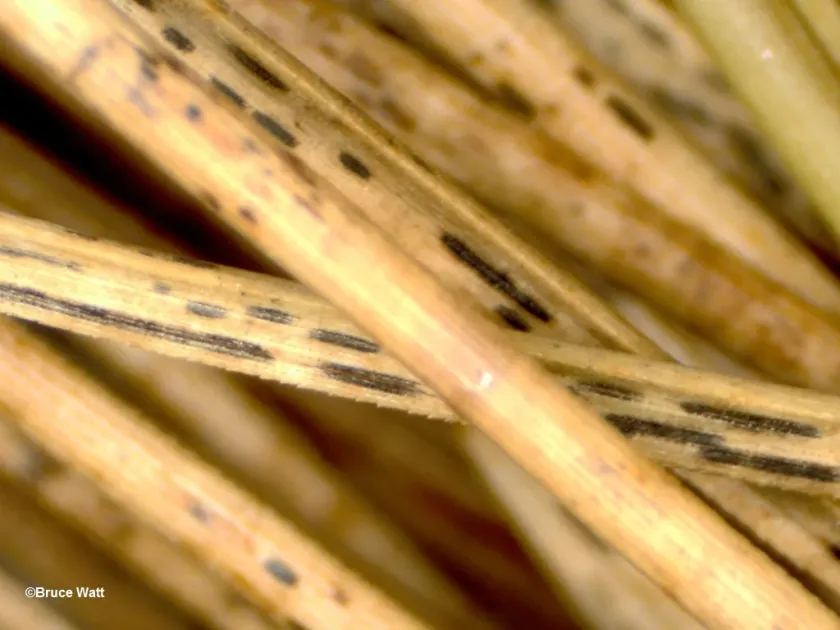
A distinctive sign is the development of dark, elongated fruiting bodies aligned along the length of the needle. These structures are often visible to the naked eye after the needle begins to discolor.
Premature needle cast is a common consequence of the infection, often occurring in late summer or autumn, resulting in a thin and sickly appearance of the tree canopy.
Affected needles typically show necrosis starting from the tip or in localized bands. In severe cases, the entire needle dies and falls, leading to significant foliage loss.
Early diagnosis is critical, as symptoms can be confused with other pine needle diseases. Microscopic examination of the hysterothecia is required for precise species confirmation.
Pathogen
The causative agent of this disease is the ascomycete fungus Ploioderma hedgecockii. This pathogen is a specific parasite that primarily infects the needles of various pine species.
The fungus completes its life cycle by producing macroscopic reproductive structures called hysterothecia. These appear as elongated, black lesions on the surface of infected needles, characteristic of the Rhytismataceae family.
The pathogen overwinters within fallen infected needles. During wet periods in the spring or early summer, the fungus releases ascospores which are dispersed by rain and wind to initiate new infections.
Mycelial growth penetrates the needle tissue, eventually leading to the degradation of internal structures and the formation of new sporulating bodies within the needle cuticle.
Research into the biology of this fungus indicates that it can persist for multiple seasons in the forest floor, maintaining a steady inoculum pressure in the vicinity of susceptible trees.
Conditions for development
High humidity and consistent rainfall are the most critical factors for the development of Ploioderma hedgecockii. Moist conditions facilitate the activation and dispersal of spores.
Dense, overcrowded pine stands often suffer from the worst infections because the lack of air movement maintains a humid microclimate within the canopy, favoring fungal growth.
The presence of infected needle litter on the forest floor provides a continuous source of inoculum, making it difficult to eradicate the disease once it becomes established in a stand.
Pine trees growing under nutritional or environmental stress exhibit higher susceptibility to the pathogen, often resulting in more severe and rapid needle loss.
Optimal temperatures for spore germination and mycelial colonization generally range between 15°C and 22°C, which often aligns with the spring growth flush of the host trees.
Why it matters
The main impact of the disease is the reduction of the tree's photosynthetic capacity due to the premature loss of foliage, which leads to decreased carbon assimilation.
Reduced vigor makes the trees more susceptible to secondary stressors, such as bark beetle infestations, which can cause mortality in already weakened stands.
In silviculture and nursery operations, this pathogen can cause significant economic losses by stunting growth and reducing the marketability or survival rate of young seedlings.
Severe infestations can lead to long-term decline in forest productivity, reducing timber quality and slowing the maturation rate of the plantation.
The aesthetic value of recreational forests and ornamental pine landscapes is significantly diminished by the persistent browning and shedding of foliage caused by the fungus.
Protection
Sanitation practices are essential for control. Removing and destroying fallen needles and severely infected branches reduces the amount of inoculum available for future infection cycles.
Forest management should prioritize site selection and proper spacing of trees to ensure good air circulation, which helps keep the foliage dry and limits spore germination.
Fungicide applications, particularly those containing copper or systemic active ingredients, can be used in high-value plantations or nurseries during the high-risk spring season.
Regular monitoring of the forest stands allows for early detection, enabling managers to intervene before the disease reaches an epidemic level.
- Improve air circulation through proper thinning.
- Remove and destroy infected needles and debris.
- Use fungicides in nursery and high-value settings.
- Promote overall tree health through adequate site selection.
- Monitor for early signs of needle discoloration.
Discussion
No discussions yet — be the first.