
Phaeotrichoconis
Phaeotrichoconis
Description
Symptoms
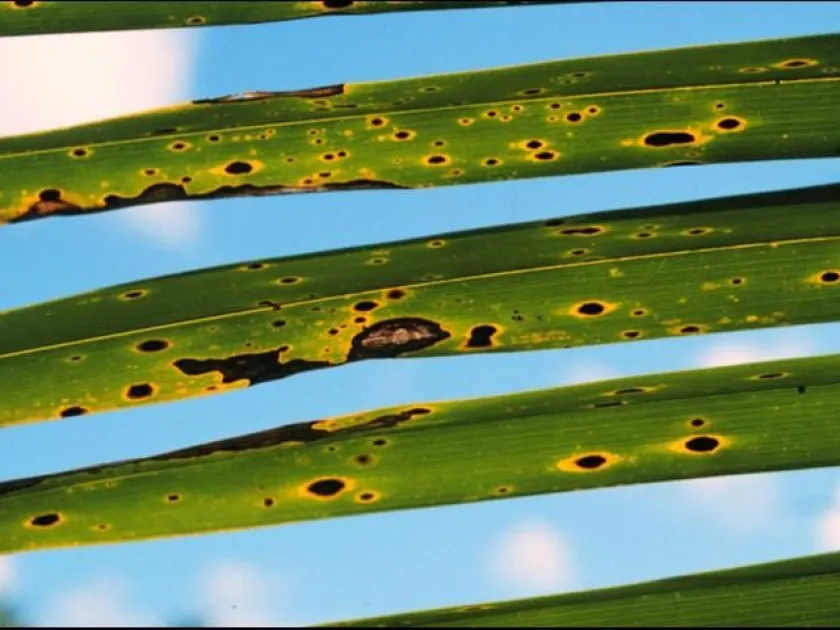
The primary symptoms of Phaeotrichoconis infection are spots on the leaves that are typically circular or elongated. Initially, these spots are light brown or yellowish in appearance.
As the infection progresses, the lesions expand and may coalesce, leading to large areas of necrotic tissue. These spots often develop a darker margin, creating a target-like appearance on the leaf.
Under conditions of high humidity, a characteristic velvety growth of the fungus can be observed on the surface of the lesions. This growth is typically olive-grey in color and represents active sporulation.
In severe cases, the necrosis extends to the petioles and stems, resulting in wilting and premature leaf drop. The overall health of the plant declines, and growth is significantly stunted.
- Light brown necrotic spots on leaves.
- Darker borders around lesion sites.
- Olive-grey fungal growth on the surface of spots.
- Premature yellowing and shedding of infected leaves.
- Reduced plant vigor and stunted development.
Pathogen
The disease is caused by the fungus Phaeotrichoconis crotalariae, which belongs to the group of mitosporic fungi. It is a specialized pathogen that affects a wide range of economically significant agricultural crops.
The pathogen colonizes plant tissues by entering through stomata or mechanical injuries to the leaf surface. Once inside, the fungal mycelium grows rapidly, causing localized cell death.
Reproduction occurs through the formation of conidia, which serve as the primary inoculum for spreading the disease. These spores are easily disseminated by wind, rain splashes, and farm equipment.
Phaeotrichoconis exhibits high persistence in the environment. It can survive for extended periods on crop debris left in the field or in the soil, acting as a reservoir for infection in subsequent seasons.
Laboratory identification of this fungus involves microscopic examination of the conidiophores and characteristic conidia, which allows agronomists to confirm the presence of the pathogen accurately.
Conditions for development
Favorable conditions for the development of Phaeotrichoconis include periods of high relative humidity, typically exceeding 85%. Free moisture on leaves from dew or rain is essential for spore germination.
The fungus thrives in warm temperatures, with the optimum range for mycelial growth and conidial production falling between 22 and 28 degrees Celsius.
Poor air circulation within dense canopies creates a microclimate that traps moisture, promoting rapid infection and spread. Wind-blown spores can easily colonize new plants within the same field.
Agricultural practices that leave large amounts of crop residue on the soil surface provide the necessary environment for the pathogen to overwinter and reinfect the next crop.
Plants under physiological stress, due to nutrient deficiencies or improper water management, show higher susceptibility to colonization by this fungal pathogen.
Why it matters
The primary damage caused by Phaeotrichoconis is a significant reduction in the plant's photosynthetic capacity, which directly results in lower biomass production and decreased crop yields.
In severe cases, the disease can lead to widespread plant senescence, resulting in uneven ripening and poor grain filling in affected cereal or pulse crops.
By weakening the plants, the infection also makes them more vulnerable to secondary pathogens and environmental stresses like drought or heatwaves.
Economic losses are compounded by the need for repeated fungicide applications, which increase production costs without guaranteeing complete recovery of the crop.
The reduced quality of the harvested product, including aesthetic damage to leafy vegetables or lower seed vigor, negatively impacts market value and distribution potential.
Protection
An effective management strategy begins with the implementation of a rigorous crop rotation program, ensuring that susceptible species are not planted in the same area too frequently.
Deep plowing or mechanical incorporation of crop debris into the soil immediately after harvest is vital to accelerate decomposition and reduce the survival rate of the pathogen.
The use of certified, disease-free seed and the application of appropriate seed treatments can prevent the introduction of the fungus into clean fields at the start of the season.
Chemical control involving systemic fungicides, such as triazoles or strobilurins, should be applied as soon as the first symptoms are detected to prevent the development of an epiphytotic.
Promoting overall plant health through balanced nutrient management and maintaining optimal plant spacing helps improve the plant's natural resistance to infection.
Discussion
No discussions yet — be the first.