
Pezicula rot
Pezicula
Description
Symptoms
The primary symptom of Pezicula infection is the formation of localized necroses on trunks and branches. Initially, these appear as sunken, brown or reddish-brown lesions.
As the disease progresses, the bark dies, cracks, and detaches from the underlying wood, forming characteristic irregular ulcers. The edges of these lesions are often raised due to the tree's attempt to isolate the infection through callus formation.
Small, cup-shaped fruiting bodies (apothecia) appear on the surface of the dead bark; these are typically light beige or brown and become highly visible during wet weather.
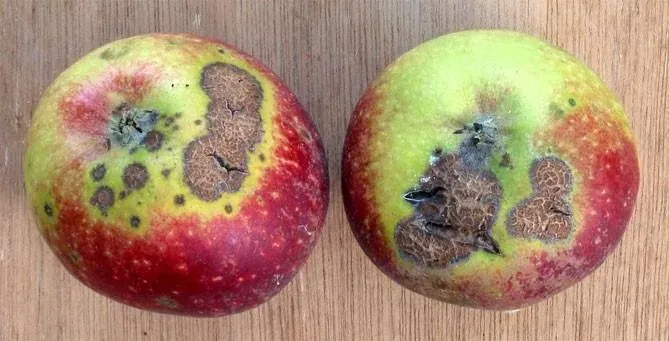
Fruits are also heavily affected, showing deep, spreading rot spots. A distinct sign of fruit infection is the presence of concentric circles of spores on the surface of the decaying tissue.
The internal flesh of the fruit softens, develops a bitter taste, and emits a peculiar odor, rendering the fruit completely unsuitable for commercial use or processing.
Pathogen
The disease is caused by fungi of the genus Pezicula, most notably Pezicula alba and Pezicula malicorticis. These ascomycete fungi are specialized pathogens of bark and pome fruits.
The life cycle of the pathogen involves the production of conidia and apothecia, which act as the primary inocula in orchards. The fungus can survive for extended periods in infected bark, mummified fruits, and organic debris.
The pathogen enters the plant tissues through mechanical wounds, cracks in the bark, sites of fruit attachment, or insect-induced wounds. Once inside, it develops as a necrotrophic parasite, gradually damaging the cambium layer.
Spore dissemination occurs primarily during cool and wet autumn and winter periods. Wind and rain splash effectively spread the spores to healthy bark or fruits, where they germinate under suitable moisture conditions.
A biological feature of Pezicula is its ability to remain latent within the bark, often causing invisible damage until the structural integrity of the branch is significantly compromised.
Conditions for development
Optimal conditions for Pezicula development include cool and rainy weather during the late growing season, particularly during the harvest period.
High moisture levels are critical, as persistent autumn rain promotes spore germination and entry into wounded bark or fruit surfaces.
Dense orchard planting with poor air circulation increases the risk of the pathogen spreading rapidly, as trapped moisture creates a perfect environment for fungal colonization.
Trees weakened by nutrient deficiency, frost damage, or sunscald are significantly more susceptible to infection compared to healthy, vigorous trees.
The presence of mummified fruits left hanging on branches or on the ground serves as a continuous reservoir for the pathogen, fueling outbreaks in subsequent seasons.
Why it matters
The primary damage caused by Pezicula is the severe reduction in fruit marketability, as latent infections lead to massive losses in storage shortly after harvest.
Infection of the main scaffold branches and trunks leads to extensive ulcers, which may girdle the branch, resulting in its death and significantly reducing the tree's productive capacity.
Trees affected by Pezicula exhibit decreased winter hardiness, making them highly vulnerable to cold damage and potentially leading to premature orchard decline.
Large-scale outbreaks necessitate expensive sanitation, including the pruning of large branches or the removal of entire trees, resulting in substantial long-term economic loss for growers.
The disease poses a major challenge for storage facilities, where even a small percentage of infected fruit can cause secondary rot across healthy produce batches.
Protection
Orchard sanitation is the cornerstone of control, requiring the systematic removal and destruction of all infected branches and mummified fruits.
Application of copper-based fungicides during late autumn or early spring is essential to reduce the inoculum load on the bark and dormant buds.
Maintaining optimal tree vigor through balanced fertilization prevents the development of excessive, succulent bark tissue that is prone to easy pathogen penetration.
All mechanical wounds on the trunk or branches caused by pruning or harvesting should be sealed with wound dressings or antiseptic compounds to prevent fungal entry.
Post-harvest management involves strict monitoring of temperature and humidity in storage facilities to minimize the spread of the pathogen among the stored fruit.
Discussion
No discussions yet — be the first.