
Pertusaria pertusa
Pertusaria pertusa
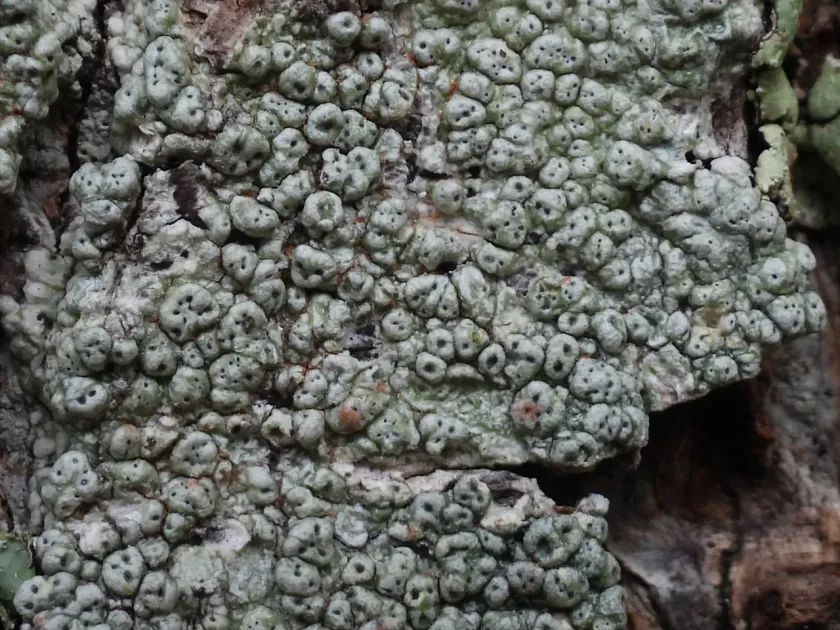
Description
Symptoms
The primary symptom is the appearance of light gray to whitish patches on the bark of trunks and main branches of trees.
These patches often have a rough, granular texture and may expand slowly over time to cover significant portions of the bark surface.
Under close observation, the characteristic pore-like structures (apothecia) are visible, which distinguish this species from other crustose lichens.
The colonies are frequently bordered by a thin, dark line that highlights their presence against the natural color of the tree bark.
Older trees with rougher bark textures are the most common hosts, as these surfaces provide better conditions for moisture retention.
Pathogen
Pertusaria pertusa is not a plant disease in the traditional agronomic sense, but rather a species of crustose lichen that grows on tree bark.
It is a symbiotic organism comprising a fungus and an alga, which utilizes the tree surface purely as a physical substrate for its growth.
The lichen does not parasitize the plant, as it obtains nutrients from the air and moisture rather than by tapping into the tree's vascular system.
The thallus of the lichen appears as a crusty, light-colored patch that is firmly attached to the bark of mature trees.
The specific name refers to the tiny, pore-like apothecia that develop on the surface, which look like small holes in the crusty thallus.
Conditions for development
High humidity and consistent rainfall are the primary environmental drivers that favor the colonization and spread of Pertusaria pertusa.
The species is highly sensitive to air quality; its presence is often considered a biological indicator of clean air and a stable ecosystem.
Poorly ventilated areas and dense canopies that prevent sunlight from hitting the trunk create environments conducive to lichen development.
Slow growth rates mean that colonization takes several years to become noticeable, usually occurring on stable, undisturbed bark surfaces.
Trees that are under environmental stress or have many bark fissures provide the initial sites for the spores of the lichen to germinate.
Why it matters
Pertusaria pertusa causes no direct physiological harm to trees, as it remains entirely on the surface of the bark without invading deeper tissues.
Indirectly, very thick mats of lichen may trap moisture against the bark, which can create a niche for secondary pests like scale insects.
Excessive lichen cover is often interpreted by orchardists as a sign of tree senescence or a lack of regular maintenance and pruning.
While not damaging, the presence of heavy lichen cover can be unsightly, detracting from the aesthetic value of ornamental garden trees.
The lichen does not compete with the tree for water or nutrients, as it is completely autotrophic and independent of the host's health.
Protection
Since it is an epiphyte and not a plant pathogen, no chemical fungicides are necessary or effective for the control of lichen species.
Mechanical removal by gently scrubbing the bark with a soft brush during the dormant season is the most effective way to clean the trunk.
Applying a lime wash to the trunks acts as a deterrent by creating an alkaline surface that is unsuitable for lichen spore attachment.
Regular pruning to allow better light penetration and airflow through the canopy effectively manages the environmental conditions favored by lichens.
- Mechanical cleaning of the tree bark.
- Regular pruning for air circulation.
- Application of lime wash to the trunk.
- Maintaining overall tree vigor through proper fertilization.
Discussion
No discussions yet — be the first.