
Philippine downy mildew of maize
Peronosclerospora maydis
Description
Symptoms
Initial symptoms include the appearance of chlorotic stripes on the leaves of young corn plants. These stripes typically become more pronounced over time, eventually covering most of the leaf surface with a pale yellow or whitish appearance.
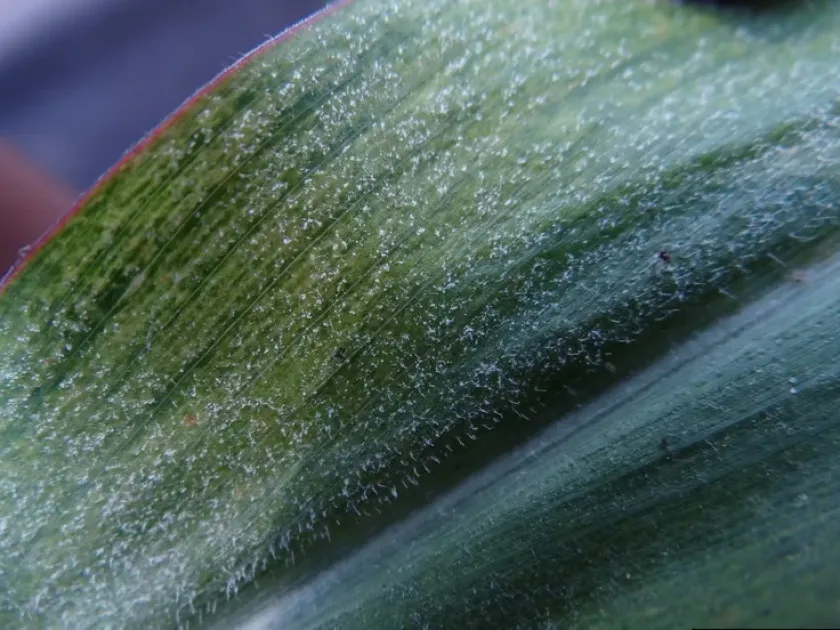
Under high humidity, a characteristic white or grayish fungal growth appears on the underside of the infected leaves. This layer consists of the pathogen's sporulation, which serves as the primary inoculum for secondary spread.
Infected plants exhibit severe deformity and stunting. Shortened internodes give the corn a bushy or dwarf appearance, a direct consequence of the systemic infection disrupting normal plant growth regulation.
The disease prevents the formation of healthy tassels or ears. Many infected plants remain completely barren or form malformed, sterile ears that fail to develop any grain, leading to total yield loss for those specific plants.
As the infection progresses, leaves become brittle, dry out, and turn brown prematurely. The plant loses its photosynthetic capacity, resulting in complete growth failure and the eventual death of the organism.
Pathogen
The causative agent of this disease is the obligate parasite Peronosclerospora maydis, an oomycete pathogen. It belongs to the group of downy mildew fungi known for causing systemic diseases in cereal crops throughout tropical and subtropical climates.
The pathogen's life cycle involves the production of sporangia, which are dispersed via wind currents during humid nights. It can persist in plant debris and infested seeds, making it a severe threat to corn production in conducive environments.
Unlike many other foliage diseases, this pathogen systemically colonizes the plant tissues, spreading through the vascular bundles. This systemic infection causes profound disruption of the plant's hormonal balance and developmental processes.
Peronosclerospora maydis is highly specialized to corn, although it may occasionally infect specific wild grass species. Its rapid sporulation allows it to colonize vast areas within a short period if environmental conditions are favorable.
Research into the genetic diversity of this oomycete is ongoing, as different strains exhibit varying levels of virulence. This necessitates continuous vigilance and the development of resistant corn hybrids to protect agricultural yields.
Conditions for development
The optimal conditions for the development of an epidemic include nighttime temperatures ranging between 20 and 25 degrees Celsius. High relative humidity, exceeding 90% during the night and early morning, is essential for spore germination.
Heavy dew, fog, or frequent rainfall events significantly facilitate the activation of the pathogen. These conditions shorten the incubation period, allowing the disease to spread rapidly through corn fields.
Monocropping and the failure to practice adequate crop rotation create a persistent reservoir for the pathogen. Corn debris left in the field allows the oomycete to survive between planting seasons and re-infect new crops.
High planting densities further exacerbate the issue by hindering airflow within the canopy. This creates localized pockets of high humidity, which are ideal environments for the rapid sporulation of Peronosclerospora maydis.
Corn is most susceptible during the early stages of development. Prolonged cloudy and rainy weather during the seedling emergence phase significantly increases the likelihood of a severe disease outbreak.
Why it matters
Philippine downy mildew is one of the most destructive corn diseases worldwide, capable of causing yield losses ranging from 80% to 100% in highly favorable conditions. It essentially renders the crop harvestable for nothing.
Economic losses arise from both the quantitative reduction in grain weight and the total loss of nutritional value. Infected plants are generally unsuitable for fodder due to their poor physiological state.
The disease suppresses the plant's immune system, making it more vulnerable to opportunistic secondary pathogens. This often leads to a complex decline, further reducing the overall health and stand uniformity of the field.
Seed production facilities face a major threat from this pathogen, as seeds harvested from infected areas can act as carriers for the disease. This leads to the implementation of strict international phytosanitary and quarantine regulations.
Global trade in maize is negatively impacted by the presence of this disease, as importing nations enforce strict quarantine measures to prevent the entry of the pathogen into disease-free regions.
Protection
The primary management strategy is the use of genetically resistant or tolerant corn hybrids. Breeding for resistance remains the most effective and sustainable tool for controlling Peronosclerospora maydis in endemic regions.
Agronomic practices, such as rigorous crop rotation, are essential to break the pathogen's lifecycle. Farmers should avoid planting corn on the same land for consecutive seasons to reduce inoculum buildup.
Seed treatment with high-quality systemic fungicides is a standard and highly effective preventive measure. Protecting the seedling during the first few weeks of growth is critical to preventing systemic infection.
Deep plowing after harvest helps bury and decompose crop residues, which reduces the survival rate of the pathogen. Effective sanitation of the field environment is a fundamental component of integrated disease management.
Early field monitoring and the prompt roguing (removal) of symptomatic plants can help localize an outbreak. This prevents the further spread of spores to healthy plants and minimizes the overall impact on the season's yield.
Discussion
No discussions yet — be the first.