
Penicillium mold
Penicillium steckii
Description
Symptoms
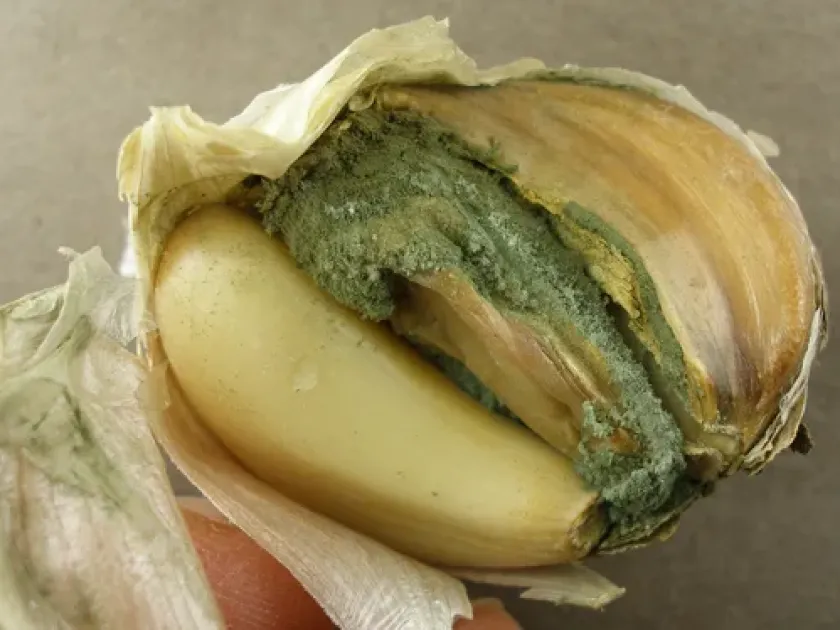
The characteristic sign of infection is the development of a dense, velvet-like fungal growth. Initially white, this mold typically turns a distinct blue-green or turquoise shade as sporulation occurs.
Infected tissues undergo a rapid decay process, becoming soft and watery. As the rot progresses, the structure of the host tissue collapses, often accompanied by a distinct, musty odor characteristic of Penicillium species.
In seeds and seedlings, the infection results in reduced germination rates and weakened growth. Necrotic patches may appear on the sprouts, leading to pre-emergence or post-emergence damping-off.
Within storage facilities, the infection spreads quickly from individual contaminated items to adjacent healthy ones, often leading to large clusters of rotten produce within a short period.
- Blue-green velvety mold growth on the surface.
- Soft, watery texture of infected plant tissue.
- Strong musty or moldy odor.
- Reduced seed viability and stunted seedling growth.
Pathogen
The disease is caused by the fungus Penicillium steckii, a member of the diverse Penicillium genus. This organism is highly adaptable and can exist as a saprophyte on decaying organic matter or as an opportunistic pathogen.
The fungus reproduces via vast quantities of conidia, which are easily dispersed by air currents and water splashes, ensuring its wide distribution in agricultural environments.
Penicillium steckii is metabolically active and capable of producing various mycotoxins during its growth cycle. These secondary metabolites can compromise the safety and nutritional quality of the infected produce.
The mycelium grows rapidly and invades host tissues, especially when the natural barriers such as the cuticle or skin of the fruit are damaged. Its ability to thrive in various substrates makes it a persistent threat.
The pathogen is known for its resilience and ability to survive adverse environmental conditions in the soil or on crop residues, remaining latent until favorable conditions trigger its germination.
Conditions for development
High relative humidity, typically exceeding 75–80%, is the primary requirement for the active development and spread of Penicillium steckii spores.
While the fungus thrives in temperatures between +15°C and +25°C, it remains capable of significant growth even at cooler temperatures common in cold storage units.
Mechanical injuries, such as bruises, cuts, or abrasions sustained during harvest or transport, are the main points of entry for the pathogen. Healthy, intact surfaces are much more resistant to infection.
Poor ventilation in storage areas creates stagnant air pockets and promotes the accumulation of moisture, which significantly accelerates the germination and spread of fungal spores.
Accumulation of dust and organic debris in storage facilities provides an ideal environment for the fungus to persist and re-infect subsequent batches of crops.
Why it matters
The primary economic impact is the loss of marketable produce due to decay and the resulting decrease in aesthetic appeal. Severely infected crops are usually discarded entirely.
Massive outbreaks in storage facilities can lead to substantial financial losses, as a small focal point of infection can quickly destroy entire consignments of harvested fruit and vegetables.
The accumulation of mycotoxins presents a serious health risk, making infected crops unsuitable for human or animal consumption, leading to the destruction of significant volumes of food.
In the field, the pathogen causes seedling blight and root rot, leading to poor plant establishment and reduced overall crop yields, necessitating costly replanting procedures.
The disease also negatively affects the reputation of producers, as contaminated supply chains can lead to rejection of shipments and long-term loss of contracts.
Protection
The most effective strategy is the minimization of mechanical damage during harvest and handling. Careful processing significantly reduces the risk of fungal entry.
Maintaining optimal storage conditions, including controlled humidity and efficient air circulation, is critical to prevent the proliferation of the mold.
Routine sanitation of storage facilities, including the disinfection of crates, pallets, and walls, is essential to eliminate residual spore loads before the start of a new season.
Sorting and removing any damaged or already infected items before placing them into long-term storage is a mandatory practice to prevent the spread of the pathogen.
Seed treatment with authorized systemic fungicides before planting provides a necessary layer of protection against soil-borne pathogens, ensuring healthier and more uniform crop emergence.
Discussion
No discussions yet — be the first.