
Penicillium rot
Penicillium simplicissimum
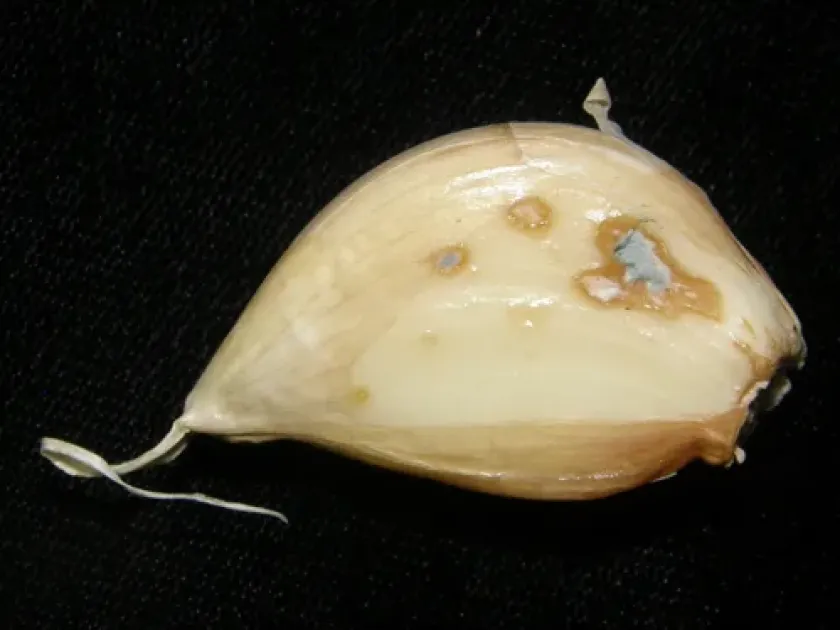
Description
Symptoms
The most prominent symptom is the development of a fuzzy, dusty, blue-green mold coating on infected plant surfaces, including fruits, tubers, bulbs, and seeds.
Infected areas exhibit soft, discolored spots, which eventually progress into widespread rot, often accompanied by a musty or moldy odor.
When seeds are infected, they often show reduced germination rates, and the surface of germinating seedlings can be covered with the characteristic fungal growth.
In stored produce, the disease manifests as rapidly expanding sunken lesions that may affect the entire item, leading to complete structural collapse of the tissue.
Under high humidity, the fungal mass becomes highly sporulated, facilitating quick transmission of the pathogen to healthy neighboring tissues within the storage crate.
Pathogen
The causal agent of this disease is the fungus Penicillium simplicissimum, a widespread saprotrophic organism belonging to the Penicillium genus. It can act as an opportunistic pathogen when conditions are favorable.
The fungus produces a sparse to dense mycelium, which quickly develops characteristic blue-green or grey-green conidiophores responsible for mass spore production.
Infection sources include soil, decomposing organic matter, and infested storage facilities, where the fungus persists as dormant spores or mycelial fragments.
Conidia are primarily dispersed by air currents, water splashes during irrigation, and through the movement of contaminated equipment or insect vectors.
The pathogen secretes potent extracellular enzymes, such as cellulases and pectinases, which degrade plant cell walls, allowing the fungus to colonize host tissues rapidly.
Conditions for development
Development of Penicillium simplicissimum is favored by high relative humidity (above 80%) and moderate temperatures, typically between 20°C and 25°C.
Poor ventilation in storage areas leads to moisture accumulation on product surfaces, providing an ideal environment for spore germination and colony establishment.
Mechanical damage caused by harvesting machinery, rough handling, or pests provides easy access for the fungus to penetrate healthy plant tissues.
Prolonged wet conditions in the field or inadequate drying after harvest are critical factors that promote the initiation of the infection process.
The presence of senescent or necrotic plant tissue also encourages the transition of this fungus from a saprophyte to an active pathogen.
Why it matters
Penicillium rot causes severe economic losses in the post-harvest sector, frequently leading to the rejection of entire batches of fruits and vegetables.
The reduction in seed viability and emergence leads to poor crop stands, necessitating replanting and increasing production costs.
Many Penicillium species produce mycotoxins that can contaminate food and feed, posing health risks to both human and animal consumers.
The disease causes significant quality deterioration, stripping the produce of its commercial value and nutritional appeal.
Rapid spread of the infection makes it difficult to manage once it has established itself within a storage environment without implementing strict quarantine measures.
Protection
Preventative measures focus on minimizing mechanical damage during harvest and ensuring thorough drying of produce before storage to inhibit fungal growth.
Maintaining optimal storage conditions, including temperatures near 0–2°C and relative humidity of 70–80% with effective air circulation, is essential.
Seed treatments using broad-spectrum fungicides are recommended to protect seedlings from soil-borne Penicillium inoculum during the initial germination phase.
Sanitation is paramount: regularly disinfecting storage warehouses, containers, and tools using effective fungicides or sanitizing agents is necessary to reduce inoculum levels.
- Implement strict crop rotation.
- Ensure proper soil drainage.
- Carefully cull infected specimens before storage.
Discussion
No discussions yet — be the first.