
Penicillium rot
Penicillium oxalicum
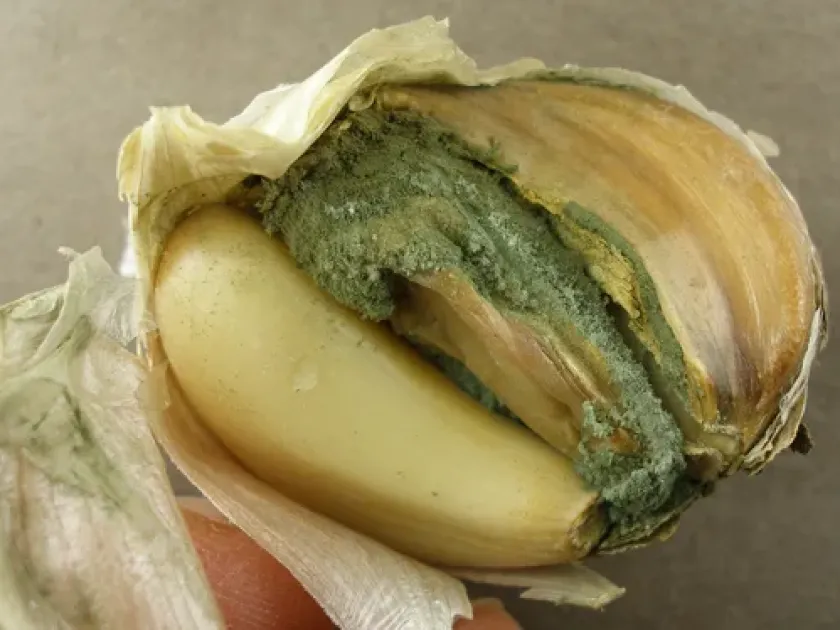
Description
Symptoms
The most visible symptom is the emergence of a powdery, blue-green or olive-colored fungal growth on the surface of seeds or decaying plant tissue.
Seeds infected with the fungus often show signs of decay, where the internal tissues become soft, discolored, and eventually disintegrate.
Seedlings affected by the pathogen typically exhibit stunted growth, brown lesions on the coleoptile, and may die before emergence (pre-emergence damping-off).
In stored produce, the rot spreads rapidly, creating pockets of infection characterized by a distinct, musty, moldy odor.
Root systems of young plants may appear necrotic and covered with a visible fungal mat, preventing nutrient uptake and leading to wilting.
Pathogen
The causative agent of the disease is the fungus Penicillium oxalicum, an anamorphic fungus from the Penicillium genus, commonly known as a soil-borne pathogen.
It survives in the soil and on crop residues as mycelium and conidia, demonstrating high resilience to environmental stressors.
The pathogen is known for its ability to produce secondary metabolites, including mycotoxins, which severely inhibit seed germination and seedling development.
Its conidia are easily dispersed by wind, water, and agricultural equipment, allowing for widespread distribution across fields and storage facilities.
Penicillium oxalicum acts primarily as an opportunistic pathogen, infecting tissues that are already weakened or physically damaged.
Conditions for development
High moisture levels in the soil or storage environment (above 75% relative humidity) are the primary drivers for the rapid development of the fungus.
Temperatures ranging from 20°C to 28°C are considered optimal for the fungal growth and sporulation of Penicillium oxalicum.
Mechanical injuries sustained during harvesting, cleaning, or planting act as entry points, making crops significantly more susceptible to infection.
Poor ventilation in storage facilities prevents the removal of moisture, creating a perfect microclimate for the fungus to multiply and spread.
Delayed harvesting or planting into cold, waterlogged soil exacerbates the risk of infection by prolonging the germination period of the seed.
Why it matters
The disease causes significant economic losses by drastically reducing seed germination rates and overall crop emergence in the field.
It compromises the uniformity of stands, leading to decreased yields and the potential necessity for costly replanting operations.
In storage, the pathogen can destroy large volumes of grain or produce, rendering the stock unfit for consumption or market sale.
The potential presence of mycotoxins in affected grain poses health risks to both humans and livestock if used for animal feed.
Increased production costs arise from the need for high-quality chemical seed treatments and the implementation of advanced climate control in storage systems.
Protection
Treating seeds with effective chemical or biological fungicides prior to planting is the most reliable method to prevent early infection.
Maintaining optimal storage conditions, including moisture levels below 13-14% and adequate aeration, is critical to stopping the rot.
Careful handling during harvest and processing is essential to minimize mechanical damage to seeds and fruit, thereby limiting infection sites.
Implementing crop rotation and selecting high-vigor seeds can help reduce the soil-borne inoculum pressure of the pathogen.
- Utilize high-quality, treated seed;
- Ensure rapid drying post-harvest;
- Maintain sanitation in storage areas;
- Avoid wounding during handling;
- Monitor humidity levels regularly.
Discussion
No discussions yet — be the first.