
Penicillium rot of gladiolus
Penicillium gladioli
Description
Symptoms
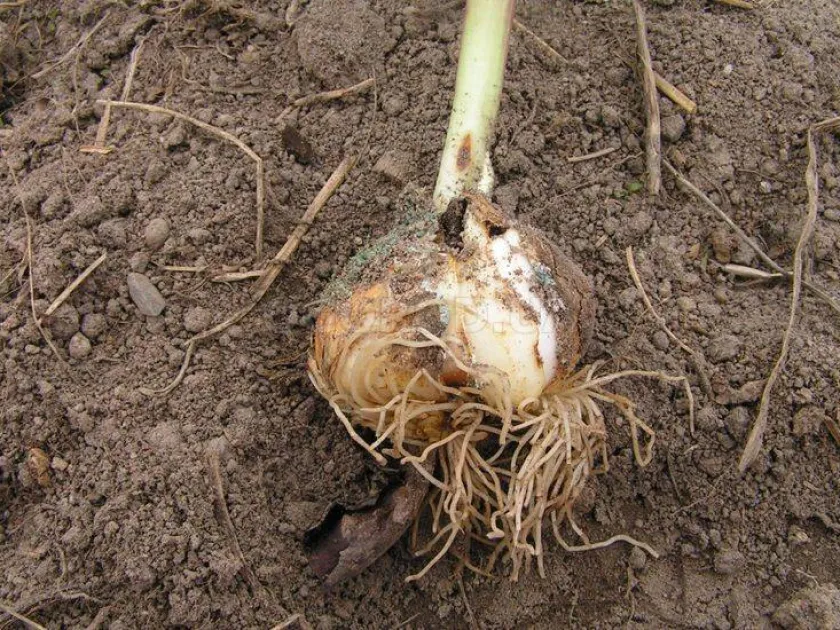
The first symptoms are typically observed during routine checks of stored corms. Small, sunken, yellowish-brown or reddish-brown spots appear on the surface of the corms.
As the disease progresses, a dense fungal growth develops on the lesions. This growth is initially white but soon turns into a characteristic bluish-green or grey powdery mass of spores.
Beneath the lesions, the corm tissue becomes soft, spongy, and brittle. In severe cases, the entire corm may rot away, turning into a brown, crumbly mass that lacks any firmness.
A distinct boundary often exists between the healthy and infected tissue. However, under high humidity, the rot spreads rapidly, potentially infecting adjacent corms within the same storage container.
If infected corms are planted in the spring, they often fail to emerge. Those that do sprout typically produce weak, chlorotic shoots that lack vigor and eventually wither due to basal rot.
Pathogen
The causative agent of this disease is the soil-borne fungus Penicillium gladioli, which belongs to the class of deuteromycetes. The pathogen is highly persistent, surviving in soil and plant debris as mycelium and conidia for several years.
This fungus primarily infects gladiolus corms during the storage period. The infection typically enters plant tissues through mechanical wounds sustained during harvesting, cleaning, or handling processes.
The pathogen functions as a saprotroph, rapidly colonizing damaged or weakened tissues. By secreting specific enzymes, the fungus breaks down the cell walls of the corm, leading to a loss of structural integrity.
The biology of the fungus allows it to spread via airborne conidia or through contaminated equipment, storage crates, and knives, making it a difficult pathogen to eradicate once it establishes itself.
While primarily associated with gladiolus, the fungus can also affect other bulbous crops when storage conditions are suboptimal, highlighting its wide host range in a storage environment.
Conditions for development
High relative humidity is the primary driver for the development of Penicillium rot. Environments with humidity levels exceeding 70-80% provide the moisture necessary for fungal proliferation.
Temperature fluctuations are equally critical; they cause condensation to form on the surface of the corms, which acts as a catalyst for spore germination and rapid fungal colonization.
Mechanical damage to the corm's protective outer husks or the basal plate serves as the primary entry point for the pathogen, significantly increasing the risk of infection after harvest.
Poor ventilation within storage facilities prevents the dissipation of moisture, creating stagnant conditions that favor the rapid transmission of spores from infected corms to healthy ones.
Insufficient curing or drying of corms immediately after digging is a major management error that leaves the plant tissues vulnerable to attack during the critical initial weeks of storage.
Why it matters
Penicillium rot causes significant economic losses for commercial growers and hobbyists alike, as it can destroy an entire season's worth of planting stock during the dormancy period.
The insidious nature of the disease makes it particularly damaging, as infected corms may appear healthy at the start of storage but be completely ruined by the time planting season arrives.
Once introduced to a field, the pathogen persists in the soil, which can complicate the rotation cycles and necessitate the use of soil fumigants or longer intervals between planting gladiolus in the same area.
Planting infected corms leads to poor stand density and reduced vitality, which translates into lower quality flowers and a diminished aesthetic value for the garden or commercial harvest.
The persistence of the fungus on storage surfaces and equipment ensures that the disease remains a recurring threat, requiring constant vigilance and rigorous sanitation protocols.
Protection
- Thoroughly cure corms at 25-30°C for 1-2 weeks immediately after harvest to ensure tissues are dry.
- Cull any corms showing signs of damage, bruising, or decay before placing them in long-term storage.
- Maintain optimal storage conditions: temperatures between 3°C and 6°C and humidity below 60%.
- Apply appropriate fungicidal dips or dusts to protect corms both before storage and prior to planting.
- Sanitize all storage containers, shelving, and tools with professional-grade disinfectants to eliminate residual fungal spores.
Discussion
No discussions yet — be the first.