
Sandy penicilliosis
Penicillium arenicola
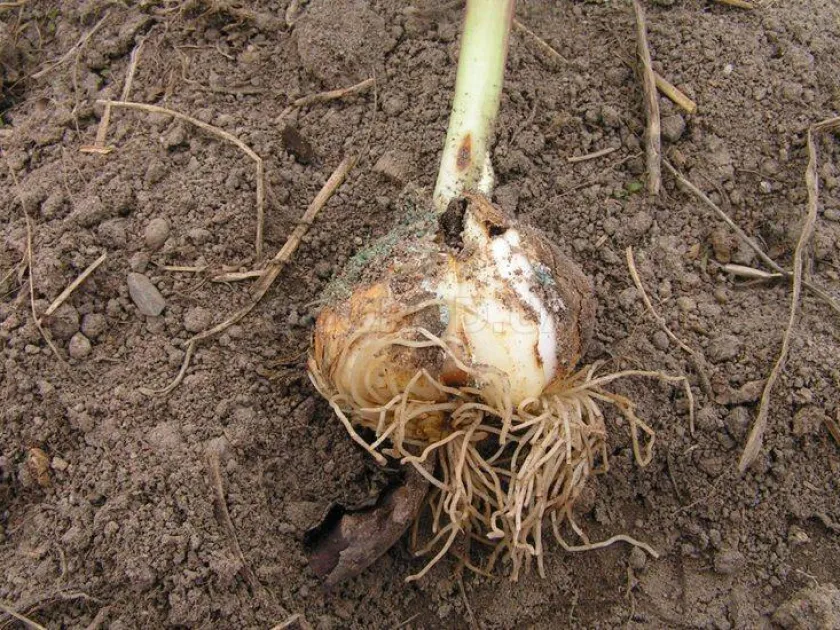
Description
Symptoms
The most visible symptom is the appearance of a dusty, blue-green or grey-green moldy layer on affected plant parts, including seeds, roots, and lower stems.
In seeds, the infection causes discoloration and rotting. Often, the germ is destroyed before the seedling emerges, resulting in poor stand establishment in the field.
Root symptoms include the development of necrotic lesions. As the disease progresses, the root system decays, leading to stunted growth and yellowing of the foliage due to impaired nutrient uptake.
In storage conditions, infected produce displays typical signs of blue mold rot. The mycelium penetrates deeply into the tissues, causing structural softening and decay.
- Dusty blue-green mycelial growth on plant surfaces.
- Poor germination and pre-emergence damping-off.
- Root necrosis and decay of root hairs.
- Stunted growth and chlorosis in affected seedlings.
- Moldy odor in storage facilities.
Pathogen
The causative agent of this disease is the microscopic fungus Penicillium arenicola, which belongs to the genus Penicillium. It is a soil-borne fungus that is widely distributed and can act as both a saprotroph and a weak parasite.
The pathogen is highly resilient, capable of surviving in various types of soil. It produces vast amounts of conidia, which act as the primary inocula for spreading the infection to healthy plants.
Penicillium arenicola thrives in the rhizosphere, where it can interact with plant roots. Under favorable conditions, the mycelium invades the host tissues, secreting enzymes that break down plant cells.
The fungus is known for its ability to persist in the soil for extended periods, even when host plants are not present. This longevity makes it a persistent threat in agricultural fields.
Mycotoxin production is a significant aspect of its biology. These toxic compounds can interfere with seed germination and affect the overall health of young seedlings.
Conditions for development
High relative humidity is the most critical environmental factor for the development of Penicillium arenicola. The fungus prefers moist environments, with optimal activity occurring at humidity levels above 75%.
Temperature plays a vital role, as the fungus is most active in moderate temperatures, typically ranging from +18°C to +25°C. Rapid growth is often observed during mild, damp springs.
Poor soil aeration and waterlogging create anaerobic conditions that weaken the plant roots, making them highly susceptible to fungal invasion.
Mechanical injuries, whether caused by insects, improper cultivation, or rough handling during harvest, provide easy entry points for the fungal spores.
Imbalanced nutrient availability, specifically an excess of nitrogen or a deficiency of micronutrients, can reduce a plant’s natural resistance, promoting infection.
Why it matters
The primary economic impact is the reduction in crop yield due to poor germination rates. This requires costly reseeding and results in uneven field maturity.
Plants that survive an early infection often remain weak and unproductive. Their inability to establish a robust root system limits their yield potential significantly.
Mycotoxin accumulation in the seeds and plant tissues poses a serious risk to food safety and livestock health, rendering the harvest unsuitable for consumption.
The persistence of the pathogen in the soil means that the disease can become a recurring problem, limiting the viable crop rotation options for farmers.
Fast-spreading spores allow the disease to move rapidly through a field, making early detection and intervention essential to avoid significant losses.
Protection
Effective control begins with the use of high-quality, fungicide-treated seeds. Systemic seed dressings provide essential protection during the vulnerable germination phase.
Proper harvest management is crucial. Crops should be harvested under dry conditions, and storage areas must be kept clean, well-ventilated, and moisture-controlled.
Good agricultural practices, such as ensuring proper soil drainage and optimizing sowing depth, help create conditions that discourage the rapid development of the fungus.
Balancing soil pH and fertility through appropriate fertilization helps improve plant vigor, enabling crops to better withstand environmental and biological stresses.
Monitoring the fields for early symptoms and applying appropriate fungicides during the vegetative stage can help contain outbreaks and protect the crop until maturity.
Discussion
No discussions yet — be the first.