
Potato blackleg
Pectobacterium atrosepticum
Description
Symptoms
Early symptoms appear on emerging shoots as leaf yellowing, wilting, and upward curling. The upper leaves often become narrow and exhibit a pale green or yellowish coloration.
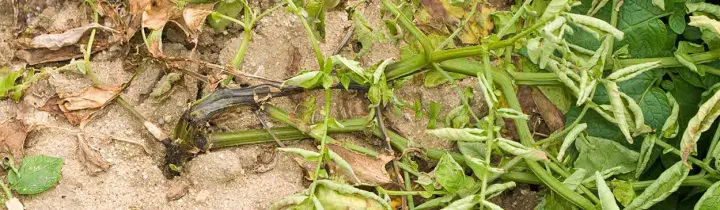
The characteristic sign of the disease is the darkening and rotting of the lower stem. The tissue at the base of the plant turns charcoal-black, becomes soft, and eventually disintegrates.
When tubers are affected, the internal flesh softens and turns into a cream or black-colored mushy substance. In advanced stages, the entire tuber can be destroyed by soft rot.
Affected plants have a restricted and decaying root system. Because the stem base is compromised, such plants can be easily pulled out of the ground with minimal effort.
In the field, the disease typically appears as patches of stunted or collapsed plants, leading to irregular gaps in the rows of the potato crop.
Pathogen
Potato blackleg is caused by the gram-negative bacterium Pectobacterium atrosepticum. This pathogen is a highly mobile, rod-shaped bacterium belonging to the family Pectobacteriaceae.
The bacterium secretes powerful pectinolytic enzymes that degrade the plant cell wall, causing cells to collapse and turn into a slimy, foul-smelling mass. This process is the primary cause of tissue decay.
The pathogen can survive in soil, in crop debris, and systemically within the potato tubers in a latent form. This makes it particularly difficult to eliminate once it has established itself in a field.
While potato is the primary host, the bacterium can also infect other solanaceous crops and various vegetable species, demonstrating a broad host range and high environmental adaptability.
Insects, particularly seedcorn maggots, play a significant role as vectors by mechanically transferring bacteria to healthy tissues during their feeding process on potato stems and tubers.
Conditions for development
The development of blackleg is strongly favored by wet and cool soil conditions, especially during the early growth stages of the potato crop after planting.
High soil moisture creates anaerobic conditions, which are ideal for the rapid multiplication of Pectobacterium atrosepticum. Poorly drained fields with compacted soil are at the highest risk.
Wounds on tubers created during harvesting, sorting, or handling provide entry points for the bacteria. If these wounds are damp, the infection progresses extremely rapidly.
Temperatures above 20°C in combination with high humidity significantly accelerate the rot, leading to widespread infection within the storage facility or the field.
Lack of crop rotation and the use of infected, untreated seed potatoes are the two most common factors leading to outbreaks of the disease in commercial farming.
Why it matters
The main impact of blackleg is the significant reduction in plant stand density, which leads to substantial yield losses. Many plants may die shortly after emergence.
Tubers that appear healthy at harvest can develop severe soft rot during storage, potentially destroying large portions of the harvest if ventilation is inadequate.
Infected lots of potatoes become unsuitable for marketing due to the foul odor and the presence of decay, causing massive economic losses for producers.
The disease limits the use of home-grown seed material, forcing farmers to bear the recurring cost of purchasing certified, disease-free seed every year.
Bacterial contamination reduces the overall plant vigor, resulting in smaller, lower-quality tubers that do not meet size or grade requirements for premium markets.
Protection
The most important control strategy is to use certified, high-quality, disease-free seed potatoes. Testing seed lots for latent bacterial infection is highly recommended.
Implementing a strict crop rotation cycle of at least 3–4 years helps reduce the bacterial population in the soil, preventing the buildup of inoculum.
Proper storage management is critical: tubers must be thoroughly dried and stored at cool temperatures with excellent air circulation to minimize the risk of spreading rot.
Minimizing mechanical damage during harvest and handling is essential to prevent bacterial entry, as healthy tubers are much more resistant to infection.
- Rogueing infected plants from the field as soon as symptoms are detected.
- Treating seed potatoes with approved bactericides before planting.
- Managing insect populations that could act as vectors for the pathogen.
- Planting resistant or tolerant potato cultivars to reduce disease incidence.
Discussion
No discussions yet — be the first.