
Parmeliella plumbea
Parmeliella plumbea
Description
Symptoms
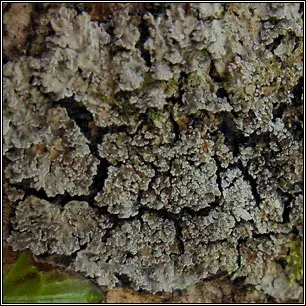
The primary visual sign of Parmeliella plumbea is the development of lead-gray or blue-gray foliose thalli on the bark of older trees.
The thallus edges are typically uplifted and scalloped, giving the lichen a distinct velvet-like texture upon closer inspection.
In mature colonies, one can observe brown apothecia, which are the reproductive structures of the fungal component, distributed across the thallus surface.
The growth pattern is generally circular or rosette-like, covering specific patches of the tree trunk without compromising the integrity of the underlying bark.
Under humid conditions, the lichen's color becomes more intense, making it easily distinguishable from the surrounding tree bark.
Pathogen
Parmeliella plumbea is a leafy lichen belonging to the Pannariaceae family. It is crucial to distinguish this organism from plant pathogens, as it does not cause any diseases in agricultural or forest crops.
The organism is an epiphyte, meaning it uses the bark of trees solely as a substrate for attachment. It does not extract nutrients or moisture from the tree itself.
The biology of Parmeliella plumbea involves a symbiotic relationship between a fungus and Nostoc cyanobacteria, which enables atmospheric nitrogen fixation.
It thrives in natural environments where it functions as a neutral component of the ecosystem, posing zero threat to the plant's health or productivity.
In modern agricultural settings, its presence is rarely observed due to the high sensitivity of this species to air pollution and chemical pesticides.
Conditions for development
Parmeliella plumbea thrives in environments characterized by high humidity, such as temperate rainforests or areas near water bodies.
It requires stable climatic conditions, as it is highly sensitive to rapid fluctuations in temperature and periods of extreme desiccation.
A crucial factor for its survival is air purity; it is an excellent bioindicator of clean air and disappears rapidly in industrialized or polluted areas.
The growth rate of this lichen is exceptionally slow, reflecting the stability of the environment over many years.
It prefers trees with specific bark chemistry, typically found in old-growth woodlands rather than highly managed orchard plantations.
Why it matters
This lichen is completely harmless to host plants. It does not possess structures like haustoria that would allow it to parasitize the tree's living tissues.
Concerns about lichens "suffocating" trees are scientifically unfounded, as the bark's physiological gas exchange remains unaffected by the presence of this epiphyte.
There is no evidence linking Parmeliella plumbea to reduced crop yields, nutrient deprivation, or structural decline of the host tree.
It does not serve as a vector for viruses or fungi, making it an ecologically benign resident of the forest or garden habitat.
In professional arboriculture, the presence of such lichen is often viewed as a positive sign of healthy air quality and ecological stability.
Protection
There are no control measures for Parmeliella plumbea, as it is not a pest or a disease and does not require management in any agricultural capacity.
If you prefer to maintain clean tree trunks for aesthetic reasons, gentle mechanical brushing is sufficient; chemical intervention is neither necessary nor recommended.
Effective orchard management focuses on plant nutrition, pruning, and protection from actual fungal or insect pests, rather than targeting benign lichens.
Maintaining a healthy tree through proper irrigation and fertilization will naturally balance the presence of epiphytic flora on the bark.
- Monitor tree health through regular professional assessment.
- Maintain proper air circulation through pruning.
- Avoid unnecessary chemical spraying near lichen habitats.
- Protect old-growth specimens in integrated land management.
Discussion
No discussions yet — be the first.