
American foulbrood
Paenibacillus larvae
Description
Symptoms
The most visible symptom is an irregular, "spotty" brood pattern, where patches of sealed cells are interspersed with empty cells, indicating high larval mortality.
Cappings over infected cells often appear sunken, greasy, and darkened. They may also have small, irregularly shaped perforations where nurse bees have attempted to clean the cell.
Inside the cell, the larva turns from a creamy white to a chocolate brown color. As it decomposes, it develops a characteristic pungent, glue-like odor.
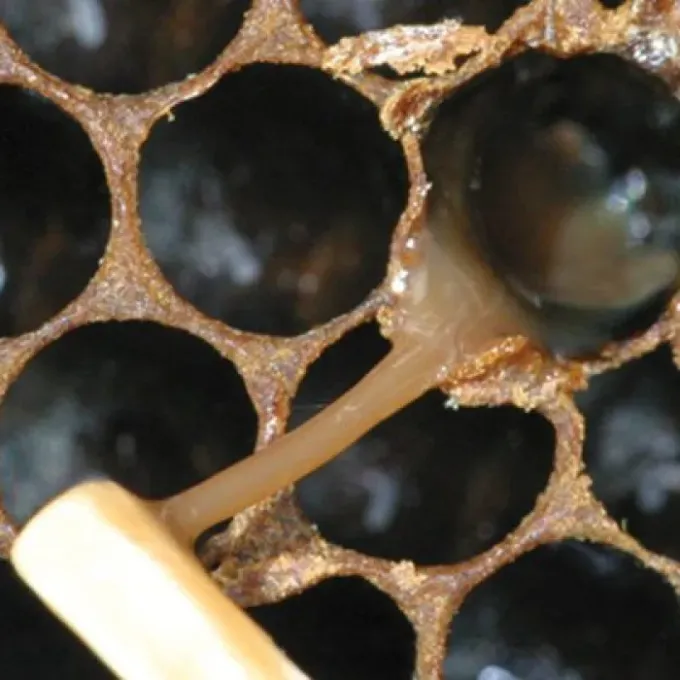
The "ropey test" is the gold standard for field diagnosis: inserting a matchstick into the cell and pulling it out produces a viscous, elastic thread of decaying larval tissue.
Once the decay is complete, the larva dries into a hard, dark scale that adheres firmly to the cell wall, making it impossible for bees to remove it.
Pathogen
American foulbrood (AFB) is a devastating infectious disease affecting the larval stages of honey bees. Despite the name, it is a bacterial pathology of insects, not a plant disease.
The causative agent is the spore-forming bacterium Paenibacillus larvae. Its spores are exceptionally resilient, surviving for decades in old comb, honey, and hive equipment.
The infection begins when young larvae ingest the spores while being fed by nurse bees. In the larval gut, the spores germinate, and the bacteria begin to multiply rapidly.
The disease exclusively targets the sealed brood. Once a larva dies, the bacteria switch to spore production, resulting in millions of new infectious spores in a single cell.
Because the spores are microscopic and extremely hardy, the disease is notoriously difficult to eradicate from a hive once the infection has become established.
Conditions for development
The spread of AFB within an apiary is frequently caused by drift of bees or the exchange of contaminated equipment, such as frames, between infected and healthy colonies.
Robbing behavior is a primary transmission route, where bees from a healthy colony invade a diseased hive to steal honey, unknowingly carrying spores back home.
Management practices that involve pooling resources, such as merging weak colonies without checking for disease, significantly increase the risk of an outbreak.
Environmental conditions, such as humidity within the hive, do not directly trigger the disease, but poor management can lead to colonies that are more susceptible to infection.
Purchasing bees or equipment from uncertified sources remains a high-risk activity that frequently introduces the pathogen to otherwise clean apiaries.
Why it matters
AFB is one of the most destructive diseases in beekeeping. If left untreated, it almost always leads to the total loss of the colony and poses a risk to the entire apiary.
The economic impact is profound due to the loss of hive productivity, the cost of incinerating contaminated equipment, and the loss of commercial colony value.
Because of its highly contagious nature, local authorities often impose strict quarantine measures that restrict the sale of bees and honey from affected areas.
Even after a colony appears to have recovered, the hidden presence of spores can lead to sudden, severe flare-ups months or years later.
The psychological and labor-intensive toll on beekeepers is immense, as managing an AFB outbreak requires constant vigilance and strict adherence to sanitation protocols.
Protection
The most common and effective management strategy is the "shook swarm" method, which involves transferring the bees to a fresh hive with new foundation and destroying the old combs.
In many regions, burning the entire hive, including the bees and equipment, is the mandatory legal requirement to prevent the spread of the pathogen to neighboring apiaries.
Scrubbing and scorching the inside of hive bodies with a blowtorch can help eliminate spores, though this must be done thoroughly to be effective.
All contaminated frames and honey must be securely stored or destroyed to ensure that bees cannot access and recycle the spores back into the population.
Preventive measures include regular inspection of brood frames, avoiding the purchase of used equipment, and maintaining strong, healthy colonies through good nutrition.
Discussion
No discussions yet — be the first.