
Oudemansiella mucida
Oudemansiella mucida
Description
Symptoms
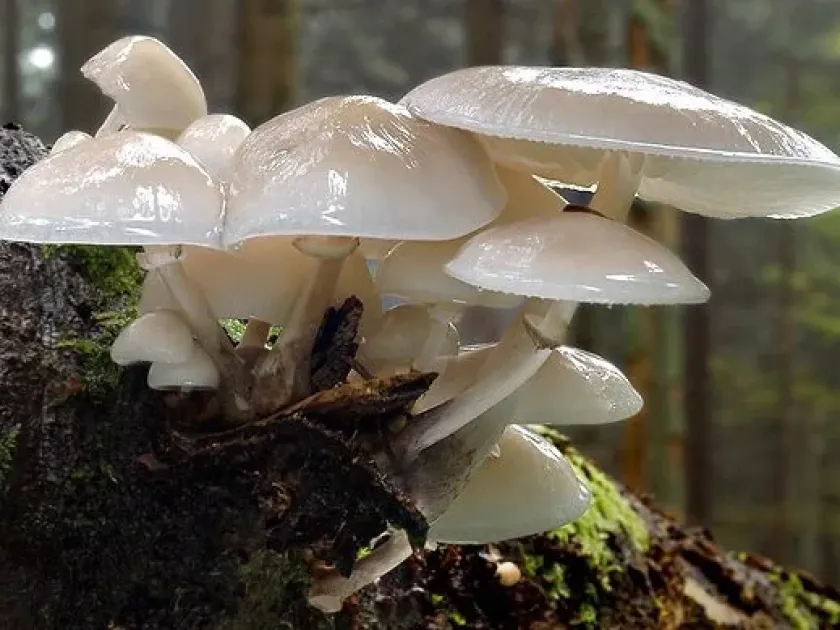
The primary diagnostic sign of Oudemansiella mucida is the appearance of striking, porcelain-white or cream-colored fruit bodies on the bark of living or dead trees.
The caps of these fruit bodies are covered with a thick, slimy, gelatinous layer, which gives them a shiny and distinct appearance, especially during wet weather conditions.
Internally, the pathogen causes white rot of the heartwood. Infected wood becomes pale, soft, and loses its structural integrity, often showing a fibrous texture.
As the mycelium progresses, bark cracking and necrosis become visible near the point of infection, eventually leading to bark sloughing in heavily colonized areas.
The fungus often forms clusters, making it highly visible on the trunks and branches of infected beech trees, signaling advanced colonization of the host's wood.
Pathogen
The causative agent is the xylo-trophic fungus Oudemansiella mucida, commonly known as the porcelain fungus. It is classified within the Physalacriaceae family.
This fungus acts as a facultative parasite, primarily attacking weakened wood but also capable of surviving as a saprotroph on dead organic matter.
It spreads via basidiospores dispersed by wind and rain, which germinate upon contact with wounds or exposed wood tissues on the host tree.
The mycelium colonizes the cambium and sapwood, secreting specific enzymes to break down complex lignin and cellulose structures, resulting in white rot.
The life cycle is moisture-dependent, with fruit bodies typically developing during the autumn or after periods of high humidity, facilitating further spore dispersal.
Conditions for development
Development is favored by environments with high humidity and moderate temperatures, which are typical in dense, unmanaged deciduous forest stands.
Trees that have suffered from environmental stress—such as prolonged drought, heavy pruning, or mechanical injuries—are significantly more susceptible to infection.
Poor airflow within a stand prevents the bark from drying quickly after rainfall, creating the perfect moisture level for spore germination and mycelial growth.
The fungus thrives in temperate climates where the seasonal temperature range allows for sustained fungal metabolism over several months of the year.
Primary entry points for the fungus are often pre-existing bark wounds or structural weaknesses, as the fungus is generally unable to penetrate perfectly intact, healthy bark.
Why it matters
The fungus causes severe wood decay, significantly reducing the mechanical strength of the trunk and branches, which leads to a high risk of tree failure and limb breakage.
Economically, infected timber loses its commercial value due to the degradation of the wood structure, making it unsuitable for high-quality lumber or carpentry purposes.
In forest ecosystems, the fungus acts as a decomposer but can become a nuisance in managed landscapes by destabilizing mature trees, posing safety risks to public paths.
Continuous infection weakens the tree's vigor, making it less resilient to other biotic or abiotic stresses, eventually shortening the lifespan of the host plant.
Large-scale infestation within a stand can lead to a significant decline in the biological diversity and economic productivity of the affected forest area.
Protection
The most effective management strategy is the early identification and removal of heavily infected trees through sanitary thinning to prevent spore spread.
Promoting overall tree health through proper maintenance, such as minimizing mechanical damage and treating exposed wounds with antifungal sealants, helps prevent infection.
Thinning out dense stands improves air circulation and increases solar exposure, which naturally reduces the moisture levels required for the fungus to flourish.
- Removal of infected woody debris;
- Sanitary pruning of affected branches;
- Wound care and protective painting;
- Forest stand density management;
- Regular monitoring of tree bark integrity.
While chemical fungicides are generally not practical for broad forest application, targeted applications may be used in botanical gardens or historic parks to preserve valuable specimens.
Discussion
No discussions yet — be the first.