
Dutch elm disease
Ophiostoma novo-ulmi
Description
Symptoms
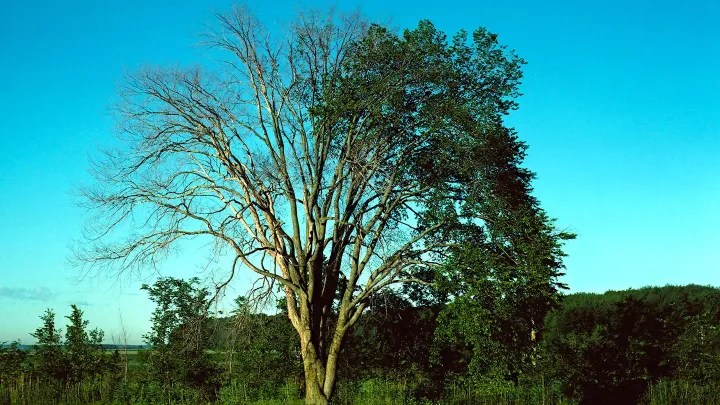
The first tell-tale sign of Dutch elm disease is the sudden wilting and yellowing of leaves on one or more branches, often referred to as flagging.
A closer inspection of the affected twigs often reveals characteristic brown or black streaking in the outer sapwood, visible when the bark is peeled back.
As the infection advances, the canopy begins to thin significantly, and entire branches may die off within a very short period during the growing season.
Small shot-holes on the bark indicate the presence of elm bark beetles, which are the primary vectors responsible for introducing the fungus into the tree.
In advanced stages, the tree will lose almost all its foliage, leading to rapid decline and eventual death of the entire specimen within a single season.
Pathogen
The disease is caused by the highly aggressive fungus Ophiostoma novo-ulmi, which invades the vascular system of elm trees.
The fungus produces spores that are transmitted by beetles, colonizing the tree's xylem and producing toxins that impede the transport of water and nutrients.
Its life cycle includes both a yeast-like state and a mycelial state, allowing the pathogen to thrive and proliferate rapidly within the host's conductive tissues.
This pathogen has evolved to exploit the beetle's biology, ensuring that as the insect moves to feed on new trees, it carries the fungal spores with it.
Ophiostoma novo-ulmi is exceptionally lethal, and its ability to spread rapidly has resulted in the loss of millions of elm trees across the globe.
Conditions for development
Transmission occurs primarily through the activity of elm bark beetles, which seek out weakened or stressed elm trees to feed and breed.
The disease can also spread underground through root grafts, where the root systems of adjacent elm trees are fused, allowing the fungus to move from tree to tree.
Warm and humid weather conditions during spring and early summer significantly favor both the movement of beetles and the rapid growth of the fungus.
Trees located in areas with high density of elms are at a greater risk of infection because root grafting is more common in such environments.
Environmental stress factors, such as drought, flooding, or mechanical damage, can make elm trees more attractive to the beetles that carry the fungal spores.
Why it matters
Dutch elm disease is considered one of the most destructive tree diseases, causing massive loss of heritage trees and altering landscapes permanently.
The ecological impact is significant, as elms provide essential habitat for various organisms, and their disappearance leads to a loss of local biodiversity.
Economically, municipalities face immense costs associated with the removal of dead trees and the potential liability risks posed by falling branches.
The disease has decimated urban tree populations, forcing cities to replace majestic elms with other, sometimes less suitable, tree species.
In forest ecosystems, the loss of elms affects forest structure and species composition, often leading to an increase in invasive plant growth in gaps left behind.
Protection
The most critical step in management is the early detection and immediate removal of infected trees to prevent further spread of the fungus.
Trenching or severing root connections between healthy and diseased trees is necessary to stop the spread of the fungus through underground root grafts.
Using pheromone traps helps monitor and reduce the population of elm bark beetles, thereby lowering the probability of new infections in a local area.
Planting resistant cultivars is the most effective long-term strategy for maintaining elms in residential landscapes and urban environments.
Professional systemic fungicide injections are available for high-value individual trees as a preventative treatment, though they must be applied consistently.
Discussion
No discussions yet — be the first.