
Hevea powdery mildew
Oidium heveae
Description
Symptoms
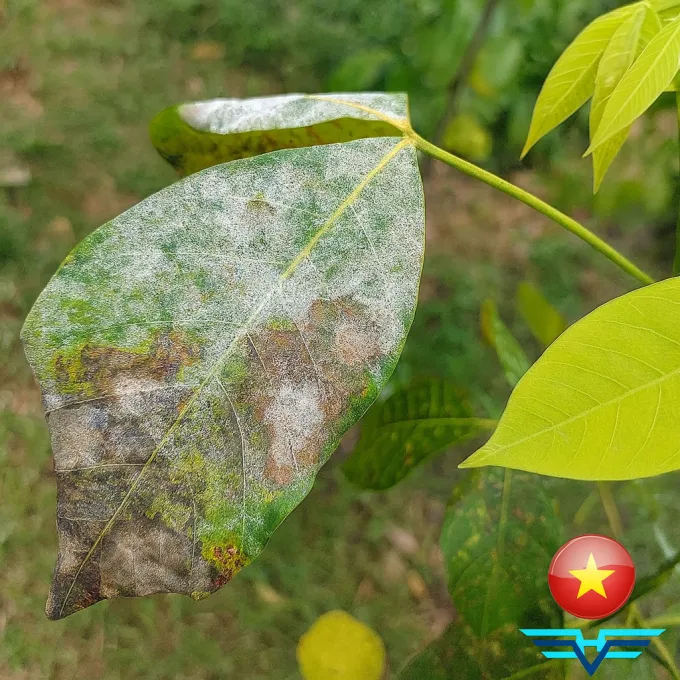
The most characteristic sign is the appearance of white, powdery mycelial patches on the underside and upper surface of tender, young leaves.
Infected leaves often become distorted, curled, and brittle, leading to severe and premature defoliation of the tree canopy.
The fungus may also infect developing shoots, resulting in necrosis and the death of apical buds, which stunts the overall growth of the plant.
Inflorescences frequently show signs of infection, appearing covered in white fungal spores, which leads to flower abortion and poor pod set.
As the infection matures, the initially white patches may turn greyish or brownish, especially as the leaf tissue undergoes necrotic changes.
Pathogen
The causal agent of this disease is the fungal pathogen Oidium heveae, a specialized parasite that exclusively infects the rubber tree (Hevea brasiliensis).
The fungus is an obligate biotroph, meaning it requires living host tissue to complete its life cycle and derive essential nutrients.
It propagates via airborne conidia, which allow the pathogen to disperse rapidly throughout rubber plantations under favorable conditions.
Oidium heveae colonizes the epidermis of young leaves, shoots, and inflorescences, forming an extensive network of hyphae on the surface.
The pathogen is highly adapted to the host, ensuring efficient exploitation of resources while maintaining its survival through successive leaf flushing cycles.
Conditions for development
The development of Oidium heveae is strongly favored by high relative humidity and cool to moderate temperatures typical of highland rubber regions.
Dew formation and misty mornings are critical environmental drivers that promote the rapid germination of conidia and infection of susceptible tissue.
The disease is most prevalent during the annual refoliation period when a large amount of succulent, susceptible young leaf tissue is present.
High planting density and lack of proper canopy ventilation create microclimates with increased humidity, which significantly exacerbates disease outbreaks.
Periods of dry, hot weather generally inhibit the spread of the fungus, as direct sunlight and low humidity are detrimental to spore viability and hyphal growth.
Why it matters
The economic impact of powdery mildew is significant, primarily due to the reduction in photosynthetic capacity following heavy defoliation.
Chronic infection results in lower latex yields, as the tree redirects energy from latex production toward recovering its leaf canopy.
Young, immature trees are particularly affected, as the disease can lead to delayed growth and increased time required before the start of tapping.
Repeated defoliation events weaken the trees, making them more susceptible to other secondary pathogens and environmental stresses.
Large-scale outbreaks can cause substantial financial losses, necessitating costly fungicide applications across extensive plantation areas.
Protection
Sulfur dusting is the most common and effective method for controlling powdery mildew, widely applied via mechanical blowers or aircraft.
Implementing a robust monitoring program is essential to time fungicide applications precisely with the flushing phase of the rubber trees.
Breeding and selecting clones with genetic resistance to Oidium heveae is considered the most sustainable long-term strategy for managing the disease.
Improved plantation management, including proper tree spacing, helps to decrease canopy humidity and reduce the overall infection pressure.
Integrated pest management strategies often combine chemical interventions with fertilization programs to boost tree health and recovery after seasonal defoliation.
Discussion
No discussions yet — be the first.