
Light leaf spot
Neopseudocercosporella brassicae
Description
Symptoms
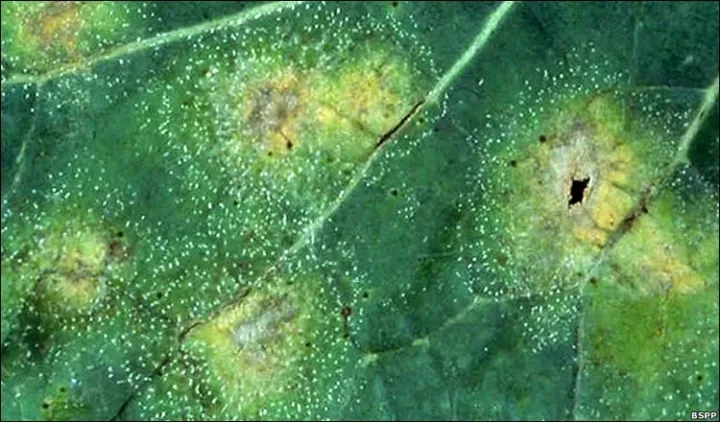
Symptoms of light leaf spot typically begin on the lower, older leaves as small, circular, pale green to white spots that later develop a darker margin.
As the disease progresses, the central portion of the lesions often becomes brittle and may tear away, creating a characteristic 'shot-hole' effect across the leaf surface.
Under humid conditions, a characteristic greyish spore-bearing layer forms on both the upper and lower surfaces of the leaf lesions, which serves as a definitive diagnostic feature.
The infection spreads upwards to younger foliage. In severe cases, individual spots coalesce, resulting in widespread leaf necrosis, yellowing, and eventually premature leaf drop.
Stem and petiole infections are also common, appearing as elongated, pale necrotic streaks that may eventually be covered by the characteristic fungal sporulation.
Pathogen
The disease is caused by the fungus Neopseudocercosporella brassicae (formerly classified as Cercosporella brassicae). This phytopathogenic fungus belongs to the class of Hyphomycetes and specifically targets plants within the Brassicaceae family.
The fungus survives between seasons as mycelium or conidia on infected crop debris left in the field. During the growing season, it spreads through asexual conidia dispersed by rain splashes, wind, and movement through the canopy.
Primary infection occurs when conidia land on leaf surfaces and germinate under moisture, entering the host tissues through stomata or mechanical wounds on the epidermis.
The pathogen is highly adapted to temperate climates, allowing it to complete its lifecycle in both spring and autumn periods, which poses a constant threat to brassica crops.
Microscopic examination of the lesions reveals clusters of conidiophores bearing spores, which appear as a greyish, mealy deposit on the necrotic spots during periods of high humidity.
Conditions for development
The development of Neopseudocercosporella brassicae is highly dependent on humidity, with an optimal range of relative humidity above 85-90% combined with mild temperatures between +15°C and +22°C.
Rainy weather, high dew point, and foggy mornings facilitate the liberation of spores and their subsequent germination on susceptible leaf tissues.
Densely planted crops that lack sufficient airflow create a stable, humid microclimate that allows the disease to spread rapidly through the canopy, potentially leading to severe outbreaks.
Plant vigor plays a role in susceptibility; crops under stress from nutrient deficiencies or irregular environmental conditions are more likely to support faster lesion development.
The presence of wild cruciferous weeds serves as a vital reservoir for the pathogen, allowing the fungus to persist and build up inoculum pressure near cultivated fields.
Why it matters
The primary damage caused by light leaf spot is the reduction of the photosynthetic leaf area, which directly impairs the plant's ability to accumulate biomass and yield.
Infection leads to premature senescence of leaves, which can stunt the overall growth of the crop and reduce the final marketable yield significantly.
Seed-bearing crops suffer from reduced seed quality and lower seed weight, and there is a significant risk of seed-borne transmission of the pathogen to future crops.
In stored cabbage, the lesions act as entry points for various saprophytic and pathogenic bacteria, accelerating the onset of soft rot and drastically reducing the storage life of the harvest.
The economic impact involves not only the loss of crop value but also the high costs associated with repeated fungicide applications required to contain the spread of the pathogen.
Protection
Effective management begins with robust crop rotation, with a break of at least 3 to 4 years between successive brassica crops to allow for the natural degradation of infected residues.
Sanitation practices, such as the deep burial or removal of crop debris after harvest, are essential to break the survival cycle of the fungus.
Controlling volunteer brassica plants and cruciferous weeds throughout the season eliminates the green bridges that the pathogen relies on for survival.
The use of certified, disease-free seed and the selection of varieties with known resistance to light leaf spot are fundamental components of an integrated pest management strategy.
- Spatial isolation of seed crops from commercial production areas.
- Optimizing fertilizer programs to ensure plant health and resilience.
- Timely application of systemic fungicides (e.g., triazoles or strobilurins) when environmental conditions favor disease development.
Discussion
No discussions yet — be the first.