
Neolecta flavovirescens
Neolecta flavovirescens
Description
Symptoms
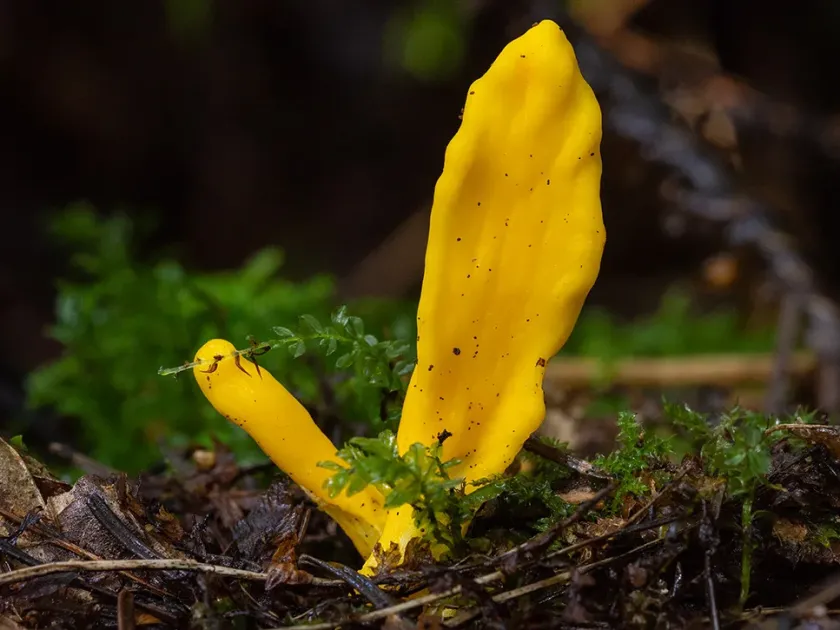
Visually, the fruit bodies of Neolecta flavovirescens look like bright yellow or yellow-green club-shaped outgrowths. They often grow in groups from the soil in forest litter or on heavily decayed wood.
The external resemblance to plant diseases is limited only to color and shape. An experienced specialist can easily distinguish them from diseases like bacterial cancer, as Neolecta does not cause necrosis.
Plant tissues located near these fungi remain healthy. No chlorosis, mosaics, or wilting, typical of pathogens, are observed in contact with this fungus.
The surface of the fruit bodies is smooth and lacks signs of rot or fungal blooms characteristic of mycelial infections. They maintain their firmness throughout their life cycle.
For diagnosis, it is recommended to inspect the root neck carefully. If the outgrowths have no direct connection to the plant epidermis but are attached to the soil, it is a saprotrophic fungus, not a phytopathogen.
Pathogen
Neolecta flavovirescens is a biological species of fungi from the division Ascomycota. Unlike the majority of agricultural pathogens, this fungus is not a parasite of cultivated plants.
Systematically, this fungus belongs to the unique class Neolectomycetes. Its uniqueness lies in its basal position within the phylogenetic tree of Ascomycota, which is of great scientific interest to mycologists worldwide.
Many people mistakenly classify this species as a disease due to its unusual appearance, which resembles growths or galls on plant tissues. However, it is an independent living organism.
The fungus reproduces via spores formed in asci — special sacs covering the surface of the fruit body. The sporulation process is typical for many sac fungi, but the morphology of the fruit bodies is highly specific.
In the field, agronomists must clearly distinguish this fungus from infectious diseases. It does not penetrate the vascular system of plants and does not feed on plant sap.
Conditions for development
The development of the fungus is closely linked to a humid climate and the presence of organic-rich soil. It prefers shaded areas where high air humidity is maintained for a long period.
Most often, this species can be found in coniferous or mixed forests, where Neolecta flavovirescens finds necessary conditions for symbiosis or feeding on decomposition products of wood.
The temperature optimum for the growth of fruit bodies is in the range of moderate values, typical for late summer and early autumn.
Soil acidity also plays an important role. As a rule, this species tends toward acidic soils characteristic of forest ecosystems.
Environmental monitoring shows that Neolecta does not spread to agricultural fields because they do not match its specific habitat requirements.
Why it matters
From an agronomic perspective, Neolecta flavovirescens poses no danger to cultivated plants. It is not a phytopathogen and does not reduce crop yields.
The pest does not affect field or fruit-bearing crops. Its presence on a site is an indicator of a healthy forest ecosystem, not a signal of an impending epiphytotic.
Economic damage from this species is zero. Using fungicides against it is impractical and economically ineffective, as it does not harm plants.
The mycological value of the species is quite high, so destroying Neolecta flavovirescens in its natural habitats is not recommended.
For agriculture, this fungus is a neutral object. It does not create competition for nutrients and does not suppress the development of root systems of cultural plants.
Protection
Specialized control measures against Neolecta flavovirescens are not required. Since this species is not a plant disease, there is no need to develop protection protocols.
Agricultural practices aimed at fighting infections would be redundant here. Regular fungicide treatments do not affect the ecological status of this rare species.
Prevention consists only of increasing staff awareness to avoid confusion with dangerous diseases such as Verticillium wilt or Fusarium.
In case of detecting suspicious outgrowths on a site, a visual analysis is sufficient. If the object is not related to plant tissue damage, protection measures are not applied.
Follow the rules of integrated plant protection: fight only confirmed pathogens while preserving the biodiversity of beneficial or neutral fungi in the environment.
Discussion
No discussions yet — be the first.