
Neocosmosporosis
Neocosmospora warna
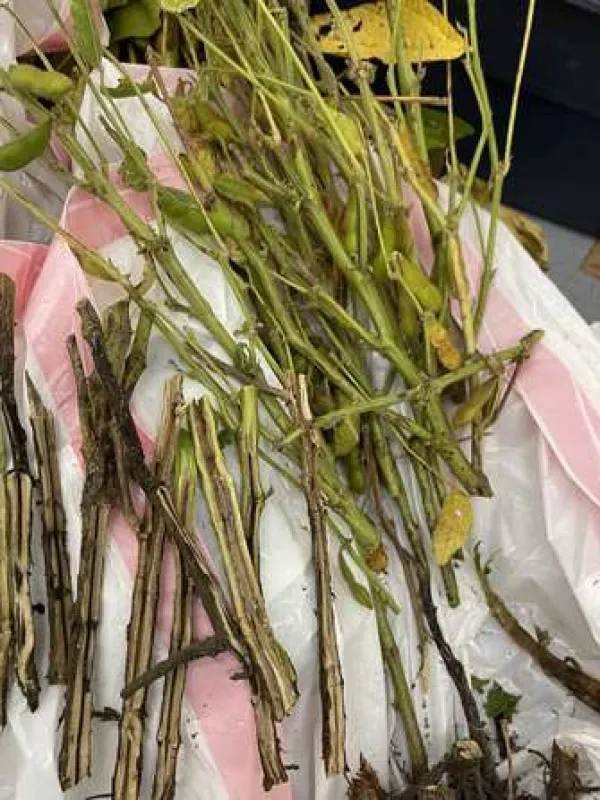
Description
Symptoms
The first symptom is a noticeable loss of turgor in the leaves, especially during the hottest hours of the day. Initially, the plant may appear to recover at night, but as the infection progresses, the wilting becomes permanent and irreversible.
Yellowing (chlorosis) of the lower leaves is a classic symptom of this vascular disease. This discoloration gradually moves upward, eventually leading to the drying and death of the entire foliage, although the dead leaves often remain attached to the stem for a long time.
A cross-section of the stem reveals a characteristic browning or dark discoloration of the vascular tissues. This is a clear indicator that the plant's water-conducting vessels are blocked by the fungal mycelium and its metabolites, preventing the transport of moisture.
In conditions of high humidity, a sparse whitish or pinkish mycelial mat may appear near the base of the stem. This represents the fungal reproductive structures, which are actively producing spores to propagate the infection to nearby plants or into the soil.
The root system becomes severely compromised, showing signs of necrosis and decay. The lateral and fine roots often turn dark and brittle, significantly reducing the plant's ability to absorb water and nutrients, which ultimately leads to the collapse and death of the plant.
Pathogen
Neocosmospora warna is a soil-borne fungal pathogen that belongs to the class Ascomycota. It is closely related to the Fusarium species complex, sharing similar life strategies, pathogenicity mechanisms, and survival traits in the environment.
The fungus survives in the soil for extended periods by forming chlamydospores. These resting structures are highly resistant to environmental stress, including drought, temperature fluctuations, and low nutrient availability, making the pathogen difficult to eradicate from affected fields.
Functioning as a facultative parasite, the fungus can live saprophytically on decaying organic matter while waiting for a suitable host. Once a susceptible plant is found, it shifts to a parasitic lifestyle, actively colonizing host tissues to derive nutrients.
Pathogenicity is primarily driven by the secretion of specific toxins and enzymes that degrade plant cell walls and interfere with metabolic processes. These substances cause systemic toxicity, leading to the breakdown of the plant's internal regulatory systems.
Infection occurs mainly through the roots, often facilitated by micro-injuries caused by growth or soil-dwelling pests. After entry, the hyphae spread rapidly through the vascular system (xylem), causing systemic infection throughout the entire plant.
Conditions for development
Neocosmospora warna thrives in warm soil conditions, with optimal development occurring between 25°C and 30°C. These high temperatures accelerate the pathogen's metabolic rate and facilitate rapid colonization of host tissues.
Excessive soil moisture coupled with poor aeration creates an ideal environment for spore germination and infection. However, the fungus is highly adaptable and can cause significant damage even under fluctuating soil moisture conditions common in agricultural systems.
The soil pH plays a role in the pathogen's activity; it tends to be more aggressive in neutral or slightly acidic soils. Managing soil pH can be a component of a long-term strategy to reduce the inoculum pressure in a given field.
High planting density promotes the rapid spread of the disease through root-to-root contact. Without adequate ventilation in the root zone, the infection can quickly move through a field, causing clusters of wilting plants that expand over the growing season.
Any injury to the roots, whether from mechanical cultivation or soil-borne insects, provides an entry point for the fungus. Reducing physical damage to the root system is essential for maintaining the plant's natural defense barriers against this pathogen.
Why it matters
The primary harm caused by Neocosmospora warna is the systemic death of the plant, as there is currently no cure once the pathogen has established itself within the vascular system. This makes the disease extremely dangerous for high-value horticultural crops.
Economic losses are severe, ranging from reduced yield quality to total crop failure. Infected plants that survive long enough to produce fruits often yield poor-quality, undersized, and unmarketable produce, leading to significant financial losses for the grower.
The pathogen accumulates in the soil over time, creating a "sick soil" effect. Once a field is heavily infested, it may become unsuitable for cultivating susceptible crops for many years, necessitating expensive soil sterilization or crop relocation.
The disease's ability to travel via infected transplants or contaminated agricultural equipment makes it a significant risk for spreading across different parts of a farm. It can silently move from one plot to another if strict hygiene protocols are not followed.
Due to the cryptic nature of the early stages, growers often fail to detect the infection until massive plant loss occurs. This lack of early warning makes the disease a major challenge for integrated pest management (IPM) programs.
Protection
A rigorous crop rotation schedule is the most effective management strategy. Susceptible crops should be avoided on infested land for at least 4 to 5 years to allow the natural decay of the fungal inoculum in the absence of a host.
Using healthy, certified seeds and seedlings is mandatory to prevent the introduction of the pathogen into clean fields. Seed treatment with broad-spectrum systemic fungicides provides an essential layer of protection during the critical seedling stage.
Balanced nutrient management is crucial; in particular, adequate potassium fertilization helps to strengthen cell walls and improve the plant's overall resistance to fungal penetration. Avoiding excessive nitrogen helps prevent soft, succulent tissue growth.
Integrated management includes the control of soil-dwelling pests that can vector or provide entry points for the pathogen. Practicing minimal tillage or careful cultivation techniques reduces the likelihood of damaging the roots and spreading the disease.
Biological control using beneficial microbes like Trichoderma species is a promising approach to suppress the pathogen in the soil. These antagonists compete for space and nutrients, helping to create a healthier rhizosphere environment for the crop.
Discussion
No discussions yet — be the first.