
Myriogenospora leaf disease of sugarcane
Myriogenospora aciculispora
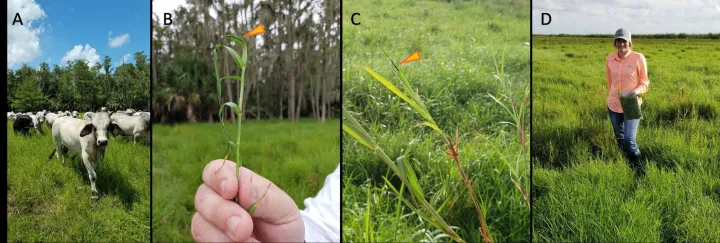
Description
Symptoms
The primary symptom of this disease is the severe deformation of sugarcane leaves. The foliage becomes rigid, twisted, and often takes on an abnormal needle-like appearance.
Dense black or dark brown fungal stromata appear on the affected leaves. These structures often wrap tightly around the upper leaves, forming a distinct coating.
As the infection progresses, young leaves fail to unfurl, remaining compressed against the stem. This prevents the normal elongation of the central shoot of the plant.
Affected plants are easily distinguished by their stunted growth and modified architecture. They appear noticeably weaker and less developed than healthy sugarcane stands.
The disease often occurs in clusters, with infected plants localized within specific sections of the plantation, reflecting the pattern of spore dispersal.
Pathogen
The pathogen responsible for this condition is the ascomycete fungus Myriogenospora aciculispora. It is a highly specialized parasite that targets members of the grass family.
This fungus specifically attacks the plant's meristematic tissues, which is the root cause of the observed morphological deformations in the sugarcane leaves and stems.
The life cycle of the fungus includes the development of reproductive structures on the surface of the plant, which facilitate the spread of spores to healthy tissue.
Myriogenospora aciculispora is well-adapted to tropical climates, allowing it to survive within the host plant tissues or in debris during periods of low activity.
As an obligate parasite, the survival of the fungus is entirely dependent on the host plant, making it a persistent threat to perennial sugarcane fields.
Conditions for development
High humidity and frequent rainfall are the primary environmental drivers for the development and spread of this disease, as moisture aids spore germination.
The tropical temperatures typical of commercial sugarcane growing regions provide the optimal thermal range for the rapid proliferation of Myriogenospora aciculispora.
Poor ventilation within dense sugarcane stands creates a microclimate with high relative humidity, significantly increasing the risk of widespread infection.
The presence of free water on leaf surfaces is essential for the fungus to successfully colonize the meristematic tissues of the sugarcane plant.
Improper agronomic management, such as excessive nitrogen application, can encourage succulent growth that is more susceptible to fungal colonization.
Why it matters
The disease significantly reduces productivity by disrupting the growth point, which inhibits the accumulation of biomass and sugar within the sugarcane stalks.
Infected plants suffer from growth retardation, leading to reduced yield per hectare and decreased overall efficiency of the plantation's operation.
The structural damage caused by the fungus makes the affected stalks unsuitable for commercial sugar extraction due to poor quality and quantity of juice.
If left unmanaged, the pathogen can spread rapidly through the field, potentially causing complete loss of production in the most severely affected areas.
Beyond physical damage, the disease weakens the plant's overall resistance, making the sugarcane more vulnerable to secondary infections or environmental stress.
Protection
The most effective strategy is the use of healthy, disease-free seed cane sourced from certified nurseries to prevent the introduction of the pathogen.
Regular sanitation, including the prompt removal and destruction of infected plants, is crucial to minimize the inoculum source and curb the spread of the fungus.
Maintaining adequate spacing between rows to improve air circulation can create a less favorable environment for fungal growth and spore development.
Applying appropriate fungicides as a preventive measure may be considered in high-risk areas, provided the application is timed correctly with the plant's growth stage.
Consistent monitoring and early detection are essential for effective management, allowing farmers to isolate infected spots before the disease becomes epidemic.
Pathogens and affected parts
Affects crops · 1
Discussion
No discussions yet — be the first.