
Mycoporum lacteum
Mycoporum lacteum
Description
Symptoms
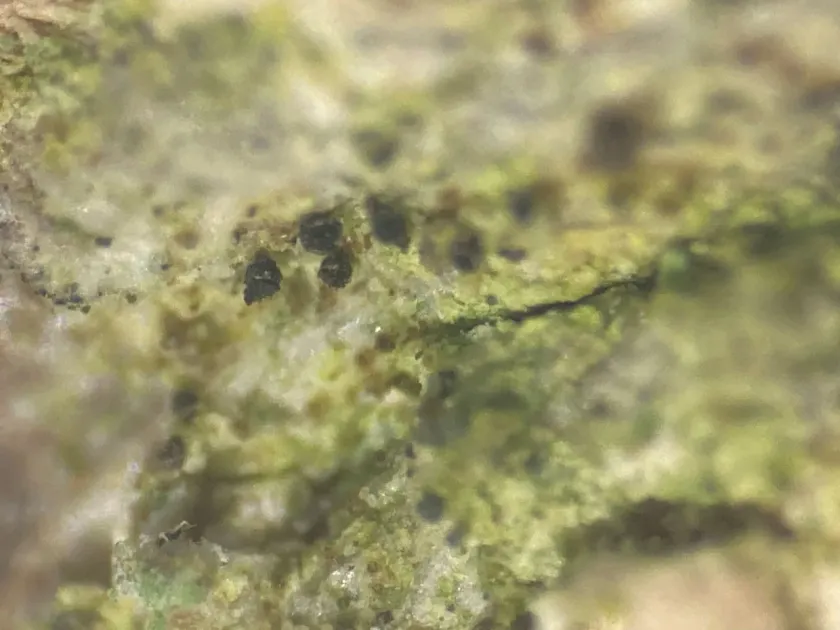
Mycoporum lacteum manifests on tree trunks and scaffold branches as thin, barely noticeable coatings or patches of a whitish or grayish-milky color.
Unlike large bushy lichens, this species belongs to crustose forms that adhere tightly to the substrate, blending seamlessly with the surface of the bark.
Upon close inspection, one can observe small fruiting bodies (perithecia) embedded in the bark, appearing as tiny dark dots that break through the plant's epidermis.
Affected areas of the bark may visually appear as lightened zones, which are often mistaken for natural aging or changes in the tree tissue pigmentation.
Over time, colonization areas may expand, covering significant portions of the trunk and giving the tree a characteristic dusty or whitewashed appearance.
Pathogen
The causative agent is the fungus Mycoporum lacteum, a member of the Ascomycota division that forms a symbiotic relationship with algae to create a crustose lichen.
The biology of the organism implies a close association with the porous structure of the bark, where the mycelium penetrates, using the tree exclusively as a physical support for growth.
This species is characterized by the specific structure of its apothecia, which develop within the cortical tissue, making them difficult to reach with external fungicides.
Reproduction occurs primarily through spores, which are dispersed by wind or water droplets during periods of high atmospheric humidity and moderate temperatures.
The fungal life cycle is strictly tied to the condition of the bark, favoring stable, shaded surfaces on old or weakened trees that are protected from direct sunlight.
Conditions for development
The development of Mycoporum lacteum depends directly on the level of air humidity in the orchard, as lichens absorb moisture through the entire surface of the thallus.
Dense plantings, lack of regular sanitary pruning, and poor orchard ventilation create an ideal microclimate for bark colonization.
The lichen spreads most actively in shaded areas where tree bark remains damp for long periods after rain or morning dew.
Low tree growth intensity and the presence of cracks in the bark facilitate spore fixation, as surface irregularities retain moisture and organic particles.
Optimal conditions for vegetation are observed during cool periods in autumn and spring when temperature regimes combine with high atmospheric humidity.
Why it matters
Mycoporum lacteum generally does not have a direct parasitic impact on living tree tissues, as it acts as an epiphyte rather than a pathogenic parasite.
However, massive coverage of bark with lichens creates a favorable environment for the overwintering of pests, such as scale insects, mealybugs, and mites that hide under the thallus.
The presence of a dense lichen crust hinders normal bark gas exchange, which can negatively affect the physiological state of weakened plants.
Secondary damage involves the accumulation of moisture under the lichen layer, creating conditions for the development of rot processes in the upper bark layers.
Trees heavily covered with epiphytes often signal reduced growth rates and general decline, requiring comprehensive orchard health management.
Protection
The main prevention method is maintaining good agricultural practices: timely pruning, crown thinning, and fertilization to improve the tree's immune system.
Mechanical cleaning of the bark using stiff brushes or wooden scrapers in early spring helps to drastically reduce the number of lichen colonies.
- Washing trunks with an iron sulfate solution (3–5%) during the dormant period.
- Whitewashing trunks with lime mixed with copper sulfate for disinfection.
- Regular sanitary removal of trees with severely damaged bark.
- Humidity control in the orchard through rational irrigation.
When using chemical protection methods, it is crucial to perform treatments before bud break to avoid phytotoxic effects on young leaves.
It is important to remember that the presence of lichens often indicates a need to improve the plant's growing conditions, not just a need for fungicide application.
Discussion
No discussions yet — be the first.