
Mycogone disease of mushrooms
Mycogone rosea
Description
Symptoms
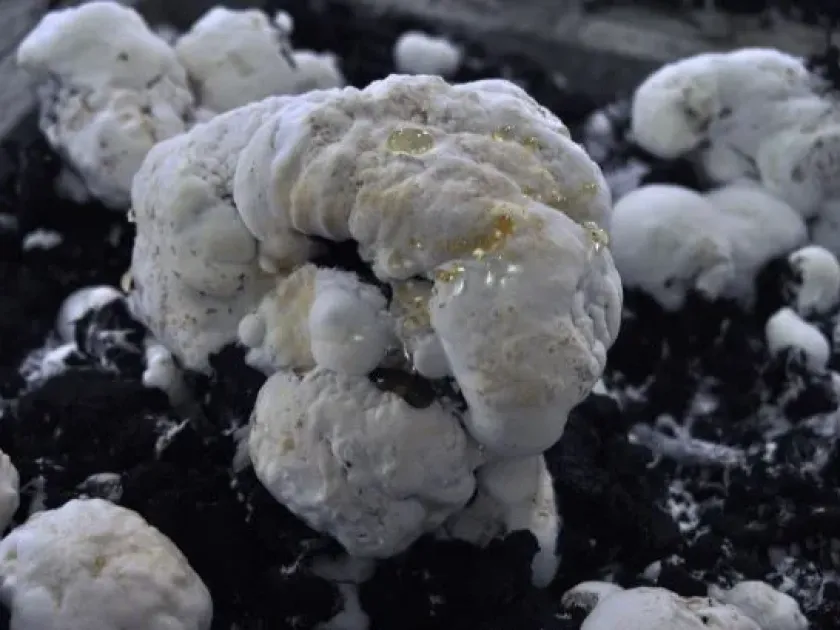
The primary sign of the disease is the deformation of mushroom fruiting bodies. Affected mushrooms look abnormal: stems thicken and become spongy, while caps fail to form properly, developing as shapeless growths.
At early stages, a white, dense, fluffy mycelium appears on the affected parts of the mushroom. Over time, this coating takes on a yellowish or pinkish hue, which is why the pathogen is commonly known as "wet bubble" or "pink mold."
Affected tissues begin to decay and emit a characteristic unpleasant, putrid odor. The tissues inside the infected areas become dark and watery, completely losing their marketability and suitability for consumption.
If the disease affects primordia (young mushroom buds), they stop growing and are gradually covered with a dense layer of mold. As a result, the mushroom mycelium in that area is suppressed, and fruit body production ceases entirely.
- Appearance of white fluffy mold on mushrooms
- Deformed mushroom stems and caps
- Mycelium color change to pinkish-brown
- Putrid odor from infection sites
- Stunted growth and development of fruiting bodies
Pathogen
The causative agent of the disease is the imperfect fungus Mycogone perniciosa (also known as Mycogone rosea), which specializes in infecting fruiting bodies of cultivated mushrooms. The parasite belongs to the class of hyphomycetes.
This microscopic fungus persists in the soil, on plant debris, and on farm equipment as spores or mycelium. Its biological cycle is closely tied to the development of the mushroom itself, as the parasite feeds on the nutrients intended for the host.
Infection spreads easily through contaminated casing soil that has not undergone sufficient heat treatment. Poorly disinfected equipment in cultivation chambers also serves as a significant reservoir for the pathogen.
The pathogen develops in several stages: first, a white, fluffy mycelium forms, which later densifies and acquires a characteristic coating. Fungal spores can be transported by air currents, irrigation water, and farm personnel.
Of particular concern is the pathogen's high survival rate in adverse environmental conditions. Fungal spores remain viable for a long time, complicating complete sanitization of rooms after a disease outbreak.
Conditions for development
The development of Mycogone disease is favored by high air humidity in the cultivation chamber, often exceeding 90–95%. These conditions create an ideal environment for the germination of fungal spores on the mushroom surface.
The optimal temperature for the active growth of Mycogone perniciosa ranges between 20–25 degrees Celsius. Temperature fluctuations towards higher values increase the aggressiveness of spore dispersal.
Poor air circulation in the room leads to moisture stagnation on the casing surface. Static, humid air promotes the rapid infection of neighboring healthy mycelium from primary infection sites.
Insufficient sterilization of the casing soil is a primary factor in initial contamination. If the soil has not been heated to the required temperature, pathogen spores successfully survive and activate during irrigation.
The lack of sanitary barriers at the entrance to the production area allows fungal spores to be carried on the shoes, clothing, or tools of the staff. Any errors in mushroom agronomy drastically increase the risk of epiphytotics.
Why it matters
Mycogone disease is considered one of the most destructive diseases in mushroom farming, capable of destroying up to 80–100% of the crop in a given room. Its rapid spread makes it extremely dangerous for large-scale production.
Economic damage includes not only direct loss of production but also the necessity of conducting costly disinfection procedures. Infected batches of mushrooms become completely unmarketable and require immediate disposal.
The disease leads to the rapid depletion of the substrate, shortening the mushroom's fruiting period. After an infection, restoring the productivity of a growing block is virtually impossible as the parasite penetrates the entire mushroom body.
Harm also manifests in the reduced quality of the remaining healthy part of the crop due to the need to strictly follow quarantine measures. This disrupts harvest and delivery schedules for fresh mushrooms.
Long-term survival of spores in room structures creates a threat of infection for all subsequent cultivation cycles. Without complete substrate replacement and thorough disinfection, fighting the fungus becomes nearly unsuccessful.
Protection
The primary method of protection is strict sanitation and hygiene in production chambers. All tools and equipment must be regularly disinfected with specialized fungicidal solutions.
It is essential to strictly control the casing soil pasteurization process. Heat treatment should be conducted at a temperature sufficient to destroy all pathogenic fungal spores within a set timeframe.
Upon detecting the first signs of the disease, affected mushrooms, along with a small layer of soil around the site, must be removed immediately. The affected area should be treated with salt or a disinfectant to localize the infection.
It is important to maintain an optimal microclimate, avoiding excessive humidity and air stagnation. Regular ventilation of chambers helps reduce the risk of mass dispersal of fungal spores through air currents.
In some cases, approved fungicides are applied to the casing layer, but chemical protection must be strictly regulated. Preference is always given to preventive measures and biological methods of pathogen control.
Discussion
No discussions yet — be the first.