
Mycena purpureofusca
Mycena purpureofusca
Description
Symptoms
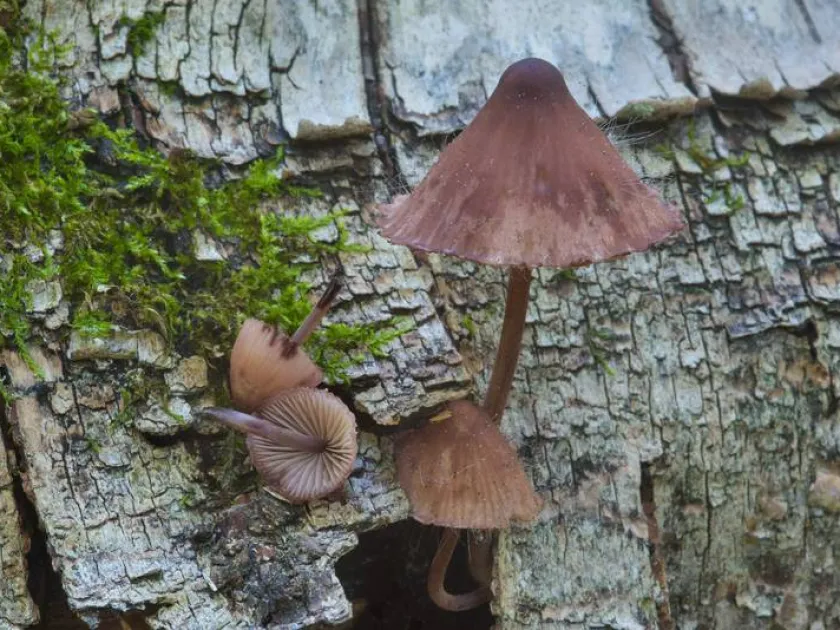
The main sign of this fungus is the appearance of small fruiting bodies on decaying wood. These mushrooms are recognized by their characteristic purple-brown or dark violet hue, from which the species name originates.
Fruiting bodies often grow in groups or clusters on decaying coniferous logs or bark. In areas with active colonization, the wood exhibits signs of softening, becoming spongy and retaining higher moisture levels.
Upon close inspection, thin white mycelial threads can be observed penetrating the surface layers of the wood or bark. This indicates active substrate decomposition by the fungal network.
The absence of necrotic lesions on living plant tissue helps differentiate this species from dangerous phytopathogens. If the fungus is found on a tree, it usually indicates that the host tissue is already dying or dead.
The visual appearance of the mushroom is typical for the Mycena genus, but the purple pigment remains an important diagnostic criterion for identification during forest health monitoring.
Pathogen
Mycena purpureofusca is a fungus belonging to the Mycenaceae family. In an agronomic and forestry context, this organism is categorized not as a primary plant pathogen, but as a saprotrophic basidiomycete that participates in the breakdown of organic matter.
The fungus is a wood-decay agent that specializes in decomposing cellulose and lignin within dead timber. Its mycelium invades the substrate, contributing to the gradual breakdown and mineralization of the wood fibers.
Biologically, this species is not a specialized disease of living crops. However, in forest nurseries or highly stressed plantations, it can occasionally be found on decaying or moribund woody debris from coniferous species.
The life cycle involves an active vegetative phase as mycelium and a reproductive phase, producing fruiting bodies. Spores are dispersed by wind, ensuring the fungus is widely distributed within woodland ecosystems.
It is crucial to distinguish the saprotrophic role of this fungus from that of parasitic species. Mycena purpureofusca performs a vital ecosystem service by recycling dead wood into nutrients available for other plants.
Conditions for development
The primary requirement for the development of this fungus is the presence of moisture. It prefers shaded areas with high relative humidity, typical of coniferous forest environments.
The fungus develops within temperature ranges common to temperate climates. Optimal mycelial growth occurs during periods of frequent rainfall and moderate temperatures, often peaking in the autumn.
Substrates for colonization include fallen branches, stumps, bark, and other woody debris. The species thrives even in nutrient-poor environments by efficiently utilizing cellulose as an energy source.
Disturbing forest litter or allowing large accumulations of woody debris creates an favorable environment for these saprotrophs to thrive. High amounts of organic material increase the local spore density.
In agricultural settings, the fungus may appear on wooden supports, stakes, or trellis poles that remain in constant contact with moist soil, necessitating appropriate structural management.
Why it matters
Mycena purpureofusca does not cause direct harm to living agricultural crops. From a forest management perspective, its activity is considered beneficial as it clears woody debris.
The potential negative impact is limited to the physical degradation of wooden infrastructure on farms. Supports for greenhouses, fences, and wooden decks may be weakened if they are in direct contact with damp ground.
Biologically-driven wood decay leads to a loss of structural integrity, which could cause support structures to fail unexpectedly. This requires regular inspection of all wooden elements on the property.
While the fungus is not a pathogen, its massive presence may serve as an indicator of excessive moisture or poor drainage. Such conditions can facilitate the development of true plant diseases.
Understanding the role of this organism allows agronomists to focus resources on preventing genuine phytopathogens rather than wasting effort on harmless saprotrophs.
Protection
Specific chemical treatments against Mycena purpureofusca are not required for crop protection. Control measures are purely preventative and focused on preserving wooden materials.
To prevent decay in wooden supports, it is recommended to use antiseptic wood preservatives. Treatments based on copper compounds or modern fungicides effectively inhibit mycelial penetration.
A key maintenance practice is ensuring adequate drainage and reducing moisture accumulation. Removing rotting wood and clearing the area of debris reduces the potential for fungal colonization.
In greenhouses, maintaining proper humidity levels and avoiding direct contact between wood and soil using waterproof barriers or metal footings is standard practice to prevent structural decay.
Sanitation of the area, including the removal of old stumps and fallen branches, reduces the natural reservoir for fungal spores, thereby minimizing the risk to exposed wooden structures.
Discussion
No discussions yet — be the first.