
Mycena pterigena
Mycena pterigena
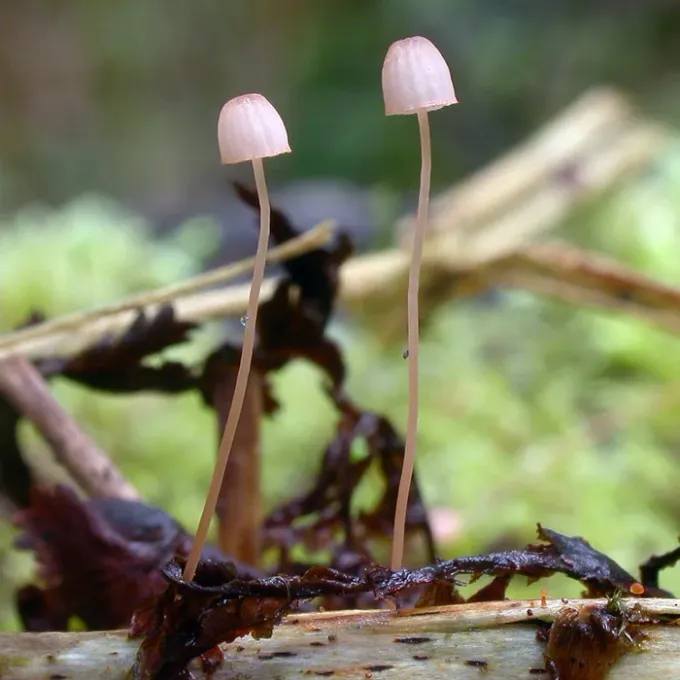
Description
Pathogen
Mycena pterigena is a species of gilled fungus belonging to the Mycenaceae family. It is essential to clarify that this organism is not a plant pathogen and does not cause diseases in crops or garden plants.
Biologically, this species is a specialized saprotroph. It thrives exclusively on decaying vegetable matter, specifically the petioles and stems of dead ferns.
This fungus lacks the biological capacity to infect healthy, living plant tissues, meaning it has no significance as a causal agent of crop diseases in agriculture.
Its mycelium plays a crucial ecological role as a decomposer, breaking down complex organic compounds in plant debris and contributing to the nutrient cycle in forest soils.
The taxonomic classification places it within the order Agaricales, with a life cycle strictly tied to the biodegradation of organic materials already in a state of decay.
Conditions for development
The growth of Mycena pterigena requires high humidity, commonly found in damp woodland environments. Active fruiting occurs predominantly during periods of persistent rainfall.
The fungus colonizes specific substrates, namely the old, necrotic stems of ferns. It does not grow on living hosts under normal biological conditions.
Optimal environmental temperatures align with the temperate climate patterns, typically late summer and autumn, when soil and air moisture are at their peak.
Dispersal is achieved through spores released into the air, which settle on suitable decaying debris and germinate when sufficient liquid water is present.
Shaded environments are preferred, as they provide the stable moisture levels required for the long-term survival of the mycelial network in decaying organic matter.
Why it matters
Mycena pterigena causes absolutely no damage to agricultural, horticultural, or garden crops. It is entirely benign to living plants and does not impact yield or plant health.
In agricultural practice, this fungus is not considered a pest, and its presence does not require any form of intervention or monitoring by agronomists.
As a saprotroph, it functions as a natural recycler, helping to clear ecosystems of dead plant biomass without ever encroaching on healthy vegetation.
Even in the context of decorative fern gardens, the fungus does not harm the living plants, as it only targets dead leaves and stalks as part of its feeding cycle.
Consequently, the economic impact of Mycena pterigena is non-existent, and it does not represent a risk factor in any plant production scenario.
Protection
Since this fungus is not pathogenic, no specific protection or control measures are developed, recommended, or necessary for its management.
The application of fungicides is completely unnecessary and would be considered an environmental misuse of chemicals, as the target is not a disease-causing agent.
If the presence of these fungi is undesirable for aesthetic reasons, the simple removal of decaying fern foliage and debris will effectively limit their growth.
Maintaining proper garden or field sanitation, such as removing excessive stagnant organic material, is sufficient to prevent the development of saprotrophic fungal communities.
Agronomists should prioritize control strategies for actual pathogens while viewing Mycena pterigena as a harmless component of the natural environment.
Discussion
No discussions yet — be the first.