
Juniper sooty mold
Metacapnodium juniperi
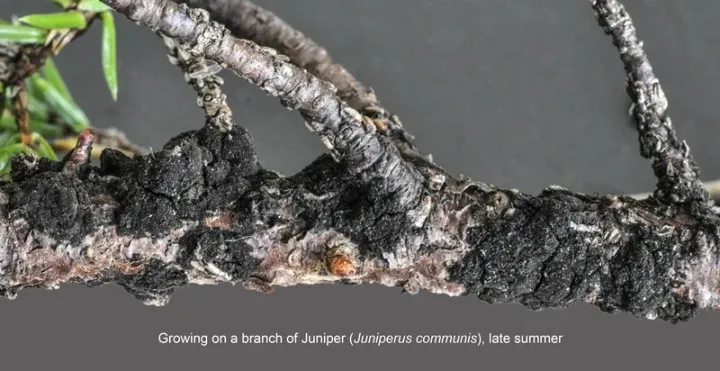
Description
Symptoms
The most visible symptom is a black or dark-grey powdery coating appearing on the needles and stems of the juniper.
Initially, the coating can be rubbed off, but as it matures, it adheres more strongly to the needles, making it harder to remove.
The presence of honeydew often makes the foliage feel sticky before the dark fungal growth becomes clearly visible.
Affected needles may lose their vibrant color, turn yellow, and eventually drop off, leading to a thin and patchy appearance.
The overall aesthetic value of the ornamental juniper is significantly reduced as the plant looks dirty and neglected.
Pathogen
The disease is caused by the fungus Metacapnodium juniperi, which belongs to the group of sooty mold fungi.
This pathogen is essentially a saprophyte, as it does not invade the plant tissue directly but feeds on the surface.
It thrives on honeydew, a sticky substance secreted by sucking insects like aphids, scales, and whiteflies.
The fungus forms a black, soot-like mycelium covering the leaves and branches, which gives the disease its characteristic name.
Spores of the fungus are disseminated through the air, water splash, and the movement of insects across the plant surface.
Conditions for development
High humidity and warm temperatures are the primary environmental drivers for the rapid spread of sooty mold.
The presence of a heavy infestation of sucking insects is the absolute requirement for the development of this disease.
Poor air circulation, often caused by overly dense planting or lack of pruning, keeps the foliage moist for longer periods.
Stagnant air and shaded conditions within the plant canopy create a microclimate perfect for fungal colonization.
Lack of regular garden maintenance and pest management programs significantly increases the likelihood of infection.
Why it matters
The primary damage is caused by the physical blockage of sunlight, which inhibits the plant's ability to perform photosynthesis.
The fungal crust interferes with the gas exchange through the stomata, negatively impacting the plant's respiratory efficiency.
Continuous colonization can weaken the plant, making it more susceptible to environmental stress and secondary pathogen attacks.
Prolonged heavy coating on the branches can eventually lead to tissue dieback and the death of individual shoots.
In landscaping, the cosmetic damage makes the infected junipers unsightly and often requires immediate remedial action.
Protection
The most effective strategy is to eliminate the source of honeydew by controlling aphid and scale insect populations with insecticides.
Once the insects are under control, affected areas can be washed or treated with appropriate copper-based fungicides.
Improving air circulation through regular pruning and removing dead branches is essential for preventing recurrence.
Maintaining healthy, well-spaced plants helps ensure they are less attractive to sap-sucking pests in the first place.
- Apply systemic insecticides to eliminate sucking insects.
- Use copper-based sprays to sanitize the foliage surface.
- Prune the canopy to increase light and air penetration.
- Monitor plants for early signs of insect activity.
Discussion
No discussions yet — be the first.