
Meruliopsis taxicola
Meruliopsis taxicola
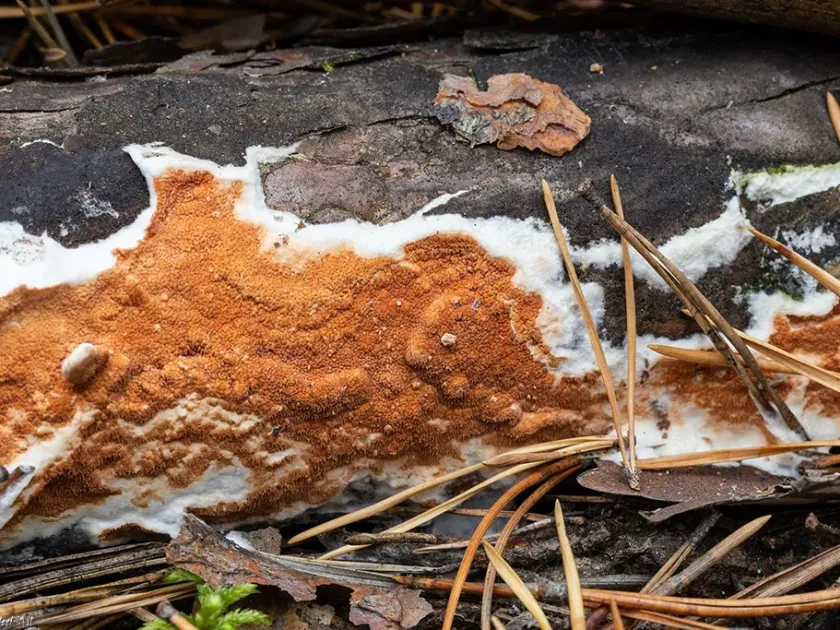
Description
Symptoms
The most visible symptom is the presence of leather-like, reddish-brown fruit bodies on the surface of the wood. These structures are often firmly attached and possess a porous or maze-like hymenophore.
Infected wood exhibits a significant color shift toward dark brown. The natural structural integrity of the timber is lost, as the fibers become brittle and break down into characteristic cubes upon drying.
Cracking is a hallmark of the advanced decay caused by this fungus. Deep, perpendicular fissures develop, and within these cracks, one can often find white or pale pinkish mycelial mats spreading through the substrate.
Significant weight loss occurs as the fungus consumes the structural cellulose. Decayed wood becomes extremely light, hollow-sounding when tapped, and fragile to physical pressure.
Sporulation can be observed in the form of fine dust or a light coating on and around the fungal fruit bodies. Surfaces may eventually become desiccated, masking the ongoing decomposition occurring beneath.
Pathogen
The causative agent of this disease is the wood-decaying fungus Meruliopsis taxicola (formerly known as Gloeoporus taxicola). It is a basidiomycete fungus that primarily specializes in decomposing coniferous wood, causing a specific type of brown cubical rot.
The fungus develops an extensive mycelium that infiltrates the wood cells. By secreting powerful enzymes, it breaks down cellulose and hemicellulose, which are the main structural components of wood, ultimately compromising its integrity.
The fruit bodies of the fungus are distinctive in appearance: they are typically resupinate (spread out) with slightly reflexed edges. The hymenophore surface displays a range of vibrant colors, including deep red, purple, and orange shades.
In forest ecosystems, Meruliopsis taxicola acts as a primary decomposer of fallen logs, stumps, and dead standing timber. It is highly efficient at recycling woody biomass back into the soil nutrient cycle.
The biological success of this fungus depends on its ability to survive in various environments as long as sufficient moisture is present. Its spores are spread by air currents, allowing it to colonize new substrates rapidly.
Conditions for development
Moisture is the primary driver for Meruliopsis taxicola development. The fungus requires high moisture levels, generally above 30%, to thrive and effectively degrade wood fibers.
Temperature fluctuations are tolerated well by the fungus, but it shows maximum activity within the range of +15°C to +25°C. In sheltered or shaded areas, the growth rate is consistently high.
Poor ventilation is a critical risk factor. In enclosed environments or storage stacks without airflow, moisture levels accumulate, creating an ideal incubation chamber for the fungal mycelium.
Direct contact with damp soil provides a continuous water supply, allowing the fungus to transition from ground debris into structural timber. Capillary action keeps the wood moist even during drier periods.
Shade is essential for the formation of visible fruit bodies. Exposure to direct, intense sunlight and low humidity levels inhibits the development of the fungus on the outer layers of the wood.
Why it matters
The primary damage is the catastrophic loss of structural strength in coniferous timber. Because the fungus selectively destroys the structural framework of the wood, it poses a safety risk in building applications.
Economic losses are high in the lumber industry, where stored raw materials can be rendered useless within a single season if not managed correctly. The decay process is often irreversible.
Meruliopsis taxicola can infest timber yards, spreading spores across vast piles of stacked wood. Once a pile is colonized, the fungus can progress through the entire stack, causing massive financial waste.
Outdoor furniture, garden structures, and wooden fencing made of coniferous wood are highly susceptible to this fungus, leading to frequent maintenance and replacement costs.
Early-stage infections are often difficult to detect because the degradation happens internally. By the time fruit bodies appear on the surface, the interior wood has often already undergone significant structural damage.
Protection
Effective prevention starts with drying timber to a moisture content below 20%. Wood kept below this threshold remains largely immune to the growth of Meruliopsis taxicola.
Proper storage is essential; lumber should be stacked on elevated foundations to prevent soil contact and provided with spacers to ensure constant airflow throughout the entire pile.
In construction, the use of pressure-treated wood or specialized wood preservatives is necessary. It is crucial to use moisture barriers at points where wood contacts concrete or soil.
Regular inspections of wooden structures are vital for early intervention. If fruit bodies are detected, the infected wood should be cut out and disposed of by burning to prevent further spore distribution.
Sanitation of the site is important. Removing dead stumps and decaying wood near structures reduces the local spore load and minimizes the chance of infestation in healthy wood.
Discussion
No discussions yet — be the first.