
Hemlock-poplar rust
Melampsora abietis-canadensis
Description
Symptoms
On hemlock needles, symptoms appear in spring as bright yellow or orange aecia arranged in rows on the lower surface, leading to early needle cast.
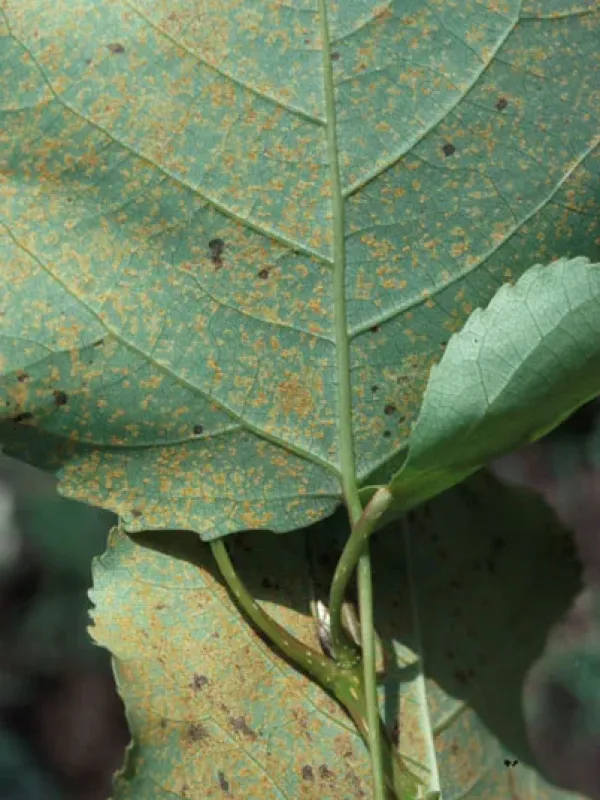
Poplar leaves exhibit small, yellow-to-orange pustules known as uredinia, which later develop into dark brown or black crusts representing teliospores.
Heavy infections cause premature leaf drop on poplars by mid-summer, while affected hemlocks display thinning foliage and stunted growth.
A distinctive feature is the presence of powdery spore masses that can be easily brushed off infected tissue, marking the active stages of the rust.
Deformation of leaf blades on poplars and needle curling on hemlocks serve as clear visual identifiers of advanced rust infestation.
Pathogen
The disease is caused by the heteroecious rust fungus Melampsora abietis-canadensis. Its life cycle requires two distinct hosts to complete the reproductive phase.
The primary host is the eastern hemlock (Tsuga canadensis), where the fungus initiates its development in the needles. The secondary host is the poplar species.
The pathogen produces aecia on the hemlock needles during the spring. Subsequently, spores are dispersed to poplar leaves, where uredinia and telia are formed.
As a member of the Basidiomycota, this fungus overwinters in fallen poplar foliage and infected hemlock needles, ensuring the survival of the population through harsh seasons.
The biological cycle is tightly synchronized with the phenology of both hosts, making it a persistent challenge for foresters and nursery managers.
Conditions for development
High humidity and moderate temperatures are the primary environmental drivers for spore germination and infection establishment on host tissues.
Wind acts as the main vector, transporting spores across significant distances. Proximity between hemlock and poplar plantings facilitates rapid transmission.
Dense canopies with restricted airflow maintain a moist microclimate, which is highly conducive to Melampsora spread and colonization.
Prolonged rainy weather during the spring season provides the water film necessary for spores to successfully penetrate the plant host defenses.
Temperatures ranging from 15°C to 22°C (59°F–72°F) are optimal for the growth and metabolic activity of the fungal mycelium.
Why it matters
The primary damage is physiological stress, which manifests as reduced tree vigor, slowed annual increment, and increased susceptibility to secondary pests.
Widespread leaf and needle loss depletes energy reserves, leaving the trees vulnerable to drought, cold, and other environmental stressors.
Nursery stock suffering from this rust loses commercial value rapidly, as aesthetic damage makes plants unsuitable for sale or landscape use.
In urban forestry, infested trees look sickly, detracting from the landscape's aesthetic quality and often necessitating premature removal of the affected plants.
Chronic infestations over several years can cause dieback of major branches, potentially leading to the death of the entire tree if left untreated.
Protection
The most effective preventative strategy is maintaining spatial separation between hemlock and poplar trees to disrupt the fungus's host cycle.
Sanitation practices, such as raking and disposing of fallen poplar leaves in the autumn, are crucial to reducing the primary inoculum source.
Chemical control using copper-based fungicides or systemic triazoles can be effective if applied early in the season before the disease becomes widespread.
Pruning out heavily infected branches helps reduce local spore concentrations, though this must be combined with tool disinfection to prevent further spread.
Proper spacing and crown thinning improve ventilation, which helps dry out the canopy and prevents the moist conditions required for fungal development.
Discussion
No discussions yet — be the first.