
Spruce needle cast
Lophodermium piceae
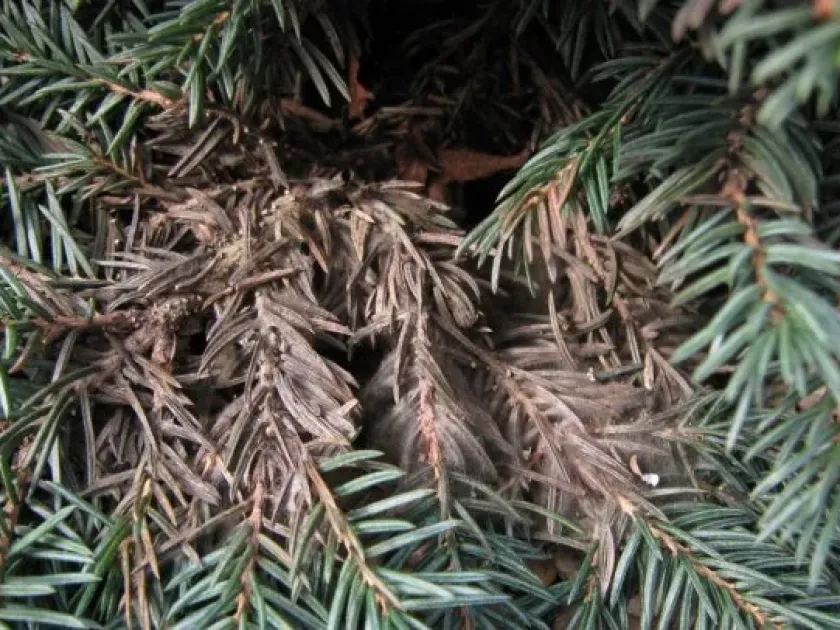
Description
Symptoms
The earliest symptom is the yellowing of needles, often beginning on the lower branches. Over time, the discolored needles transition to a reddish-brown or dull brown shade.
Needles may exhibit small, irregular spots, and eventually, characteristic dark transverse bands appear across the surface of the infected needles.
A diagnostic sign is the appearance of tiny, black, shiny, football-shaped fruiting bodies (apothecia) that emerge through the epidermis of the needles.
Premature needle drop is common, leading to significant thinning of the lower canopy. This gives the tree a sparse and sickly appearance over time.
In advanced stages, entire clusters of needles may drop off, leaving branches bare and exposing the internal structure of the tree crown.
Pathogen
The causal agent of this disease is the ascomycete fungus Lophodermium piceae. It belongs to the order Rhytismatales and specifically targets the needles of various spruce species.
The fungus completes its life cycle by forming dark, elongated fruiting bodies known as apothecia on dead or dying spruce needles. These structures are essential for the production and release of spores.
Once the spores are released, they are disseminated by wind or rain splash, landing on healthy needles where they germinate under specific environmental conditions.
The mycelium penetrates the needle tissue, colonizing the internal space and disrupting the tree's ability to perform photosynthesis, ultimately leading to needle death.
The fungus is well-adapted to surviving on fallen forest debris, allowing it to remain in the environment as a recurring source of inoculum for subsequent seasons.
Conditions for development
High humidity and prolonged cool, wet weather are the primary drivers of disease development. These conditions are essential for spore germination and infection.
Dense, poorly ventilated stands are particularly susceptible, as the lack of airflow keeps needles damp for longer periods, facilitating fungal colonization.
Poor site management, specifically the accumulation of old, infected needle litter around the base of the tree, creates a high-pressure environment for spores.
Trees that are under stress—due to drought, nutrient deficiency, or poor soil drainage—have weakened defense mechanisms, making them prime targets for the fungus.
The timing of spore release coincides with periods of frequent rain, meaning that wet springs and summers significantly increase the risk of an outbreak.
Why it matters
The primary harm caused by this fungus is the significant reduction of photosynthetic capacity, which directly stunts the growth of the spruce tree.
Continuous needle loss weakens the tree's overall vigor, making it much more vulnerable to secondary attacks by wood-boring insects like bark beetles.
In nursery settings, this disease can be devastating, resulting in high mortality rates among young seedlings and substantial economic losses.
Ornamental spruce trees lose their aesthetic appeal as the crown thins and discolors, decreasing the value of the landscape where they are planted.
If left unmanaged, chronic infections can lead to the death of individual branches or eventually the death of the entire tree over several growing seasons.
Protection
Cultural control is the first line of defense; removing and destroying fallen needle debris helps reduce the primary inoculum load on the site.
Improving air circulation by properly spacing trees and pruning lower branches helps create a microclimate that is less favorable to fungal spores.
Fungicide applications, particularly those containing chlorothalonil or copper-based compounds, can be highly effective when applied preventively during the sporulation season.
- Monitor tree health regularly to catch early signs of infection.
- Ensure adequate watering and fertilization to boost plant resilience.
- Use professional-grade fungicides if the infection becomes widespread.
For ornamental trees, maintaining tree vigor through appropriate mulching and hydration helps the tree resist mild infections without needing chemical intervention.
Discussion
No discussions yet — be the first.